State funerals are never just about mourning. They are carefully staged displays of power, identity, and symbolism—and Khamenei’s funeral in Tehran offered a striking example of how political theatre, ritual design, and visual messaging converge in moments of national crisis. While international headlines focused on incendiary rhetoric directed at Donald Trump, the broader scene around Khamenei’s funeral also revealed how architecture, color, flags, and crowd choreography are used to communicate authority and emotional intensity.
For readers interested in luxury brands, luxury decor, and luxury design, this may seem far removed from the world of refined interiors and premium aesthetics. Yet the visual language on display at Khamenei’s funeral shows a core truth shared by both political spectacle and high-end design: environments are built to shape perception, reinforce status, and create lasting emotional impact.
Khamenei’s Funeral as a Designed Political Spectacle
The most widely reported moment from Khamenei’s funeral came when eulogist Mohammad Rasouli publicly called for the killing of US President Donald Trump during prayers over the former Iranian leader’s body. He also led chants against America and Israel, while posters and slogans supporting violence toward Trump and Israeli Prime Minister Benjamin Netanyahu appeared around the ceremony.
Those remarks escalated tensions at a moment when Washington and Tehran were still engaged in negotiations related to ending the Iran war. Trump, for his part, has previously said he issued severe retaliatory instructions if Iran ever tried to assassinate him. He also made fresh remarks suggesting he was closely monitoring developments surrounding Khamenei’s funeral.
But beyond the rhetoric, Khamenei’s funeral functioned as a meticulously visual event. Large crowds, ceremonial prayers, symbolic flags, and controlled staging turned the gathering into a national image of grief and defiance. In political communication, visuals often carry as much force as speeches.
The Visual Language of Khamenei’s Funeral
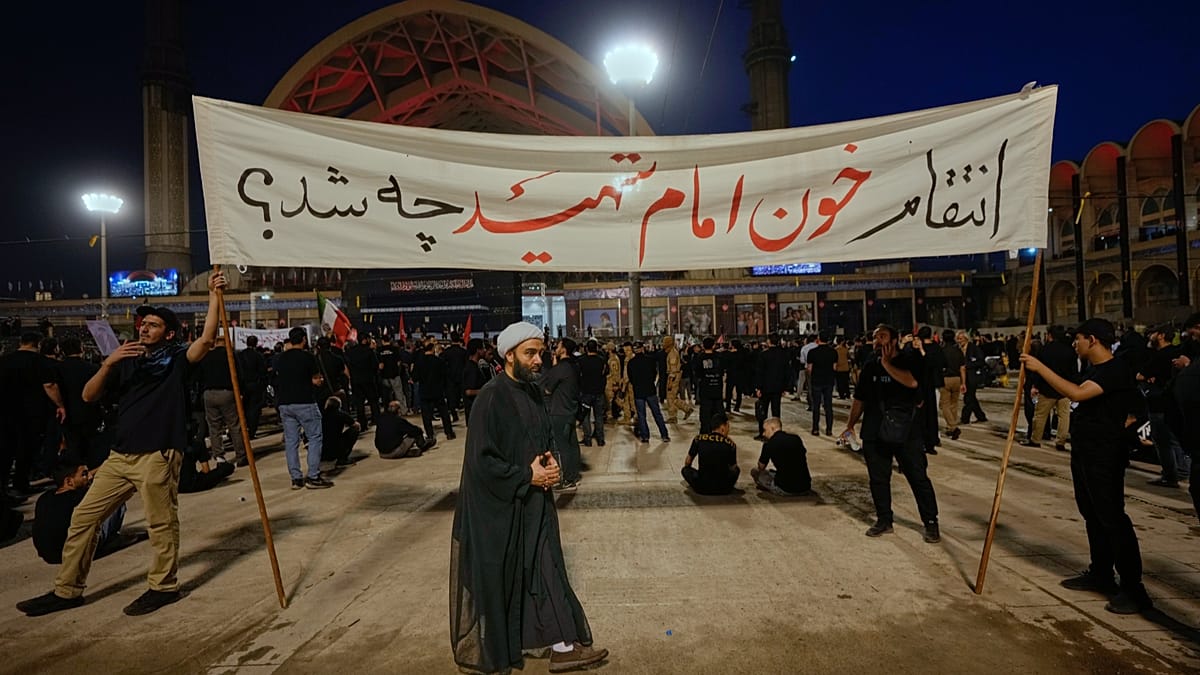
One of the most notable design elements at Khamenei’s funeral was the use of red flags. A red banner bearing the phrase “Ya Litharat al-Hussein” was raised above Tehran’s Mosalla, invoking vengeance for Hussein ibn Ali, a foundational symbol in Shia Islam. Participants also carried similar red flags, reinforcing the message of retribution.
From a design perspective, this was a powerful use of color psychology and symbolic repetition. Red is universally associated with urgency, sacrifice, blood, and emotional heat. In the context of Khamenei’s funeral, it transformed the ceremony from a memorial into a visual declaration of unresolved conflict.
Key symbolic design elements included:
- Red flags: signaled vengeance, sacrifice, and mobilization
- Large-scale religious architecture: amplified solemnity and state power
- Posters and slogans: acted as message-driven graphic design within the event space
- Crowd density: projected legitimacy, unity, and emotional force
- Ritual staging: shaped the funeral into a choreographed political narrative
In many ways, Khamenei’s funeral demonstrates how design is not only decorative—it is strategic. Whether in a presidential palace, a luxury flagship store, or a ceremonial prayer complex, every visual choice affects how a space is interpreted.
What Luxury Design Can Learn From Ceremonial Power
Although Khamenei’s funeral belongs to the realm of geopolitics rather than lifestyle, there are useful lessons here for anyone studying luxury design and brand environments. Elite design has always understood the value of atmosphere, symbolism, and emotional immersion. The difference is that luxury uses these tools to signal exclusivity and refinement, while political ceremonies use them to convey legitimacy and command.
Shared principles between state spectacle and luxury spaces
- Control of visual hierarchy: Important symbols are placed prominently to direct attention.
- Material and spatial authority: Grand architecture creates a sense of permanence and dominance.
- Color as messaging: A limited but intense palette can instantly frame emotion.
- Ritual and repetition: Repeated motifs build identity and memorability.
- Audience experience: Every element is arranged to create a specific emotional response.
Luxury hospitality, premium retail, and high-end residential design all rely on these same fundamentals. A chandelier in a double-height entrance, a carefully curated stone palette, or a dramatic procession through a gallery-like hallway all serve to produce feeling and reinforce meaning.
The Architecture of Mourning in Tehran
Khamenei’s funeral also highlighted the role of monumental architecture in shaping collective emotion. Tehran’s Mosalla is not simply a background location; it is an active participant in the ceremony’s impact. Vast open prayer halls, elevated domes, and long sightlines create a sense of scale that can make individual attendees feel part of something larger than themselves.
This is a principle familiar to luxury design professionals. Grand proportions can communicate prestige, while carefully framed spatial sequences can heighten anticipation and emotional response. In elite interiors, this might appear as a sculptural stair, a cathedral-like foyer, or an art-filled atrium. In Khamenei’s funeral, the same logic was deployed for ideological effect.
Why Khamenei’s Funeral Matters Beyond the Headlines
Most coverage of Khamenei’s funeral will understandably focus on the death threats, the anti-American chants, and the implications for US-Iran relations. Those are serious and newsworthy issues. However, the ceremony also deserves attention as a case study in how modern power is staged visually.
Khamenei’s funeral was not just a religious farewell. It was a branded political moment, built through symbols, setting, and spectacle. The crowd size, the raised red flags, the architecture, and the spoken rhetoric all worked together to send a message both inward to domestic audiences and outward to the world.
For those working in luxury brands and luxury decor, that may sound surprisingly familiar. The most effective spaces—whether political, cultural, or commercial—do more than look impressive. They tell a story, shape belief, and leave an emotional imprint.
Conclusion
Khamenei’s funeral was a deeply charged political event, but it was also a masterclass in symbolic staging. From red flags of vengeance to monumental architecture and tightly controlled ritual, every detail contributed to a larger narrative of power and defiance. The key takeaway is clear: Khamenei’s funeral shows that design, symbolism, and space are never neutral. Whether in geopolitics or luxury design, they are tools used to influence how people feel, what they remember, and what they believe.