

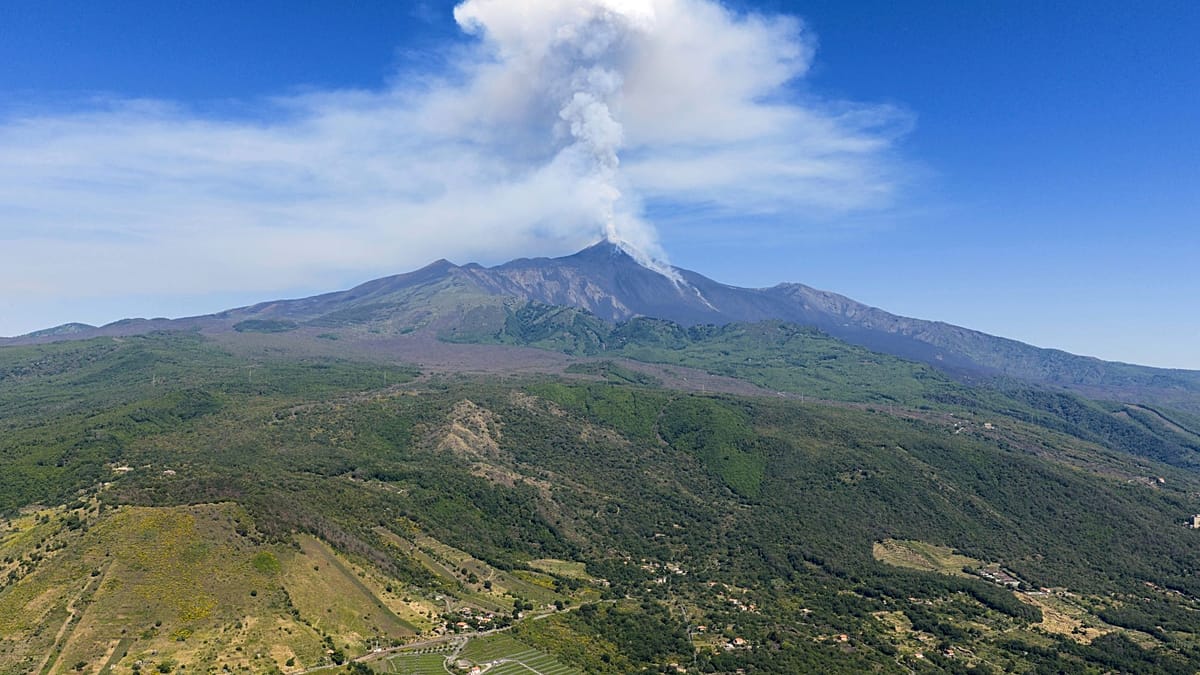
The Catania Airport shutdown has once again put Sicily’s dramatic relationship with nature in sharp focus. As Mount Etna’s volcanic activity disrupted flights across the island, the event also underscored a deeper truth for travellers, designers and architecture enthusiasts alike: Sicily’s most compelling luxury lies in the tension between raw elemental power and refined built beauty.
While the immediate concern is practical—cancelled departures, diverted arrivals and stranded passengers—the wider story reaches beyond travel logistics. In eastern Sicily, infrastructure, hospitality design and high-end interiors all exist under the shadow of Europe’s most active volcano. That reality has shaped the island’s architecture, material palette and distinctive sense of place for centuries.
Catania Airport Shutdown and What Travellers Need to Know
The current Catania Airport shutdown followed renewed volcanic activity at Mount Etna, prompting the suspension of arrivals and departures until at least early evening local time, according to airport authorities. Travellers have been urged to check directly with their airline before heading to the terminal.
Several flights have been diverted to Palermo Airport, with additional services scheduled to accommodate redirected traffic. Airlines are also arranging bus transfers to help passengers continue their journeys to their intended Sicilian destinations.
Key details affecting passengers include:
- Temporary suspension of flights at Catania Airport
- Ongoing ash emissions from Mount Etna
- Some aircraft rerouted to Palermo
- Ground transport being organised by airlines
- Flight status checks strongly recommended before travel
The disruption follows increased volcanic tremors in recent days and a raised civil protection alert level. Aviation authorities have also monitored an ash cloud reaching roughly 4,500 metres, a serious concern for aircraft operations.
Why Mount Etna Matters to Luxury Architecture in Sicily
The Catania Airport shutdown is a reminder that Mount Etna is not just a natural landmark; it is one of the defining forces behind Sicilian identity. For the luxury architecture sector, Etna’s presence has long influenced where and how people build.
In towns and estates surrounding the volcano, architecture often reflects a balance of resilience and elegance. Historic villas, boutique hotels and restored palazzi commonly feature thick masonry, shaded courtyards and locally sourced volcanic stone. These choices are aesthetic, but they are also practical responses to climate, terrain and seismic conditions.
Volcanic landscapes have contributed to a design language that feels both grounded and sophisticated. Dark basalt, textured lava stone and mineral-rich earth tones appear across facades, terraces and garden walls, giving Sicilian luxury properties a visual depth that cannot be replicated elsewhere.
Materials shaped by the volcano
Etna’s geological influence is especially visible in the material culture of eastern Sicily. Designers and architects frequently embrace:
- Lava stone flooring with a naturally dramatic finish
- Basalt cladding for exterior walls and landscape features
- Handcrafted ceramics that offset dark stone with colour
- Lime plaster and natural pigments inspired by ash, sand and earth
- Iron, bronze and weathered timber for tactile contrast
These materials help create interiors that feel luxurious without becoming detached from their surroundings. That connection to place is increasingly valuable in global high-end design.
Luxury Interiors Rooted in Place, Not Excess
For the world of luxury interiors, Sicily offers an instructive model. Rather than relying solely on opulence, the island’s most memorable spaces often draw their power from restraint, craftsmanship and regional authenticity. The same volcanic setting behind the Catania Airport shutdown also inspires some of Sicily’s most atmospheric design schemes.
In high-end homes and hospitality projects near Etna, interiors tend to blend cool stone surfaces with soft linens, artisanal woodwork and sculptural lighting. The result is serene but never bland. There is often a dialogue between permanence and fragility—between heavy mineral forms and airy Mediterranean light.
Signature traits of Sicilian luxury interiors include:
- Natural textures over synthetic gloss
- Muted palettes punctuated by ceramic colour accents
- Indoor-outdoor continuity through terraces and courtyards
- Custom craftsmanship over mass-produced decoration
- Historical restoration paired with contemporary minimalism
This design sensibility has become increasingly influential as affluent travellers and homeowners seek environments with story, provenance and emotional resonance.
When Natural Events Test Travel Infrastructure
The Catania Airport shutdown also reveals how vulnerable even major gateways can be when located near extraordinary natural phenomena. Catania Airport, around 45 kilometres from Mount Etna, is a key arrival point for international and domestic visitors, served by major European carriers including Ryanair, easyJet, Wizz Air, KLM and Lufthansa.
For Sicily’s luxury travel and property sectors, airport disruption can have a ripple effect across villa rentals, design-led hotels, curated experiences and event planning. Yet it also reinforces the need for adaptive infrastructure, contingency planning and regional transport flexibility.
In destinations where nature is central to the appeal, resilience is part of the premium experience. Luxury today is not only about aesthetics; it also depends on thoughtful systems, seamless communication and the ability to respond gracefully when conditions change.
The design lesson in disruption
There is a broader lesson here for architects, developers and hospitality brands. Building in exceptional landscapes requires more than visual ambition. It demands sensitivity to geology, climate and risk. The best luxury design in Sicily succeeds because it respects the environment rather than trying to dominate it.
From volcanic stone resorts to restored countryside estates, the island’s finest spaces understand that beauty and instability can coexist. That tension is precisely what makes Sicily so compelling.
Conclusion: Beyond the Catania Airport Shutdown
The Catania Airport shutdown is first and foremost a practical travel disruption, and passengers should continue to monitor airline updates closely. But beyond the immediate inconvenience, it offers a striking reminder of how deeply Mount Etna shapes Sicily’s identity—from its transport networks to its architecture, interiors and luxury appeal.
In Sicily, true luxury is inseparable from place. The same volcanic forces that interrupt flights also help define the island’s most memorable materials, spaces and design narratives. The takeaway is clear: the Catania Airport shutdown may pause movement, but it also highlights why Sicily remains one of Europe’s most powerful intersections of nature, architecture and refined living.