
Architecture news rarely captures the layered life of a city as vividly as Amman Design Week 2026. Returning after a seven-year pause, the Jordanian event reopens not simply as a design festival, but as a citywide exploration of how memory, craftsmanship, public life, and material culture accumulate over time.
Running from October 2 to 17, 2026, Amman Design Week brings together more than 220 designers and participants across exhibitions, installations, workshops, talks, performances, and public-space projects. Founded by Her Majesty Queen Rania Al Abdullah in 2016, the event’s fourth edition unfolds under the theme “Accumulations”, examining how layers of labor, knowledge, ecology, and everyday use shape the places people inhabit. For readers who follow luxury architecture and luxury design, this year’s edition offers something especially compelling: a sophisticated view of design not as surface styling, but as a cultural and spatial practice rooted in context.
Architecture News From Jordan: Why Amman Design Week 2026 Matters
This edition is significant for several reasons. First, it marks the return of one of the region’s most influential design platforms since its last edition in 2019. Second, it expands beyond traditional exhibition spaces into existing buildings, parks, streets, heritage sites, and landscapes across Ras El Ain, Jabal Al Lweibdeh, Jabal Amman, Iraq Al Amir, and, for the first time, Aqaba.
Under the leadership of architects Sarah Hejazin and Bisher Tabbaa, co-founders of the Jordanian studio FADAA, the event embraces architecture as lived experience. Rather than isolating objects in a white-box setting, the festival places design directly within the urban fabric, allowing visitors to encounter ideas through the city itself.
This approach reflects a broader shift in contemporary architecture news: the most important design conversations today are increasingly about reuse, local production, public realm improvement, and the cultural meaning of materials.
The Theme “Accumulations” Brings Depth to Contemporary Design
Curated by architect and educator Faysal Tabbarah, the central exhibition investigates how daily practices and cultural memory leave traces in the built environment. Each project is presented alongside a related “trace,” which may include an artifact, archival item, oral history, inherited tool, or ecological reference.
That curatorial strategy gives the event unusual richness. Instead of treating architecture and design as finished products, Amman Design Week presents them as evolving systems shaped by:
- Use over time
- Repair and adaptation
- Local craftsmanship
- Environmental conditions
- Social and domestic rituals
For audiences interested in luxury home decor and luxury interiors, this theme also offers an important reminder: true design value often comes from depth, permanence, and story, not novelty alone.
The Hangar in Ras El Ain Anchors the Main Exhibition
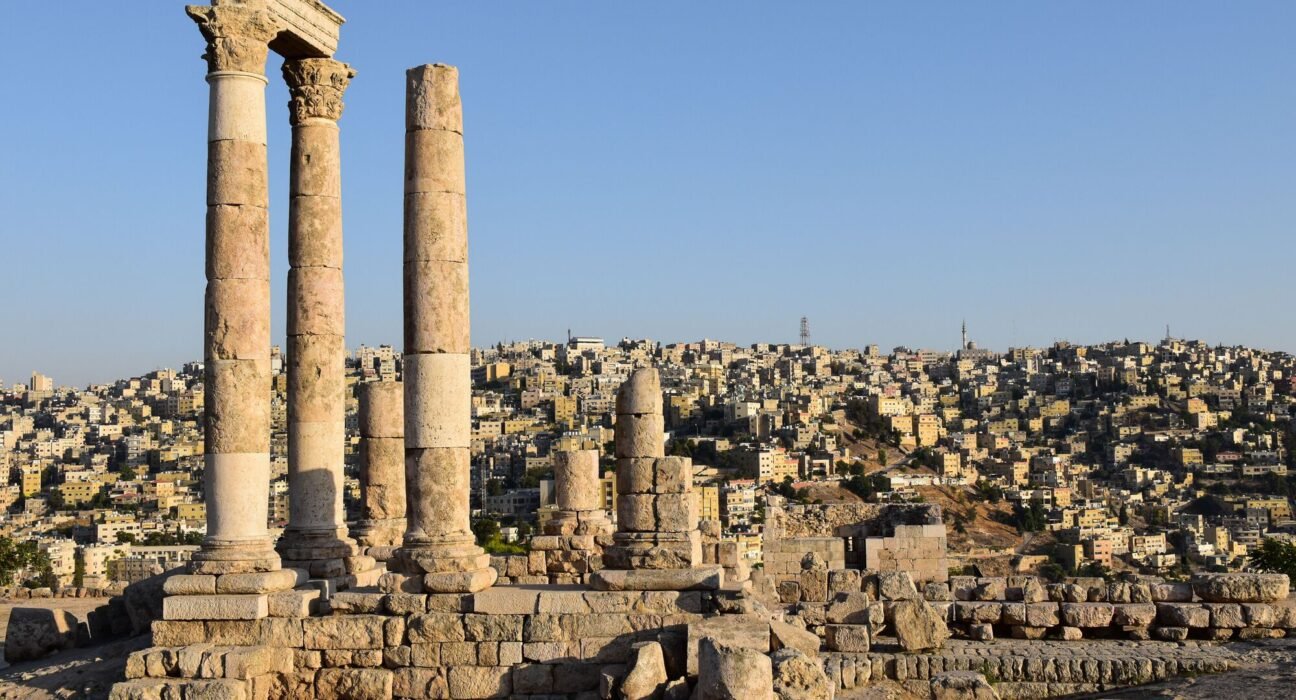
One of the strongest pieces of architecture news in this year’s program is the use of the Hangar in Ras El Ain as the main exhibition venue. Originally built in the 1930s to house the generators that powered a growing Amman, the industrial structure has since been rehabilitated into a cultural space. Its visible history makes it an ideal setting for a festival centered on change, memory, and layered use.
Inside the Hangar, projects move across architecture, furniture, material research, publishing, and civic design. Highlights include Praxis’ exploration of green infrastructure in Amman, tracing interventions through a staircase, a park, and undeveloped land. DASA Architecture Practice’s Common Ground uses modular blocks on a grid to create a flexible gathering space, leaving room for visitors to shape the social life of the installation themselves.
Other works consider how objects transform over time. Al-Mastaba by Laith Matarweh Studio for Architecture imagines stone and concrete as a future ruin open to weathering and vegetation, while Binayah by Abdulrahman Al Muftah and Huzaima Al Rifai explores furniture as an inhabitable architectural element informed by layered landscapes and regional building traditions.
Public Space Becomes the Stage for Design Innovation
Another major takeaway from this architecture news story is the event’s commitment to permanent and semi-permanent interventions in the public realm. In Ras El Ain Park, several installations turn everyday urban space into a site for gathering, recreation, and reflection.
Notable projects include:
- Folly by Civil Architecture, a shaded gathering structure with a ceramic-tile roof developed and manufactured in Jordan
- Nawwarat Amman by Abeer Anabtawi, a basketball court inspired by tomatoes, chamomile, mallow leaves, and wheat
- Domes of the Rock by Mohamad Nahleh, a wood-and-steel intervention that links park infrastructure to the architectural history of Jerusalem’s Dome of the Rock
These works show how local materials, ecological thinking, and civic use can elevate public environments. In the world of luxury design, this is an increasingly relevant lesson: refinement is no longer defined only by exclusivity, but also by cultural intelligence and meaningful public impact.
From Neighborhood Houses to Ancient Landscapes
Amman Design Week 2026 extends far beyond a single venue. In Jabal Al Lweibdeh, Darat Abu Adnan—a restored 1950s home—becomes a key site within the program. The house reflects an era when international modern influences were adapted to local materials and domestic life, making it especially relevant for readers interested in luxury home architecture and heritage-inspired design.
Elsewhere, the project Ard Al Sahn by L.E.FT and collaborators transforms an intersection near the Shariah Mosque into an extension of shared civic space using local stone waste, flowering trees, and bird baths. It is a thoughtful example of urban design that serves both spiritual and neighborhood life.
In Iraq Al Amir, the setting shifts again to the monumental landscape around Qasr Al Abd. Here, contemporary design enters into dialogue with archaeological remains, agricultural terraces, springs, caves, and olive groves. The result is one of the most memorable dimensions of this architecture news update: architecture is framed not as an isolated object, but as part of a long continuum of land, labor, and settlement.
Talks and Critical Dialogue Expand the Conversation
Beyond installations and exhibitions, the event also features talks, walks, performances, workshops, and residencies curated by Khaled Al-Bashir. Among the most anticipated discussions is How is Architectural Value Constructed?, a panel examining how recognition, criticism, research, and storytelling shape architectural meaning over time.
This makes Amman Design Week especially relevant within global design discourse. Like other major architecture events in Oslo, Tallinn, and Copenhagen, it asks larger questions about what architecture does, who it serves, and how value is assigned.
Why This Architecture News Story Resonates Globally
What makes Amman Design Week 2026 stand out is its refusal to separate design from context. It ties contemporary practice to existing buildings, inherited knowledge, local production, and the lived rhythms of the city. That makes it more than an event calendar item—it is a model for how future-facing design can remain grounded in place.
For anyone following architecture news, the return of Amman Design Week signals the growing importance of regionally rooted, materially aware, and socially engaged design. Its clearest takeaway is also its most powerful: the best architecture does not erase what came before. It builds on it, reveals it, and turns those accumulated layers into new cultural value.