Architecture news this week reveals a design world grappling with some of its biggest questions: how to house more people well, how to build resilience into cities, and how to transform existing structures into high-value civic assets. From UN-Habitat’s recognition of global housing initiatives to sauerbruch hutton’s refined timber-hybrid government complex in Berlin, the latest developments show that luxury architecture and public-interest design increasingly share the same priorities—sustainability, adaptability, and long-term urban value.
For readers tracking luxury architecture, luxury home trends, and high-end design thinking, these projects matter not only for their aesthetics, but also for the ideas they bring to the future of premium living environments and city-making.
Architecture News Highlights a Global Housing Challenge
One of the most important stories in architecture news this week comes from UN-Habitat, which announced the five recipients of its 2026 Scroll of Honour Award. The recognition spans Brazil, Myanmar, Pakistan, Tunisia, and the United Kingdom, celebrating efforts that advance adequate housing and sustainable urban development.
The timing is significant. According to the UN-Habitat World Cities Report 2026, as many as 3.4 billion people still lack adequate housing. That figure reframes housing not as a niche policy issue, but as one of the defining design and development challenges of our era.
Several themes stand out:
- Housing quality matters as much as supply, especially in rapidly urbanizing regions.
- Local materials and circular building strategies are gaining traction as scalable solutions.
- Community-led development is increasingly recognized as essential to long-term resilience.
For the luxury market, this broader context is worth watching. Innovations in material science, climate-responsive construction, and flexible planning often emerge from necessity before being adopted into premium residential and hospitality design.
Adaptive Reuse Continues to Shape Contemporary Architecture News
Another major thread in current architecture news is adaptive reuse—the strategic conversion of existing buildings into new destinations with social, cultural, or commercial value. Rather than demolishing and rebuilding, architects are finding elegant ways to preserve embodied carbon, retain urban memory, and create highly distinctive spaces.
OMA’s FLAMA School in Houston
In Houston, construction has begun on the Frank Liu Jr. Academy for Music and Arts, a new tuition-free public charter school designed by OMA under Jason Long, with RDLR Architects and SWA Group. The project converts a 1930s coffee plant into a 6,050-square-meter educational campus.
The design approach is notable for balancing industrial heritage with contemporary learning environments. The historic façade remains, while the interior is reconfigured with perimeter classrooms, circular skylights, and a dramatic double-height cafetorium. It is a strong example of how adaptive reuse can deliver architectural character that new-build schools often struggle to achieve.
University of Groningen’s Learning Centre
In the Netherlands, Benthem Crouwel Architects and Nieuwe Architecten are transforming a 1960s structure into the Interfaculty Learning Centre at the University of Groningen. The redesign preserves the modular framework and key material elements while introducing timber and biobased additions.
This kind of intervention is becoming a model for future-focused campus architecture: low-waste, flexible, and materially intelligent. In luxury design terms, it reinforces a growing preference for authenticity, craftsmanship, and sustainable performance over purely ornamental excess.
Berlin’s Timber-Hybrid Office Sets a New Benchmark
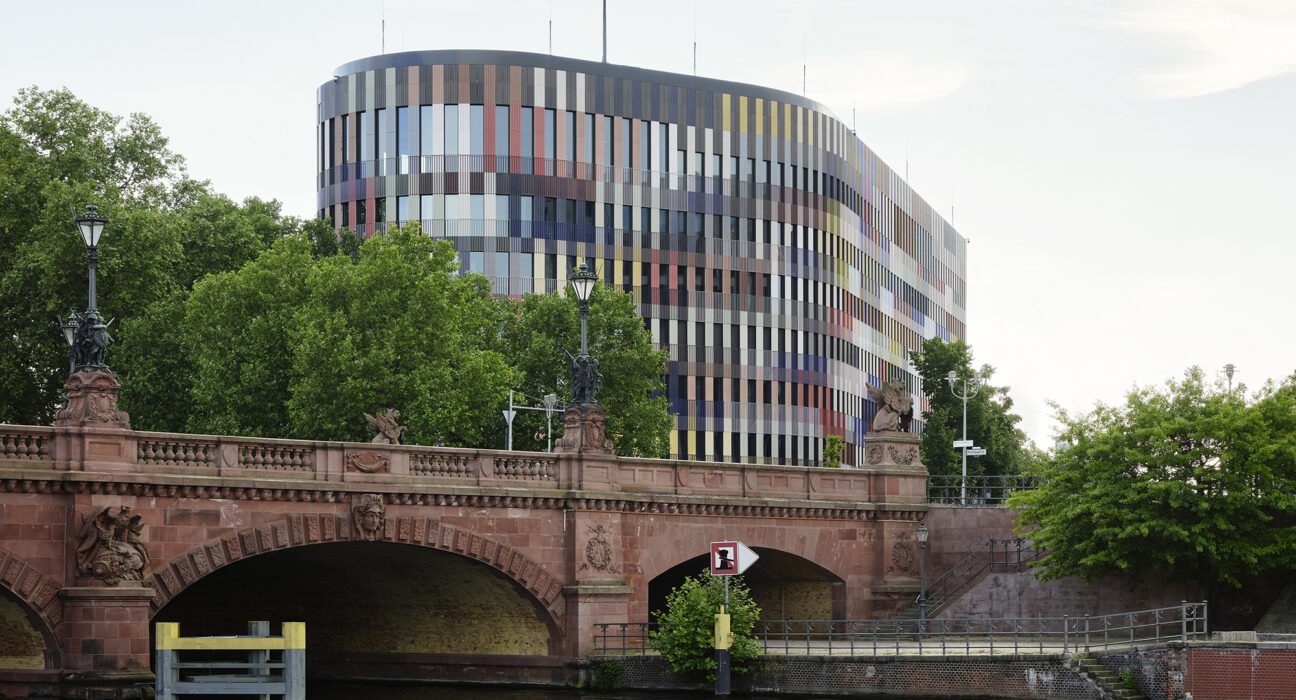
The standout project in this week’s architecture news is undoubtedly sauerbruch hutton’s Office Building for Federal Authorities at the Spreebogen in Berlin. Completed as the temporary seat of the German Federal President during the refurbishment of Schloss Bellevue, the 18,700-square-meter complex demonstrates how institutional architecture can be both technically advanced and visually compelling.
The development comprises two timber-hybrid buildings that combine prefabricated timber office modules with reinforced concrete cores and plinths. This construction strategy delivers structural efficiency while reducing environmental impact compared with conventional methods.
Its architectural expression is equally sophisticated. The façade layers colored railings over fluted glazed ceramic components, producing a shifting visual effect across the elevations. The result is precise yet lively—an approach that aligns with the best of European modernism while feeling fresh and contemporary.
What makes this project especially relevant in architecture news is its emphasis on future adaptability. Though designed for a temporary presidential function, the buildings can later be repurposed for another federal authority. That long-view thinking is increasingly central to elite design, where durability and flexibility are becoming markers of true luxury.
Cultural Buildings Are Expanding the Urban Conversation
Beyond housing and offices, architecture news this week also points to the growing power of cultural projects to reshape cities.
Frank Gehry’s Colburn School Expansion
In Los Angeles, Frank Gehry’s expansion of the Colburn School is scheduled to open in September 2027. The 100,000-square-foot addition will include the new Terri and Jerry Kohl Hall, a 1,000-seat concert venue, alongside expanded facilities for music and dance.
Its interlocking opaque and transparent volumes, finished in a metallic pink coating, bring sculptural drama to downtown LA. Street-level and rooftop gardens soften the composition, while the in-the-round concert hall promises an immersive audience experience. It is the kind of cultural architecture that blends spectacle with civic purpose—a formula often echoed in luxury hospitality and branded residential developments.
Utopian Hours 2026 in Turin
Meanwhile, Turin’s Utopian Hours festival returns with a program focused on public space, climate adaptation, food systems, and community-led urban development. Featuring figures such as Peter Cook, Wim Walschap, Zahra Ebrahim, and Carolyn Steel, the event underlines how design culture is moving toward interdisciplinary urban thinking.
That makes it a valuable signal in architecture news: the future of great architecture will be shaped not just by buildings, but by how those buildings support social life, environmental resilience, and civic identity.
Why This Matters for Luxury Architecture and Design
For those following luxury architecture, luxury decor, luxury home design, and high-end interiors, the week’s biggest takeaway is clear: prestige is no longer defined by finish alone. Today, the most influential projects share several qualities:
- Adaptability that extends a building’s useful life
- Sustainable materials such as timber, ceramic, and biobased systems
- Cultural relevance that connects design to community and place
- Resilience in the face of climate and urban pressures
These principles increasingly shape premium homes, boutique developments, and luxury interiors. The market is shifting toward spaces that feel responsible as well as refined.
Conclusion: Architecture News Points to a Smarter Definition of Luxury
This week’s architecture news shows an industry moving beyond surface-level innovation toward deeper, more durable value. Whether through UN-Habitat’s housing awards, OMA’s adaptive reuse school, or sauerbruch hutton’s elegant timber-hybrid complex in Berlin, the message is consistent: the future belongs to architecture that is flexible, sustainable, and socially aware.
For luxury-minded readers, that is the real evolution to watch. The next generation of exceptional design will not only look beautiful—it will perform beautifully over time. In that sense, the most important story in architecture news today is not just what architects are building, but how intelligently they are building it.