

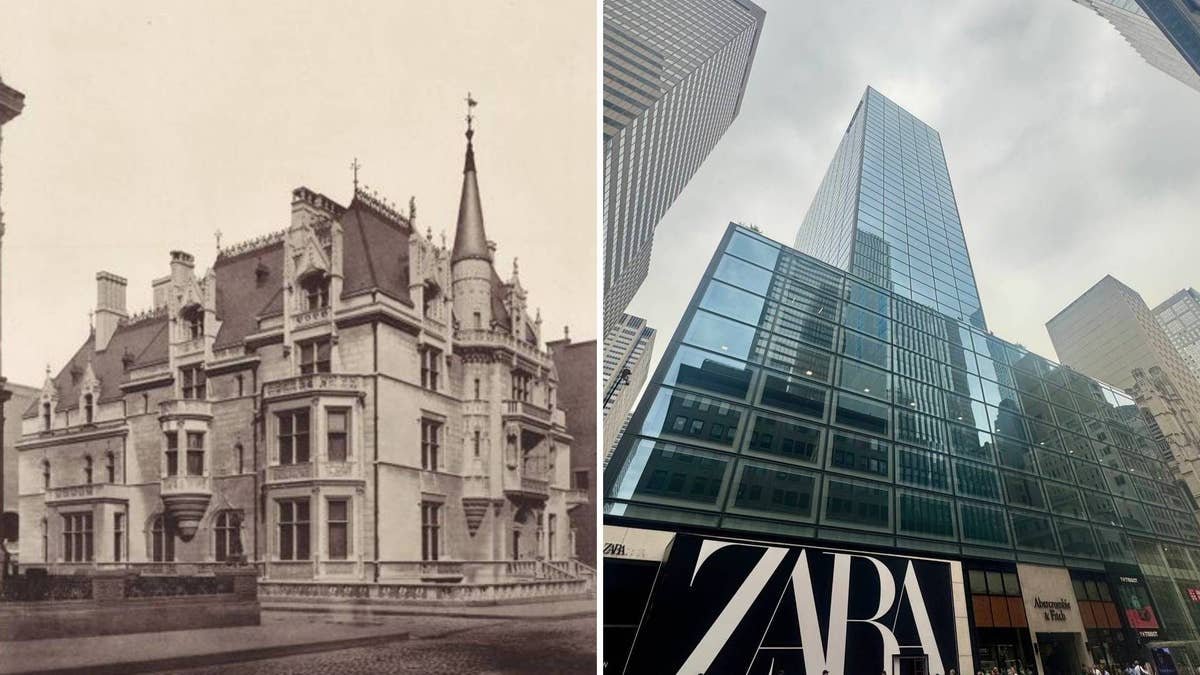
Few stories capture the rise and reinvention of New York quite like the Vanderbilt dynasty. Long before today’s celebrity homes dominated social feeds and real estate headlines, the family’s vast Fifth Avenue residences defined America’s most extravagant address, setting the standard for luxury homes and shaping the blueprint for modern luxury celebrity homes.
During the Gilded Age, the Vanderbilts transformed Fifth Avenue into a corridor of palatial architecture. Between the 1880s and early 1900s, family members commissioned enormous townhouses and chateau-style mansions with ballrooms, marble staircases, frescoed ceilings, and blocks of private living space. Most are gone today, replaced by retail flagships, office towers, and apartment buildings, but their legacy still explains how Manhattan evolved from elite residential enclave to commercial powerhouse.
For readers interested in architecture, urban change, and the history behind iconic celebrity homes, the Vanderbilt story offers a rare before-and-after look at wealth, design ambition, and the relentless pressure of development. If you enjoy property features and cultural history, related coverage across DailyDigest.ie, MediaDigest.ie, and NewsDigest.ie can add broader context on heritage, media trends, and city change.
The Rise of Vanderbilt Row and New York’s Early Luxury Homes
The Vanderbilt family arrived on Fifth Avenue as Lower Manhattan became more commercial and less desirable for elite residential living. Fifth Avenue, especially near Central Park, offered wider streets, larger lots, and room for landscaped setbacks. It became the perfect setting for a new class of American palaces.
These were not ordinary mansions. They were sprawling luxury homes built to display status, host society events, and establish family dynasties. In many ways, they were the 19th-century equivalent of today’s headline-making luxury celebrity homes: architect-designed, lavishly detailed, and impossible to ignore.
- Scale: some homes exceeded 100 rooms
- Style: Beaux-Arts, Châteauesque, and brownstone palatial forms
- Purpose: family prestige, entertaining, and social positioning
- Location: prime Fifth Avenue frontage near Central Park
Entire stretches of the avenue became so closely tied to the family that the area was widely known as Vanderbilt Row.
Celebrity Homes of the Gilded Age: The Most Famous Vanderbilt Mansions
854 Fifth Avenue: One of the Last Survivors
Among the rare survivors is 854 Fifth Avenue, a Beaux-Arts mansion later owned by Emily Thorn Vanderbilt Sloane White. Unlike many vanished Vanderbilt-era residences, this house still stands, making it one of Manhattan’s most fascinating historic celebrity homes. Over the decades, it served diplomatic purposes and later returned to private ownership.
Its appeal lies in the details that remain intact: grand proportions, original decorative craftsmanship, and even Cold War-era modifications, including a shielded communication room. Sold for a reported $50 million, it proves that historic luxury homes still command enormous attention when pedigree and preservation align.
The Triple Palace: A Mansion Complex on an Epic Scale
At 640 and 642 Fifth Avenue and 2 West 52nd Street stood William Henry Vanderbilt’s so-called Triple Palace. This massive residential complex occupied nearly a full block and contained immense private living quarters for multiple family members. It represented a level of domestic grandeur rarely seen before or since in New York.
Today, the site has been replaced by commercial buildings and major retail tenants, illustrating a familiar Manhattan pattern: residential prestige eventually gave way to higher-value business use. It’s a sharp reminder that even the most extraordinary celebrity homes can disappear when land values shift.
660 Fifth Avenue: Petit Château
William Kissam Vanderbilt and Alva Vanderbilt’s Petit Château became one of the avenue’s great symbols of social ambition. Designed in a French-inspired style, it was as much a statement as a residence. Alva used the home to stage society-defining events, proving that architecture could function as personal branding long before the age of influencers and modern luxury celebrity homes.
The mansion was eventually demolished, and the site later became part of the commercial skyline. Its disappearance marks the transition from aristocratic avenue to corporate corridor.
742–748 Fifth Avenue: The Largest Private Residence in New York City
Cornelius Vanderbilt II’s mansion remains legendary as the largest private residence ever built in New York City. With more than 130 rooms and opulent interiors by elite designers, it embodied the absolute peak of Gilded Age luxury homes.
Yet even this giant could not survive economic and urban pressures. After its demolition, the site became home to the iconic Bergdorf Goodman building. The replacement is fitting in its own way: where one monument to wealth once stood, another symbol of Manhattan luxury took its place.
Why These Luxury Celebrity Homes Disappeared
The downfall of the Vanderbilt mansions was not caused by fading glamour alone. Several larger forces reshaped Fifth Avenue and made these private estates increasingly impractical.
- Commercial encroachment: retail and office development became more profitable than residential use.
- Maintenance costs: giant mansions were expensive to heat, staff, and preserve.
- Changing tastes: younger heirs often preferred newer, more manageable residences.
- Property taxes: carrying costs pushed owners toward sales and redevelopment.
That pattern still resonates today. Many high-profile celebrity homes reflect the same tensions between privacy, prestige, upkeep, and location value. For audiences following real estate market shifts, urban redevelopment stories on NewsDigest.ie and media-focused property coverage on MediaDigest.ie can complement this historical perspective.
What Stands There Now
One of the most compelling parts of the Vanderbilt story is the contrast between then and now. In place of these lavish luxury homes stand some of Manhattan’s best-known commercial and residential addresses.
- Bergdorf Goodman rose where Cornelius Vanderbilt II’s mansion once stood
- Office towers and flagship stores replaced the Triple Palace
- The Tishman Building succeeded Petit Château
- Modern residential construction took over other former mansion plots
This evolution highlights a deeper truth about New York real estate: land rarely stays frozen in one identity. The avenue that once showcased America’s grandest private dwellings now reflects the city’s global retail, office, and mixed-use economy.
The Lasting Legacy of Vanderbilt Celebrity Homes
The Vanderbilt mansions were more than extravagant addresses. They were cultural signals, architectural experiments, and early examples of how homes can shape public identity. In that sense, they remain part of the long lineage connecting Gilded Age mansions to today’s most talked-about luxury celebrity homes.
For anyone fascinated by celebrity homes, these vanished Fifth Avenue palaces offer a powerful lesson: even the most magnificent residences are vulnerable to changing tastes, economics, and city growth. Their disappearance helped create modern Manhattan, but their influence still lives on in the way we talk about prestige property, legacy architecture, and luxury homes. The clearest takeaway is this: the Vanderbilt era may be over, yet its vision of celebrity homes as status, spectacle, and cultural history remains as relevant as ever.