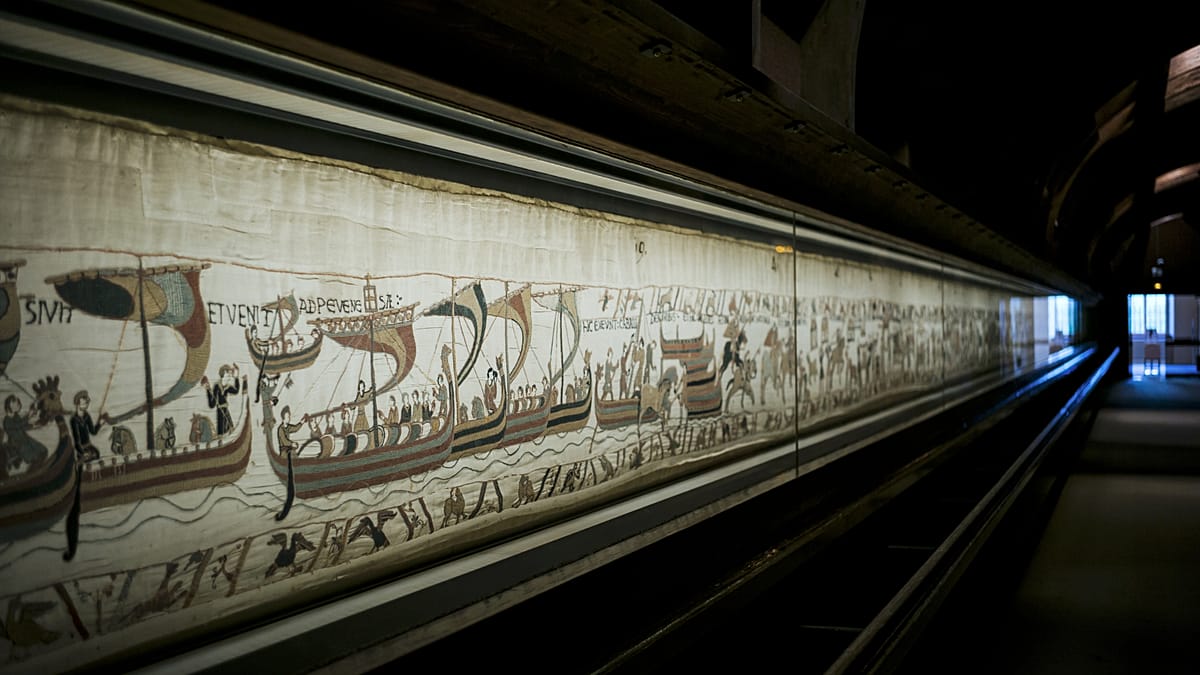
The Bayeux Tapestry exhibition in London has triggered extraordinary demand, with online queues stretching to nine hours and more than 75,000 people waiting to secure tickets. For lovers of luxury architecture, heritage interiors, and museum design, that frenzy says something important: this is not simply a cultural event, but a rare encounter with one of Europe’s most influential objects of visual storytelling.
Set to open at the British Museum from September 2026 to July 2027, the exhibition marks a historic moment. The 11th-century masterpiece will be shown outside its Norman home for the first time in a millennium, making the Bayeux Tapestry exhibition one of the most significant museum presentations in recent memory.
Why the Bayeux Tapestry exhibition has captured global attention
The surge in bookings reflects more than public curiosity. The Bayeux Tapestry occupies a unique position at the crossroads of art, design, politics, and architecture. Measuring roughly 68.38 metres, the embroidered textile narrates the Norman conquest of England in 1066 and has long been admired for its remarkable composition, sequencing, and craftsmanship.
Several factors explain why the Bayeux Tapestry exhibition is drawing such intense interest:
- Historic rarity: it has rarely left its usual home and has never before been displayed in another museum in modern times.
- Design significance: the work is an early masterclass in narrative design, spatial rhythm, and visual communication.
- Cultural symbolism: it tells a foundational story in English and French history.
- Museum prestige: the British Museum adds an international stage and a high-design exhibition context.
For audiences interested in luxury design and interiors, the tapestry also offers a lesson in how objects shape spaces. Monumental works such as this do not merely hang on walls; they define the atmosphere, circulation, and emotional tempo of a gallery.
The British Museum as a stage for heritage and design
The choice of venue matters. The British Museum is not only one of the world’s most recognized cultural institutions, but also a powerful architectural setting for historical display. Hosting the Bayeux Tapestry exhibition here elevates the experience beyond artifact viewing and into the realm of spatial storytelling.
In luxury interiors and exhibition design, context is everything. A masterpiece of this age and fragility demands:
- Controlled lighting that protects delicate fibers while preserving visual depth
- Climate management to stabilize temperature and humidity
- Thoughtful visitor flow to prevent overcrowding
- A restrained design language that lets the object remain the focal point
The museum has already experienced immense digital traffic, yet reports indicate the booking system held up under pressure. That operational resilience mirrors a broader challenge museums increasingly face: balancing public demand with premium visitor experience.
A case study in exhibition design restraint
Unlike immersive blockbuster shows filled with theatrical effects, the Bayeux Tapestry exhibition is likely to depend on curatorial precision rather than spectacle. That makes it especially relevant to readers interested in refined design. In luxury spaces, restraint often communicates more powerfully than excess, and a textile of this stature needs exactly that approach.
A textile masterpiece with architectural influence
Although commonly discussed as a historical artifact, the Bayeux Tapestry can also be understood as a precursor to architectural storytelling. Its sequential scenes function almost like a frieze, guiding the eye through time and space. This same principle appears across grand interiors, ceremonial corridors, and heritage buildings where decoration serves narrative as much as ornament.
The Bayeux Tapestry exhibition therefore resonates with contemporary luxury architecture in several ways:
- Scale: its length creates a spatial experience rather than a single-image encounter.
- Craft: it celebrates handwork, material intelligence, and artisanal labor.
- Narrative: it proves that decoration can carry political, cultural, and emotional meaning.
- Legacy: it shows how enduring design outlives trends and technologies.
Historians have also noted that while the tapestry depicts the Norman conquest, it was likely produced in England. That layered origin adds another dimension to its design legacy: it is both a political statement and a collaborative cultural object.
The extraordinary challenge of moving a 1,000-year-old treasure
Part of the fascination around the Bayeux Tapestry exhibition lies in the sheer complexity of transporting it. Curators have implemented a strict protocol because the textile is highly sensitive to vibration and already weakened in places by age, wear, and tears.
For museum professionals and design audiences alike, this is where conservation becomes a form of invisible luxury. The public sees the finished display, but behind it sits an intricate system of protection, engineering, logistics, and material expertise.
What makes the transport so delicate?
- The fabric is approximately 1,000 years old
- Its fibers are vulnerable to movement and environmental stress
- Its exceptional length complicates packing and installation
- Existing fragility requires highly controlled handling from start to finish
This behind-the-scenes sophistication is part of what makes major museum exhibitions so compelling. They are not only curatorial achievements, but also triumphs of design planning and technical execution.
Ticket demand, pricing, and what visitors should know
When bookings opened, more than 10,000 people were reportedly already in the virtual waiting room, and queues later climbed above 76,000. Waiting times reached up to nine hours. The highest-priced tickets are set at £33, positioning the show as a premium but still accessible cultural experience by London museum standards.
If demand remains strong, prospective visitors should approach the Bayeux Tapestry exhibition strategically:
- Book online rather than waiting for last-minute availability
- Avoid peak release windows if additional ticket batches are announced
- Consider weekday visits for a calmer gallery experience
- Allow time to fully engage with the display rather than rushing through it
For design-minded travelers, this is the kind of exhibition worth planning a broader London itinerary around, pairing museum time with visits to the city’s leading architecture, decorative arts, and historic interiors.
Why this exhibition matters beyond history
The Bayeux Tapestry exhibition is more than a major museum event. It highlights how heritage objects continue to inform modern conversations about design, identity, craftsmanship, and the spaces we create around art. In a cultural era often driven by speed and novelty, this thousand-year-old textile reminds us that the most enduring luxury is permanence: work made with skill, meaning, and narrative depth.
For anyone passionate about architecture, interiors, or material culture, the takeaway is clear. The Bayeux Tapestry exhibition is not just worth the queue; it is a masterclass in timeless design, historical storytelling, and the power of exceptional objects to transform a space.