
Architecture news from the Netherlands is spotlighting a major cultural transformation in the historic city of Zutphen. Dutch studio Mecanoo has been selected to redesign the Theatre Hanzehof & Buitensociëteit into Hanzehuis, a new civic destination that blends heritage preservation, contemporary design, and community life under one roof.
For readers following luxury architecture and elevated cultural design, this project stands out for its refined balance of old and new. Rather than replacing a beloved landmark, the scheme carefully restores the historic fabric while adding a warm, modern timber volume designed to support performances, education, social exchange, and everyday public use.
Architecture News: Mecanoo Wins Hanzehuis Cultural Center Project
According to the announcement, the Municipality of Zutphen appointed Mecanoo after a European tender procedure to lead the transformation of the existing theater complex into a broader cultural hub. Developed in collaboration with Hanzehof theater, de Muzehof center for the arts, BIJ de Bieb library, ABT Consulting engineers, and building services consultant Nelissen, the project marks a significant investment in the city’s cultural future.
The vision for Hanzehuis is ambitious yet grounded in place. The plan preserves the main historic building while introducing a new architectural volume that accommodates expanded programming. Once complete, the destination will unite culture, knowledge, education, and community engagement in a single integrated setting.
In today’s architecture news landscape, projects like Hanzehuis reflect a growing shift away from single-purpose institutions. Instead, cities are favoring flexible cultural buildings that can function as performance venue, learning environment, social anchor, and public living room all at once.
A Historic Theater with Deep Roots in Zutphen
The Theatre Hanzehof & Buitensociëteit has a long and layered history. Originally designed in 1891 by architect D. Lijsen, the building began as a private social club and concert hall on the edge of Zutphen’s historic Hanseatic center. It became known for architectural qualities such as its coffered neoclassical ceiling and strong acoustics, features that helped establish its cultural value over generations.
Over time, the complex evolved through several renovations and expansions, including repairs following wartime damage and later modernization efforts. Before its current reinvention, it served multiple roles, including:
- A congress center
- A theater hall
- A cinema
- A venue for local and regional events
Its present-day facilities already play an important role in city life, with a 550-seat theater hall and a 600-seat concert hall welcoming around 75,000 visitors annually. The site hosts approximately 120 professional concerts and performances each year, in addition to events organized by social groups and regional organizations.
This context makes the latest architecture news especially compelling: Hanzehuis is not creating relevance from scratch, but building on an already meaningful civic institution.
How Hanzehuis Will Blend Heritage and Contemporary Design
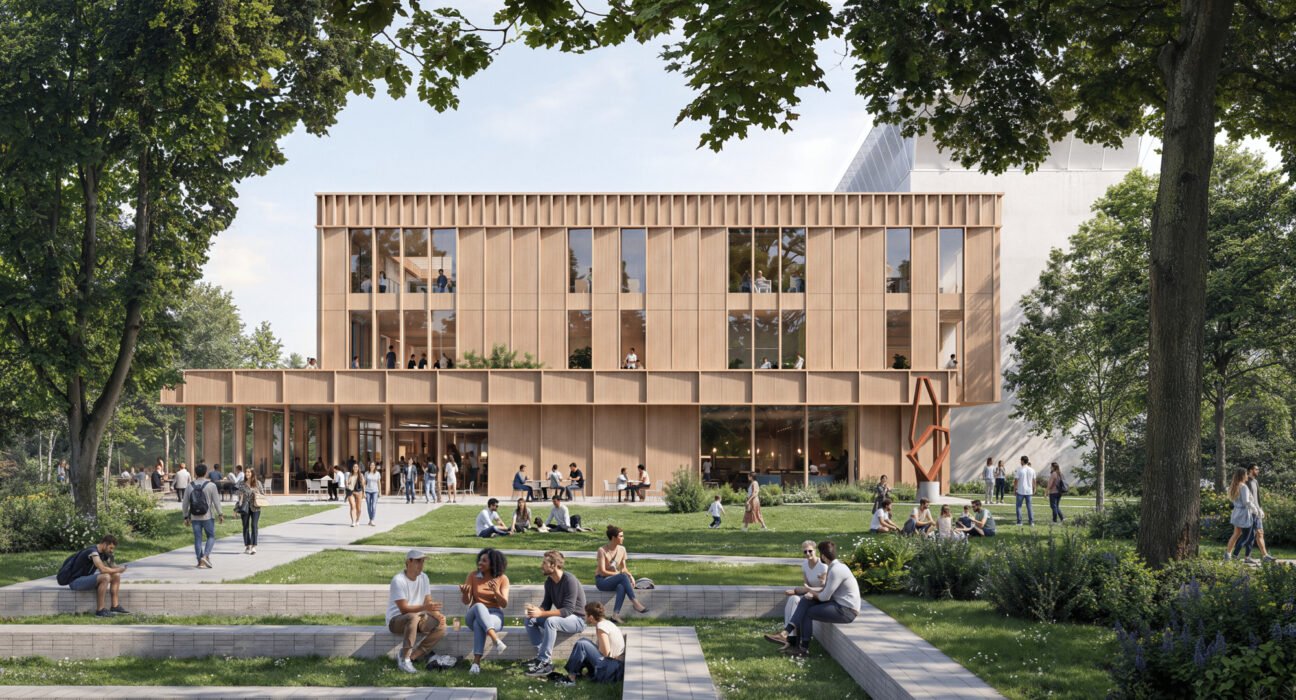
Mecanoo’s proposal is centered on respect for the site while expanding its capacity for contemporary public life. The architectural concept brings together three key components: the preserved main theater hall, the historic Buitensociëteit, and a new timber addition.
The use of timber signals a warmer, more sustainable design language while creating a clear distinction between old and new. This approach is increasingly visible in luxury architecture, where material richness and contextual sensitivity are often more powerful than visual excess.
Planned functions within the new cultural center include:
- Theater spaces
- Music and dance studios
- A public café
- Flexible areas for studying and working
- Learning and workshop spaces
- Informal leisure and gathering zones
Rather than operating as isolated rooms, these spaces will be woven together into a unified experience. Mecanoo has described the concept as “a living room for the city,” a phrase that captures the project’s emphasis on openness, comfort, and social connection.
De Straat: The Interior Route as Social Spine
One of the most distinctive elements in this architecture news story is the introduction of De Straat, or “The Street.” This internal circulation route will link the historic structures, the new building, and the surrounding park landscape.
More than a hallway, De Straat is envisioned as a transparent and accessible meeting place where visitors, performers, students, and local residents can cross paths naturally. In practical terms, it supports the project’s larger mission: turning a performance venue into a dynamic cultural ecosystem.
This kind of in-between space is increasingly important in contemporary cultural architecture. It encourages spontaneous interaction, extends dwell time, and makes the building feel welcoming even to those who are not attending a formal event.
Why This Project Matters in Today’s Architecture News
Hanzehuis captures several themes shaping current architecture news across Europe and beyond. It speaks to the value of adaptive reuse, the revival of civic institutions, and the integration of education, art, and public space within a single destination.
Key reasons the project matters include:
- Heritage preservation: The historic identity of the original complex remains central to the redesign.
- Community-driven programming: The building will support everyone from children attending workshops to audiences at professional concerts.
- Flexible modern use: Spaces are designed for formal and informal activity, increasing relevance throughout the day.
- Architectural warmth: The new timber volume introduces a tactile, human-scaled contrast to the historic structures.
- Urban connection: The project ties architecture to the surrounding park and city center, strengthening its civic role.
For audiences interested in luxury design and luxury home decor trends, there is also a broader lesson here: true sophistication often comes from thoughtful curation, material harmony, and purposeful spatial flow. Those same principles apply at the scale of a cultural institution.
Project Timeline and What Comes Next
The development schedule for Hanzehuis is already taking shape. The preliminary design is expected in February 2027, followed by the final design in July 2027. Technical development will come next, with construction anticipated to begin in mid-2028. If the schedule holds, the new cultural center is set to open on January 1, 2030.
That timeline places Hanzehuis among a wider wave of international cultural projects now redefining how public architecture serves communities. In recent architecture news, studios and institutions around the world have similarly focused on art, education, sustainability, and public accessibility as interconnected goals rather than separate priorities.
As Hanzehuis moves from concept to reality, it will be one to watch—not only as a Dutch cultural project, but as a model for how heritage buildings can be renewed with clarity, generosity, and contemporary relevance.
Conclusion
The most compelling architecture news often reveals how design can enrich daily life, not just reshape skylines. Mecanoo’s Hanzehuis proposal for Zutphen does exactly that, transforming a historic theater complex into an inclusive cultural center where performance, learning, and community can thrive together. If successful, Hanzehuis will offer a powerful reminder that the future of great architecture lies in creating places people truly want to share.