Architecture news this week reveals a clear shift in how leading designers, museums, and developers are shaping the future of cultural space. From waterfront civic landscapes in Shenzhen to context-driven exhibitions in Copenhagen, the most compelling projects are redefining luxury architecture as something more public, immersive, and deeply connected to place.
Across global design capitals, the conversation is no longer limited to iconic forms alone. Instead, this latest wave of architecture news highlights how cultural infrastructure, adaptive reuse, and mixed-use environments are being crafted as refined, flexible experiences—an evolution that resonates strongly across luxury architecture, luxury design, and luxury home-inspired spatial thinking.
Architecture News Highlights a New Era of Cultural Design
A central theme across this week’s architecture news is the idea that architecture now operates beyond the building envelope. Major exhibitions and newly unveiled developments suggest that cultural projects are increasingly conceived as landscapes, platforms, and public frameworks rather than standalone objects.
This shift matters for luxury design because it signals a more sophisticated understanding of value. Prestige today is not defined only by exclusivity, but also by how spaces foster connection, experience, and environmental responsiveness. In practical terms, that means:
- More accessible public circulation
- Stronger integration between architecture and landscape
- Flexible interiors and outdoor event space
- Adaptive reuse strategies that preserve heritage while adding contemporary function
- Climate-conscious design embedded into form and material decisions
Exhibitions Expanding the Architectural Conversation
Housing, landscape, and design research take center stage
Several major exhibitions featured in this week’s architecture news examine how built environments shape everyday life. Australia’s upcoming contribution to the 2027 Venice Architecture Biennale, Lived In, draws from the Housing Atlas of Australia to explore more than a century of multi-dwelling housing. By combining drawings, photography, film, and data, the exhibition places density, domesticity, and urban transformation at the center of architectural discourse.
In Shanghai, Jean Nouvel: Without the Artist, Architecture Disappears offers a different but equally compelling perspective. Presented inside the Museum of Art Pudong—a building designed by Nouvel himself—the exhibition uses models, archival materials, films, and even a reconstruction of the architect’s Paris studio to blur the line between exhibition content and architectural setting.
Barcelona’s Parlour Gardens: Dreams from the Rooftop extends the discussion into climate and ecology. By inviting landscape architects to reinterpret rooftop garden traditions through living ceramic installations, the exhibition connects domestic landscape design with contemporary environmental concerns. For readers interested in luxury home decor and luxury design, this is a reminder that elevated aesthetics and ecological intelligence are becoming inseparable.
Shenzhen Emerges as a Key Story in Architecture News
MAD’s Shenzhen Bay Culture Square
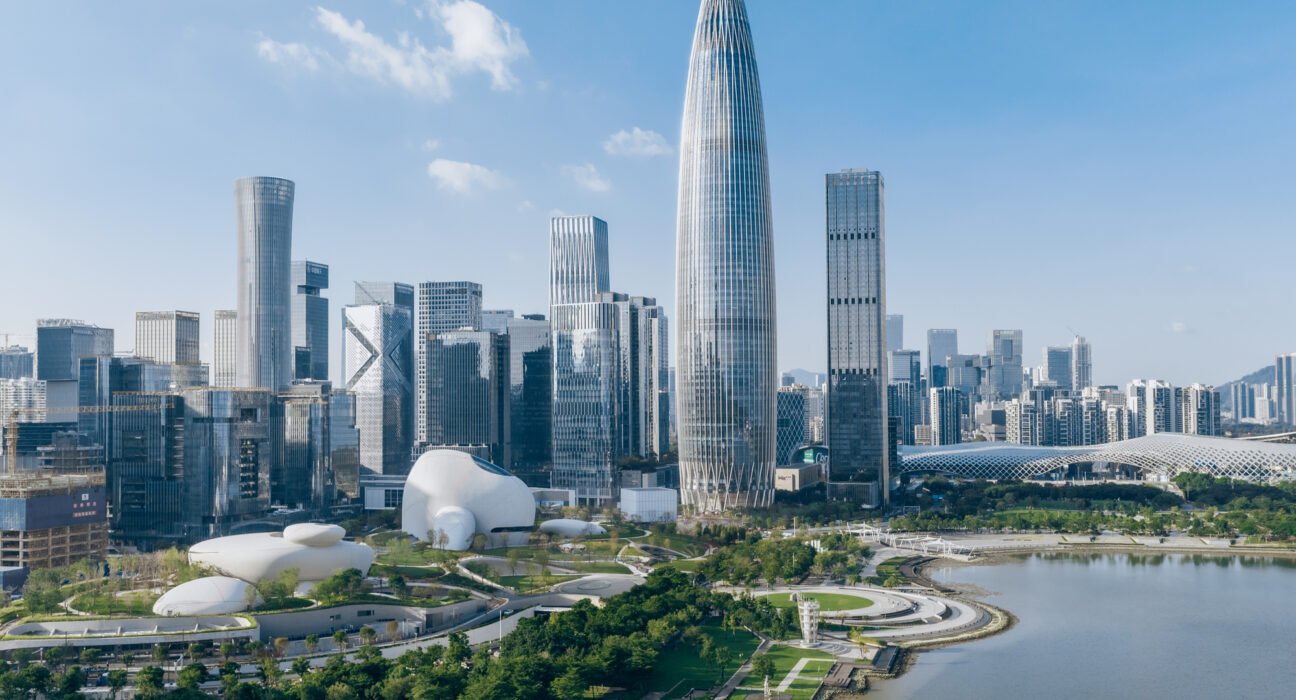
Among the most notable projects in current architecture news, MAD’s Shenzhen Bay Culture Square stands out for its ambitious rethinking of cultural infrastructure. Located on a waterfront site in Shenzhen’s Nanshan District, the project merges exhibition spaces, learning facilities, plazas, and planted roofs into a continuous civic landscape.
Rather than presenting itself as a closed institutional object, the design behaves like an open field. Paths, terraces, and outdoor rooms create a porous urban experience where cultural programming and everyday public life coexist. That approach aligns strongly with broader luxury architecture trends, where spatial generosity, seamless circulation, and nature-integrated design increasingly define premium environments.
MVRDV’s Bihailou Art Village
Also in Shenzhen, MVRDV’s Bihailou Art Village pushes mixed-use cultural design in a vertical direction. Built around the studio’s “Vertical Village” concept, the development organizes theaters, restaurants, retail, and museum functions into interconnected volumes linked by public circulation routes.
The project’s significance lies in its attempt to preserve the permeability and diversity of a traditional neighborhood within a dense modern context. In the world of luxury design, this kind of layered urbanism reflects a growing demand for destinations that feel curated, experiential, and socially active rather than monolithic.
Context-Responsive Architecture Gains Momentum
Dorte Mandrup’s PLACE exhibition
At the Danish Architecture Center, Dorte Mandrup’s PLACE exhibition explores how architecture can emerge directly from the character of a site. Featuring projects in Denmark, Greenland, Norway, and Germany, the exhibition examines the relationship between climate, history, landscape, and materiality.
This is one of the most thoughtful entries in recent architecture news because it emphasizes restraint and responsiveness over spectacle. Projects such as the Ilulissat Icefjord Centre and the Wadden Sea Centre show how architecture can deepen a visitor’s connection to the environment rather than compete with it. That philosophy increasingly influences luxury home and luxury decor trends as well, particularly in the use of tactile materials, local references, and serene spatial composition.
Adaptive Reuse and Kinetic Design Shape Future Cultural Hubs
AGO Cultural Complex in Modena
In Modena, CRA-Carlo Ratti Associati and Chuck Hoberman have unveiled a model for the kinetic roof of AGO – Fabbriche Culturali, a major adaptive reuse project transforming the former Sant’Agostino Hospital into a 22,000-square-meter cultural complex.
The roof, inspired by origami geometry, is designed to open and close over the central courtyard, allowing the space to host exhibitions, performances, and public gatherings in multiple configurations. Photovoltaic integration adds a sustainability dimension, proving that technical innovation can support architectural drama without compromising environmental performance.
For anyone tracking architecture news through a luxury lens, AGO is a prime example of how heritage conversion can produce spaces that feel both historic and cutting-edge.
Vertical Cities Continue to Evolve
ZHA’s Z8 Tower in Beijing
Another significant development in architecture news is the start of construction on ZHA’s Z8 Tower in Beijing’s CBD. The 140-meter mixed-use tower combines office space with retail, dining, leisure, and cultural uses, creating what can best be described as a vertical urban ecosystem.
Facing the central park, the tower incorporates planted terraces, atriums, and verandas that pull greenery into the building’s experience. Climate-responsive façade elements, including external shading fins, also improve energy performance across seasonal changes. The result is a high-density project that embraces flexibility, wellness, and environmental control—three features now central to luxury architecture worldwide.
What This Week’s Architecture News Means for Luxury Design
Viewed together, these projects and exhibitions point to a broader transformation in architecture and design:
- Cultural buildings are becoming landscapes rather than isolated monuments.
- Luxury is becoming more experiential, defined by atmosphere, adaptability, and public value.
- Adaptive reuse is rising as a premium strategy for creating layered, authentic destinations.
- Context matters more than ever, with climate, heritage, and local identity shaping design decisions.
- Mixed-use environments are maturing into more refined, community-oriented models.
For professionals and enthusiasts across luxury home, luxury decor, and luxury architecture, this is a powerful signal: the most influential spaces of 2026 are not just visually striking—they are intelligent, open, and deeply rooted in place.
Conclusion
This week’s architecture news makes one thing clear: the future of great design lies in the seamless fusion of culture, landscape, technology, and public life. Whether through Shenzhen’s expansive civic projects, Dorte Mandrup’s context-led exhibition, or adaptive reuse in Modena, the best new work shows that luxury architecture is becoming more responsive, more layered, and far more meaningful. For anyone following architecture news closely, these projects are not just headlines—they are a blueprint for where premium design is headed next.