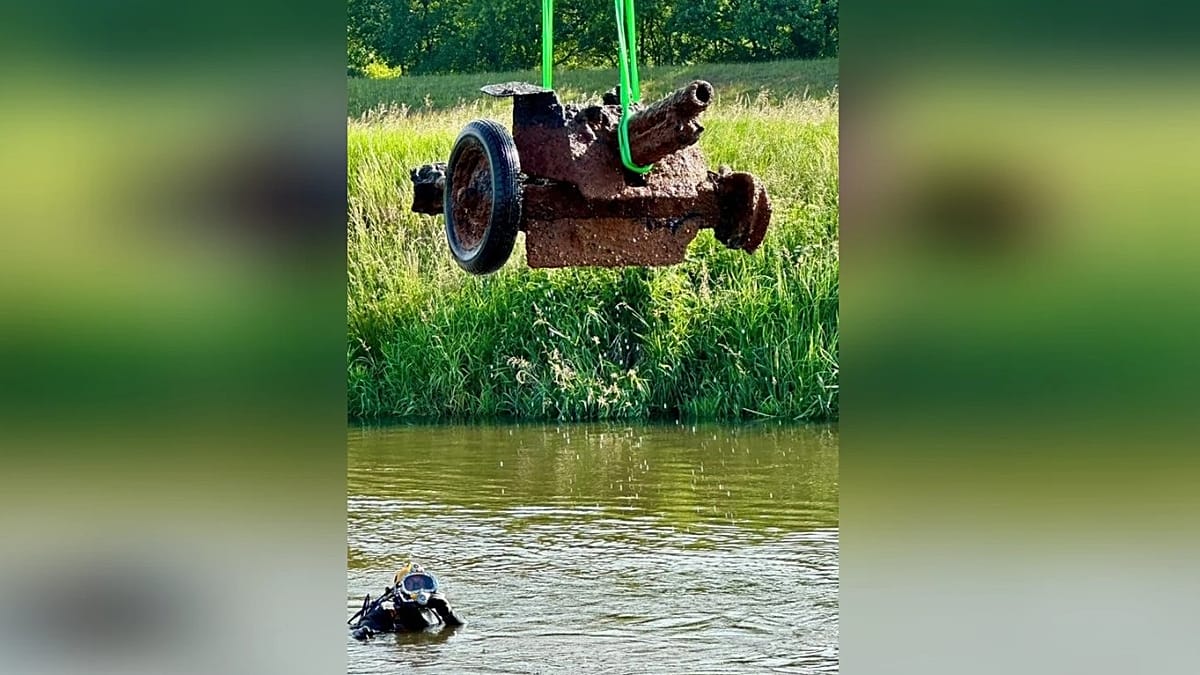
Beneath Europe’s rivers and beneath the surfaces of its cities, history still waits to be uncovered. The recent discovery of a WWII gun recovered from German river waters near Forst is more than a military headline—it is a reminder that landscapes, infrastructure, and even modern design territories are often built over the physical remains of conflict.
Recovered from the Neisse river in eastern Germany, the Soviet-era 76 mm infantry gun offers a striking example of how wartime history continues to intersect with contemporary planning, restoration, and regional identity. For audiences interested in luxury architecture, luxury design, and luxury interiors, this event also highlights a broader truth: every refined space exists within a deeper cultural and historical context.
WWII Gun Recovered from German River Near Forst
Germany’s Explosive Ordnance Disposal Service recovered the weapon during waterway works close to Forst in Lower Lusatia, near the Polish border and roughly 20 kilometres from Cottbus. The artillery piece was identified as a Soviet 76 mm infantry gun, model M1943, a weapon widely used by the Red Army during the Second World War.
Although the gun was heavily rusted, officials said it remained remarkably well preserved. Its condition was likely due to years spent buried in the mud and sand of the Neisse, which shielded key structural elements from more aggressive deterioration. According to regional experts, finds of this scale and type are unusual for the area, making the recovery especially notable.
The WWII gun recovered from German river waters was transported to a dismantling facility in Kummersdorf, where it is expected to be safely disposed of rather than displayed in a museum.
A Wartime Landscape Still Shaping the Present
To understand why the discovery matters, it is important to consider Forst’s history. In April 1945, the town became the site of intense fighting between the German Wehrmacht and the advancing Red Army. Much of the town was devastated in the final weeks of the war.
That history still echoes through the region’s built environment. In many parts of Europe, postwar reconstruction shaped everything from civic planning to housing stock, industrial zones, transport links, and waterfront development. The WWII gun recovered from German river territory near Forst is a physical reminder that landscapes are not static—they are layered archives.
Why river discoveries matter
Rivers often preserve objects differently from open ground, especially when silt and sand create low-oxygen conditions. This can protect metal artifacts long enough for them to emerge decades later during:
- Dredging and waterway improvement projects
- Bridge and embankment engineering works
- Flood prevention upgrades
- Urban redevelopment near historic waterfronts
For architects, designers, and developers, such discoveries underscore the importance of historical surveys and site-sensitive planning.
What This Means for Architecture and Design
At first glance, a wartime recovery operation may seem far removed from luxury interiors or high-end architecture. Yet the connection is stronger than it appears. Design does not happen in a vacuum. It emerges from place, memory, materials, and the narratives embedded in a site.
The story of a WWII gun recovered from German river sediment can inform how we think about heritage-led development and sophisticated adaptive design. In Europe especially, luxury properties often occupy historically complex settings—former industrial buildings, riverfront districts, reconstructed town centres, and estates shaped by political upheaval.
Key design lessons from historically charged sites
- Context enhances value: Homes and hospitality spaces with a well-understood local story often feel more authentic and enduring.
- Material memory matters: Patina, texture, and restoration can be used thoughtfully to acknowledge age without compromising elegance.
- Site research is essential: Redevelopment near historic zones may require archaeological review, environmental testing, and ordnance checks.
- Landscape is part of the narrative: Rivers, gardens, and urban edges can carry historical significance just as strongly as buildings themselves.
Europe’s Ongoing Encounters with WWII Remnants
The WWII gun recovered from German river banks is not an isolated case. Across Europe, unexploded bombs, buried ammunition, and military artifacts continue to be found during construction and infrastructure works. These discoveries regularly disrupt rail systems, trigger evacuations, or delay redevelopment plans.
Recent years have shown how common this remains. In France, bomb disposal operations have affected transportation networks. In German cities such as Cologne, large-scale evacuations have followed the discovery of unexploded wartime devices. Such incidents reveal that the legacy of the Second World War is not merely commemorative—it is operational, logistical, and spatial.
For the design world, this has practical implications. Luxury developments in historically significant European locations may require:
- Detailed land-use history assessments
- Close coordination with local authorities
- Specialist remediation or clearance procedures
- Longer planning timelines for sensitive sites
From Recovery to Reflection
There is also a cultural dimension to this discovery. While the gun will likely be dismantled rather than exhibited, the event still contributes to public memory. Not every artifact becomes a museum object; some serve their purpose simply by being found, documented, and understood.
That act of recovery can influence how communities relate to place. It can inspire more thoughtful preservation, more informed urban storytelling, and a stronger appreciation for the unseen histories beneath modern life. In luxury architecture and interiors, where narrative increasingly shapes desirability, this kind of historical awareness can become a subtle but powerful design asset.
Designing with historical intelligence
Today’s most compelling spaces often balance refinement with depth. Whether through curated materials, local craftsmanship, archival references, or landscape preservation, designers are increasingly creating environments that feel rooted rather than generic. Events like the WWII gun recovered from German river discovery reinforce the value of that approach.
A polished interior or architecturally ambitious property gains meaning when it responds to the ground it stands on—literally and culturally.
Conclusion
The WWII gun recovered from German river waters near Forst is a dramatic historical find, but it also carries a wider message. Europe’s rivers, towns, and redevelopment zones still hold the material traces of war, and those traces continue to shape planning, preservation, and design decisions today.
For anyone working in or inspired by luxury architecture, luxury design, or luxury interiors, the takeaway is clear: exceptional spaces are not defined by beauty alone. They are elevated by context, by memory, and by a respectful understanding of the histories embedded within the landscape.