

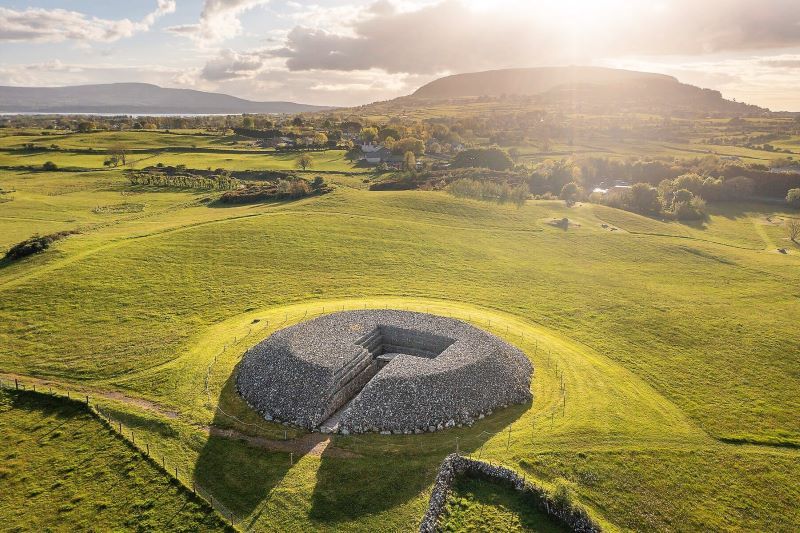
For travelers who think luxury is only found in five-star suites, Ireland Travel offers a richer definition: access to places that feel timeless, rare, and profoundly moving. In County Sligo, Carrowmore Megalithic Cemetery delivers exactly that kind of elevated experience, pairing prehistoric wonder with the wild beauty of Ireland’s northwest.
Set on the Cúil Irra Peninsula, Carrowmore is widely recognized as the oldest and largest collection of megalithic tombs in Ireland. Built roughly between 4600 and 3900 BC, the site predates the Egyptian pyramids and remains one of the country’s most extraordinary heritage destinations. For visitors planning an Ireland Travel itinerary with depth, exclusivity, and cultural prestige, Carrowmore deserves a place near the top.
Why Carrowmore Matters for Ireland Travel
Carrowmore is not simply an archaeological stop; it is one of the foundational landscapes of ancient Ireland. The cemetery is considered one of the four great passage tomb complexes in the country, alongside Newgrange, Loughcrew, and Carrowkeel. What makes Carrowmore especially compelling is both its scale and its age.
Although more than 100 monuments are believed to have once stood here, only around 30 survive today. Over the centuries, quarrying, agricultural clearance, and early amateur digs damaged or destroyed many of the original structures. Even so, what remains is powerful: a ceremonial landscape of stone circles, passage tombs, dolmens, and cairns spread across open ground with commanding views of the surrounding countryside.
For discerning visitors, this is where Ireland Travel becomes something more meaningful than sightseeing. Carrowmore offers a direct encounter with the island’s Neolithic past, in a setting that still feels atmospheric and remote.
What You’ll See at Carrowmore
Listoghil and the surviving satellite tombs
The most significant monument at Carrowmore is Listoghil, a large central cairn that anchors the cemetery. Around it are numerous smaller “satellite tombs,” creating a striking ritual layout that hints at the social and spiritual importance of the site thousands of years ago.
Visitors will encounter two principal monument types:
- Passage tombs – burial chambers once covered by earth or stone, approached through a stone-built passage.
- Dolmens – simple but dramatic tomb structures formed by upright stones supporting a large capstone.
The site’s visual impact is subtle rather than theatrical, which is part of its charm. Unlike more enclosed heritage attractions, Carrowmore invites you to read the landscape itself: the alignments, the spacing, the rise of ground, and the relationship between monument and horizon.
A setting that elevates the experience
Luxury Travel in Ireland increasingly centers on immersive, place-based experiences, and Carrowmore fits that trend perfectly. The cemetery lies within one of Sligo’s most evocative regions, with views toward Knocknarea, where Queen Maeve’s cairn dominates the skyline. The interplay between these sacred landmarks creates a sense of continuity that sophisticated cultural travelers will appreciate.
The Fascinating Archaeology Behind Carrowmore
Part of what makes Carrowmore such a standout in Ireland Travel is the long scholarly debate surrounding its age and origins. Research at the site stretches back nearly two centuries, and each wave of excavation has added new layers to its story.
In 1837, archaeologist and artist George Petrie documented and numbered the monuments for the Ordnance Survey. His numbering system is still used today, despite later revisions to the estimated number of tombs. In the 1880s, William Gregory Wood-Martin carried out the first recorded excavations.
Much later, Swedish archaeologist Göran Burenhult led major excavation campaigns between 1977 and 1982, and again from 1994 to 1998. Based on radiocarbon evidence, he argued that parts of Carrowmore might date as early as 5400 BCE and proposed that some monuments ranked among Europe’s oldest megalithic chambers. That early dating proved controversial, but it intensified academic interest in the site.
Subsequent analysis by Dr. Stefan Bergh and Dr. Robert Hensey in 2012 used red deer antler samples to suggest a date range of roughly 3800 to 3000 BC for parts of the cemetery. More recent DNA research has also widened the story, indicating connections to Neolithic populations whose distant origins trace back to Anatolia.
For modern visitors, these debates only enhance Carrowmore’s appeal. The site is not frozen in certainty; it remains a living subject of archaeological discovery.
How to Experience Carrowmore in Style
A well-planned Ireland Travel itinerary can transform a visit to Carrowmore from a quick historical stop into a refined cultural day out. County Sligo combines heritage, scenery, and boutique hospitality, making it ideal for luxury-minded travelers.
Ideas for a premium visit
- Arrive early or later in the day for softer light, fewer crowds, and a more contemplative atmosphere.
- Pair Carrowmore with nearby heritage sites such as Carrowkeel or Knocknarea for a broader view of Sligo’s ancient ritual landscape.
- Stay in a high-end country house or boutique hotel in Sligo to combine prehistoric exploration with fine dining and polished service.
- Book a private local guide if available, as expert interpretation can reveal subtle archaeological details that are easy to miss.
This is the kind of destination that rewards slow travel. Rather than rushing through, take time to absorb the silence, the geometry of the monuments, and the extraordinary fact that these stones have stood for millennia.
Why Carrowmore Belongs on Your Ireland Travel Itinerary
Carrowmore appeals to travelers who value rarity, authenticity, and intellectual depth. It may not be as globally famous as Newgrange, but that relative quiet is part of the luxury. Here, the experience feels more personal, more spacious, and in many ways more intimate.
In an era when premium travel is increasingly defined by exclusive access to meaningful places, Carrowmore stands out as one of Ireland’s most compelling ancient sites. It connects visitors to prehistoric craftsmanship, ritual, migration, and belief systems on a scale that is hard to match.
If your ideal Ireland Travel experience blends heritage, landscape, and a sense of discovery, Carrowmore is essential. It proves that true luxury is not always about extravagance; sometimes, it is about standing in one of the oldest sacred places in the world and feeling history all around you.