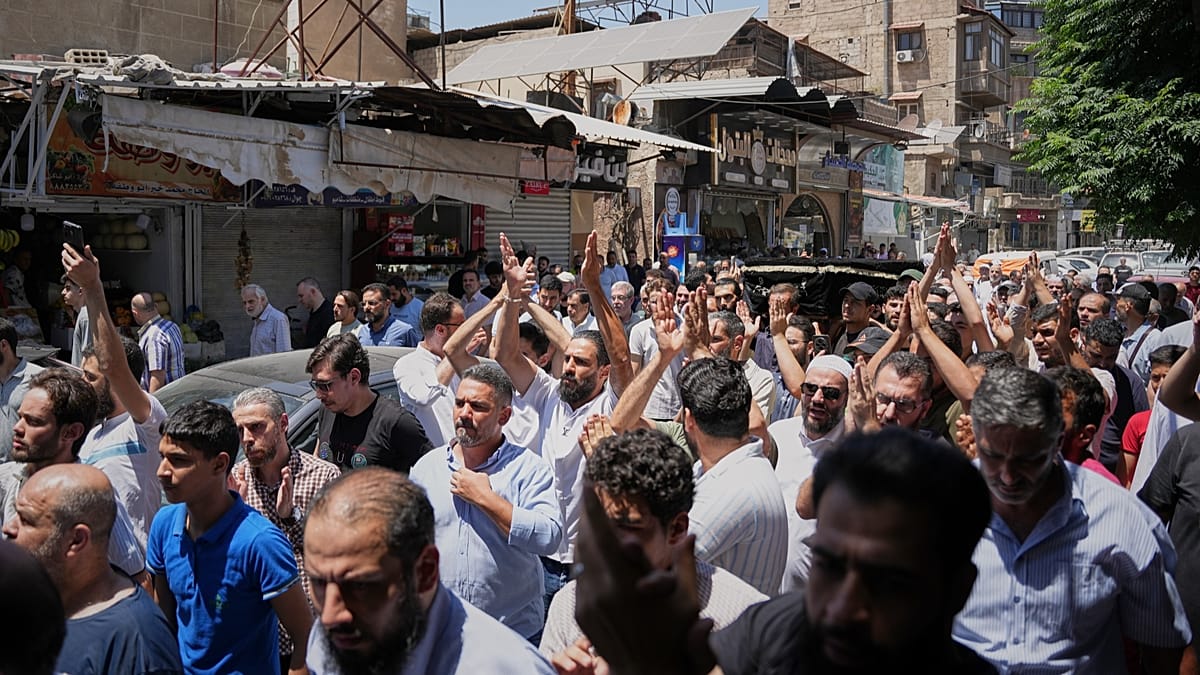
The Damascus cafe bombing has once again exposed how fragile public life remains in Syria, even in places meant for routine conversation, commerce and community. As mourners carried victims through the capital’s Midan district, the attack underscored a painful reality: when violence enters everyday spaces, it reshapes not only security but the emotional and social architecture of a city.
According to reports, an explosive device detonated at a popular cafe in Damascus, killing 10 people and injuring 21 others. The cafe was located near the capital’s main judicial complex and was known to attract lawyers and local residents. No group has claimed responsibility, and officials have pledged to bring those responsible to justice.
What Happened in the Damascus Cafe Bombing
The Damascus cafe bombing took place in a busy part of the Syrian capital, turning an ordinary urban setting into a scene of devastation. On Friday, funeral processions moved through Midan carrying the coffins of three victims, while families and residents struggled to process the scale of the loss.
Authorities said the blast killed 10 people, a figure updated by Syria’s Health Ministry from an earlier death toll of nine. Another 21 people were wounded. The attack struck a cafe near a major legal district, amplifying concerns over safety in central civic areas.
Victims and community impact
Among those killed was Fathi Qabbani, who, according to his brother Bahaa Qabbani, was passing by the cafe while heading from work when the explosion occurred. His death reflects a grim truth seen in many urban attacks: victims are often not direct targets, but ordinary civilians caught in the path of violence.
The aftermath of the Damascus cafe bombing has been marked by:
- Funeral processions in one of Damascus’s most active neighbourhoods
- Public anger and grief from families of the victims
- Renewed calls for stronger security measures
- Anxieties about the vulnerability of social and commercial gathering places
Why Public Spaces Matter So Much
For readers interested in luxury architecture, luxury design and luxury interiors, a story like this may appear outside the usual category. Yet public cafes, judicial districts and neighbourhood gathering points are essential parts of urban design. They are where civic identity is lived out daily. When such places are attacked, the damage extends beyond buildings to the very idea of shared space.
The Damascus cafe bombing highlights how cafes function as more than hospitality venues. In cities across the Middle East, they often serve as informal salons, business meeting points and social anchors. Their layout, accessibility and atmosphere help define the rhythm of urban life.
The civic design dimension
In any city, well-used public interiors succeed because they foster comfort, familiarity and trust. A neighbourhood cafe near courts and offices naturally becomes a crossroads for professionals, passersby and residents. That is what makes attacks on these locations especially destabilising.
From an urban planning and design perspective, such incidents raise difficult questions:
- How can cities preserve openness while improving security?
- What role should surveillance and perimeter planning play in dense neighbourhoods?
- How can damaged public venues be restored without losing their cultural character?
- What does resilience look like in interior and architectural reconstruction?
Security Tensions After the Damascus Cafe Bombing
Officials have promised arrests, but as of the latest reporting, no public breakthrough in the investigation has been announced. No organization has claimed responsibility for the Damascus cafe bombing, though many residents were quick to accuse loyalists of former President Bashar al-Assad, who was removed from power in an insurgent offensive in December 2024.
The emotional tone at the funerals reflected the broader political volatility. Some mourners reportedly demanded harsh punishment for remnants of the former regime. Whether or not those suspicions are confirmed, the atmosphere shows how deeply security concerns remain tied to Syria’s unsettled post-Assad landscape.
The cafe attack was not the only violent incident reported on Friday. State media also said three security personnel were wounded at a checkpoint near Jaramana after a man on a motorcycle allegedly threw grenades. He was killed when another explosive detonated in his hand, and another suspect was arrested.
A country still struggling for control
Syria’s new rulers continue to face major obstacles in asserting full control across the country. Extremist violence remains a serious concern, with previous attacks blamed on the so-called Islamic State group targeting religious minorities and places of worship, including a church in a Damascus suburb and a mosque in Homs.
Against that backdrop, the Damascus cafe bombing is not an isolated tragedy. It is part of a broader pattern in which civilian environments remain exposed to violence despite political transition.
Urban Recovery, Memory and the Future of Shared Space
Every bombing leaves two layers of destruction: the physical damage that can be repaired, and the psychological rupture that lingers long after debris is cleared. In design terms, rebuilding a cafe or a neighbourhood street is one challenge; restoring people’s confidence in returning to that space is another.
Cities recovering from conflict often rely on architecture and interiors to signal continuity. Light, materials, openness and familiar layouts can all play a role in helping communities reclaim normal life. But true recovery depends on safety, accountability and public trust.
The Damascus cafe bombing is therefore also a story about urban memory. Residents will remember where they were, who they lost and how an everyday destination became a site of mourning. That memory will shape how the city inhabits and redesigns its communal spaces in the years ahead.
Conclusion
The Damascus cafe bombing is a stark reminder that violence against ordinary public places carries consequences far beyond the immediate death toll. It strikes at the social fabric of the city, turning familiar interiors and neighbourhood landmarks into symbols of grief. As Syrian officials promise justice, the real test will be whether accountability, security and long-term urban recovery can help Damascus protect the shared spaces that make civic life possible.