

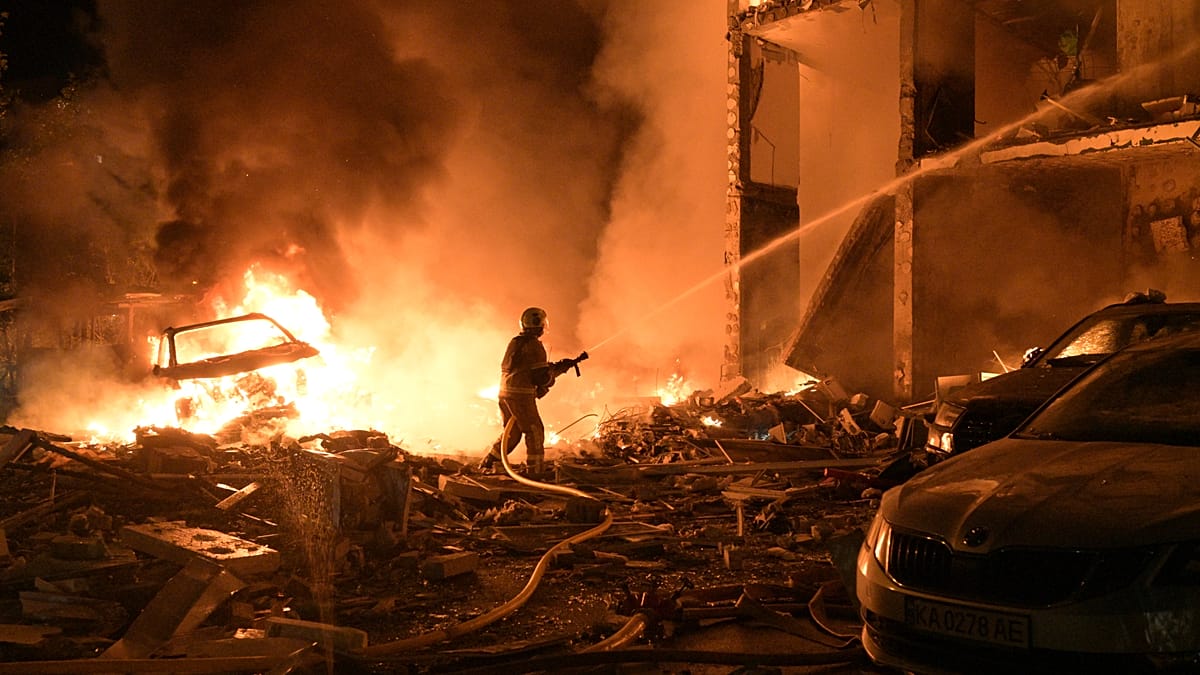
Luxury architecture is often discussed in terms of beauty, craftsmanship and comfort, but moments of war reveal a deeper truth: buildings are also vessels of safety, memory and everyday life. The latest Kyiv attack underscores how quickly homes, interiors and urban design can be shattered when missiles and drones strike residential districts in the dead of night.
According to authorities, waves of Russian ballistic and cruise missiles, alongside drones, hit Kyiv and surrounding areas overnight. At least eight people were killed, including seven in the capital and one in the Bucha district northwest of the city, while dozens were reported injured. Explosions were heard across the city, residents took shelter in metro stations, and emergency teams responded to collapsed structures and damaged multistory buildings.
Kyiv attack leaves residential architecture in ruins
The most chilling detail of the Kyiv attack is that the destruction centered on residential spaces. Officials said a building in the Podilskyi district partially collapsed, while several multistory buildings in the Darnytsia district were damaged, with fears that residents were trapped beneath rubble.
For architecture and design audiences, this is a stark reminder that homes are not abstract assets. They are layered environments shaped by:
- Structural engineering and spatial planning
- Interior design tailored to daily rituals
- Personal collections, furnishings and heirlooms
- Neighborhood identity and urban continuity
When a missile tears through a residential block, the loss is both human and architectural. Floor plans become exposed, facades collapse, and private interiors are suddenly turned inside out. Bedrooms, kitchens and living rooms cease to be intimate spaces and become part of a disaster scene.
The hidden cost to luxury interiors and domestic space
Although the language of “luxury interiors” often evokes premium materials and curated aesthetics, the core of elevated living is security, calm and permanence. The Kyiv attack demonstrates how fragile those ideals become in a conflict zone.
Even high-quality residential design cannot fully defend against sustained aerial assault. Custom millwork, natural stone finishes, art collections, statement lighting and bespoke furnishings may define a refined home, but all of it depends on the integrity of the structure itself. Once the building envelope is breached, interiors are exposed to fire, blast pressure, shattered glass, smoke and water damage.
Why interiors are especially vulnerable in urban strikes
In dense cities, interior destruction often extends far beyond the point of impact. Shockwaves can compromise adjoining apartments and towers, damaging:
- Load-bearing walls and partition systems
- Windows, glazing and balcony doors
- Electrical, plumbing and HVAC systems
- Built-in cabinetry and high-value finishes
- Artwork, textiles and personal archives
That means the Kyiv attack is not only a headline about military escalation. It is also a case study in how modern urban living spaces can be erased in minutes.
Urban resilience and the role of protective design
As Kyiv faced another major bombardment, city officials urged residents to remain in shelters while air defenses operated overhead. Images and accounts of civilians sheltering in metro stations highlight an increasingly important design conversation: how cities adapt public and private space for survival.
In architecture, resilience is no longer just about sustainability or climate adaptation. In vulnerable regions, it also includes civil defense, redundancy and emergency functionality. The Kyiv attack raises urgent questions for planners, developers and designers about how residential projects can better integrate protective measures without abandoning livability.
Design principles increasingly relevant in conflict-exposed cities
- Reinforced cores and protected stairwells
- Basement or lower-level shelter integration
- Blast-resistant glazing systems
- Compartmentalized utilities for faster recovery
- Flexible communal refuge areas within larger buildings
While no design strategy can eliminate the devastation of war, thoughtful planning can reduce casualties and support quicker rehabilitation after an attack.
Why the Kyiv attack matters beyond the battlefield
The overnight assault was reportedly the second major strike on Kyiv and its surroundings in less than a week, reflecting a wider intensification of long-range attacks. Ukrainian President Volodymyr Zelenskyy renewed calls for additional air defense support, particularly more Patriot missiles, arguing that weak replenishment only encourages further aggression.
For readers focused on luxury architecture, luxury design and luxury interiors, the significance of the Kyiv attack extends beyond geopolitics. It confronts the industry with fundamental realities:
- Architecture is inseparable from human security
- Interior design depends on structural and civic stability
- Urban prestige means little without resilience
- Rebuilding requires both technical expertise and cultural sensitivity
Every damaged apartment block represents interrupted lives, but it also represents the destruction of crafted environments that took years to conceive, finance and complete. In cities with strong architectural identities, attacks do not only kill and injure people; they also wound the visual and emotional fabric of the place itself.
Reconstruction will demand more than repairs
When the immediate emergency passes, the long-term design challenge begins. Reconstruction after the Kyiv attack will not simply involve replacing broken windows or patching facades. It may require reevaluating building codes, retrofitting residential stock, improving shelter access and rethinking how contemporary urban housing can balance elegance with emergency readiness.
That process is particularly important in cities like Kyiv, where heritage, modern development and residential density coexist. Architects and interior designers will play a critical role in restoring not just buildings, but dignity, continuity and a sense of home.
For the design world, the clearest takeaway from the Kyiv attack is this: the true value of architecture lies not only in how a space looks, but in how it protects life, preserves memory and endures under pressure. In times of crisis, resilience becomes the ultimate luxury.