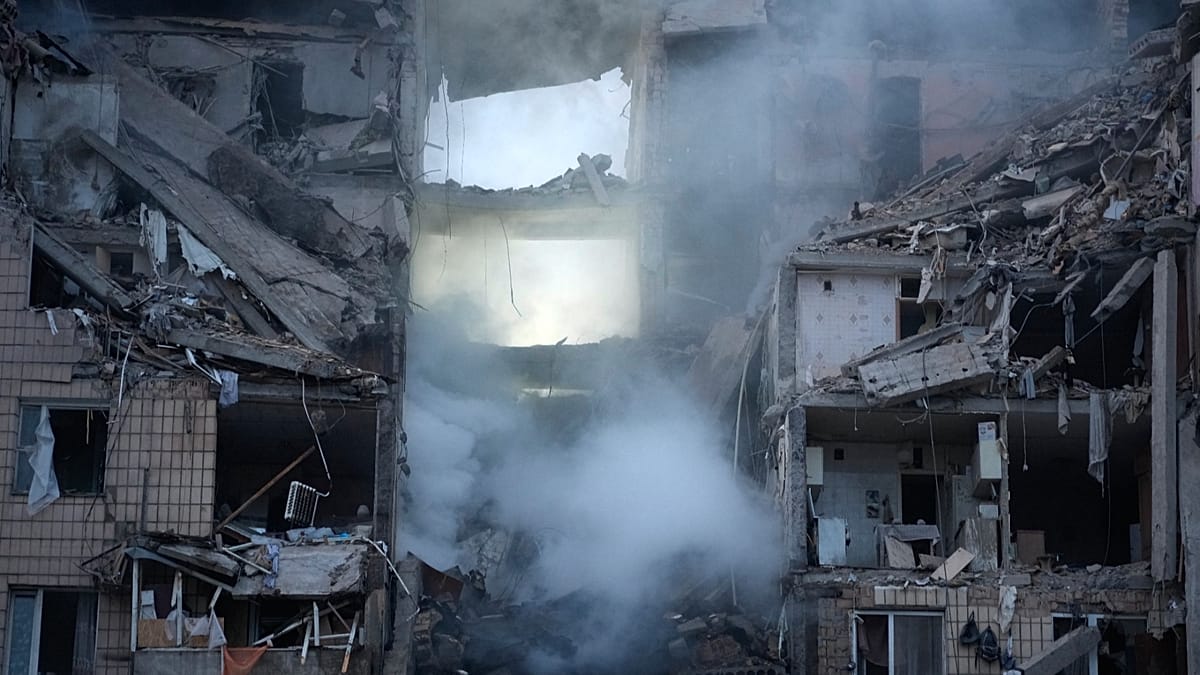
Ukraine’s air defence crisis has entered a stark new phase after officials confirmed that none of the ballistic missiles launched by Russia overnight were intercepted. The development has intensified pressure on allies ahead of the NATO summit, where the future of Patriot missile supplies is expected to become one of the most urgent security issues on the agenda.
According to Ukraine’s air force, Russia launched 29 ballistic missiles during the latest attack, and Ukraine lacked the interceptor capacity needed to stop them. The statement underlines a dangerous imbalance: while Ukraine still has air defence systems in place, its shortage of missiles is leaving major cities and civilian infrastructure increasingly vulnerable to high-speed strikes.
Ukraine’s Air Defence Crisis Deepens as Ballistic Missile Threat Grows
The current Ukraine air defence crisis is centered on one core problem: ballistic missiles require highly specialized interception capabilities, and the Patriot system remains Ukraine’s only proven option for this role. Ukrainian officials say the issue is no longer simply about the number of launch systems available, but the dwindling stock of PAC-2 and PAC-3 interceptors needed to make those batteries effective.
Air force spokesperson Colonel Yurii Ihnat made the situation clear, saying Ukraine does not currently have the means to counter this wave of Russian ballistic attacks at the required scale. His remarks suggest that Russia has recognized the gap and is now deliberately adapting its strike tactics to exploit it.
That matters because ballistic missiles are significantly harder to defend against than slower aerial threats. Their speed, flight path, and destructive power compress response time and raise the stakes for every interception attempt. In practical terms, the Ukraine air defence crisis is no longer theoretical; it is now visible in the outcomes of major overnight attacks.
Why Patriot Missiles Matter So Much
The Patriot system has become a central pillar of Ukraine’s protective shield against ballistic threats. Built in the United States and used by several allies around the world, it is one of the few systems capable of reliably engaging incoming ballistic missiles before impact.
What makes the current shortage especially alarming is that Patriot batteries without interceptor replenishment cannot provide sustained protection. Ukrainian leaders argue that a steady resupply pipeline is now just as important as additional hardware.
The key reasons Patriot interceptors are critical
- They are Ukraine’s main defence against ballistic missiles: other systems may help against drones or cruise missiles, but Patriots are the essential anti-ballistic layer.
- They protect densely populated areas: shortages increase risks to apartment blocks, energy sites, and transport infrastructure.
- They influence Russian tactics: when interceptor stocks are low, Moscow may feel encouraged to increase ballistic attacks.
- They require long-term production planning: interceptors cannot be replaced overnight, making supply continuity vital.
This is why the Ukraine air defence crisis is also a supply-chain story. Even advanced military technology loses value when ammunition stocks cannot keep up with battlefield reality.
Global Stockpiles Are Under Pressure
Another factor worsening the Ukraine air defence crisis is the wider international demand for Patriot interceptors. Recent military activity in the Middle East has placed heavy strain on available stockpiles. Reports indicate that a substantial share of global Patriot inventory has already been used in other regional conflicts, reducing the pool available for rapid transfer.
That global squeeze creates a difficult equation. Ukraine says Russia is producing roughly 120 ballistic missiles per month, while production of Patriot interceptors remains limited by manufacturing capacity. President Volodymyr Zelenskyy has pointed to annual output figures that translate into only a modest monthly flow compared with the pace of Russian missile production.
In strategic terms, this imbalance means Ukraine and its partners are confronting not only a battlefield challenge, but also an industrial one. The Ukraine air defence crisis reflects the growing importance of defence manufacturing resilience, alliance coordination, and inventory management across multiple theatres.
What NATO and Western Allies May Do Next
The upcoming NATO summit is likely to be a pivotal moment in the Ukraine air defence crisis. Kyiv is calling for stronger decisions from the United States and European partners, particularly on anti-ballistic protection and missile resupply. The message from Ukrainian officials is that support must move beyond symbolic commitments and toward practical, repeatable deliveries.
Possible areas of discussion could include:
- Accelerated interceptor transfers from allied stockpiles where feasible.
- Expanded production agreements with manufacturers to boost monthly output.
- Burden-sharing arrangements among NATO members to sustain supplies over time.
- Broader air defence integration to improve detection, tracking, and layered response capacity.
For Western governments, the stakes are clear. If Ukraine’s missile defence gap widens further, civilian casualties and infrastructure damage may rise, while Russia gains more freedom to shape escalation dynamics through mass ballistic strikes.
Why This Security Story Matters Beyond the Battlefield
Although this is foremost a military and humanitarian issue, it also has broader implications for political stability, public confidence, and the future of transatlantic security. The Ukraine air defence crisis highlights how modern warfare depends not just on weapons systems, but on reliable logistics, industrial output, and allied unity.
It also demonstrates a wider lesson for governments and strategic planners: deterrence is only credible when defensive systems can be sustained over time. In this case, the problem is not a lack of awareness, but the speed at which demand has overtaken supply.
As Russia intensifies attacks designed to exploit known vulnerabilities, Ukraine’s appeal to its partners is becoming more direct. The question now is whether allies can move quickly enough to close the interceptor gap before further large-scale strikes test the limits of existing defences.
Conclusion
The Ukraine air defence crisis has become one of the most urgent security challenges facing Europe and NATO in 2026. With Patriot interceptors in short supply and Russia increasing its use of ballistic missiles, the outcome of upcoming allied decisions could directly affect the safety of millions of civilians. The clearest takeaway is simple: without a sustained flow of anti-ballistic missiles, the Ukraine air defence crisis will continue to deepen, regardless of how many defence systems are already in place.