


Architecture News: Snøhetta’s Shanghai Grand Opera House Nears Completion Ahead of October Opening
Architecture news rarely delivers a project this ambitious at such a pivotal moment for a global city. Snøhetta’s Shanghai Grand Opera House is now in its final construction phase, setting the stage for an October 17, 2026 opening that promises to redefine Shanghai’s luxury cultural landscape and elevate the city’s standing as an international design destination.
Positioned on the Huangpu River in the Expo Houtan district, the vast new venue is more than an opera house. It is a civic landmark, a performance complex, a public rooftop destination, and a major statement in contemporary cultural architecture. With its spiraling form, riverfront setting, and carefully choreographed interiors, the project reflects how today’s most important arts buildings must serve both elite performance standards and everyday urban life.
Architecture News: A Landmark Cultural Project for Shanghai
This latest architecture news story centers on a project first conceived through an international competition won by Snøhetta in 2016. In 2019, the firm was formally commissioned alongside East China Architectural Design & Research Institute (ECADI), Theatre Projects, and Nagata Acoustics to carry the development from concept to completion.
Originally expected to finish in 2025, the building is now preparing for its official debut in autumn 2026. The opening season is expected to launch with 82 performances across 47 productions, signaling the scale of the venue’s cultural ambition from day one.
The opera house also forms part of a broader urban and cultural strategy. Shanghai has long invested in strengthening its identity as a global capital of commerce, innovation, and design. This project supports that ambition by creating a major destination for Chinese opera, Western opera, classical music, and experimental performance under one roof.
A Riverfront Design Inspired by Movement
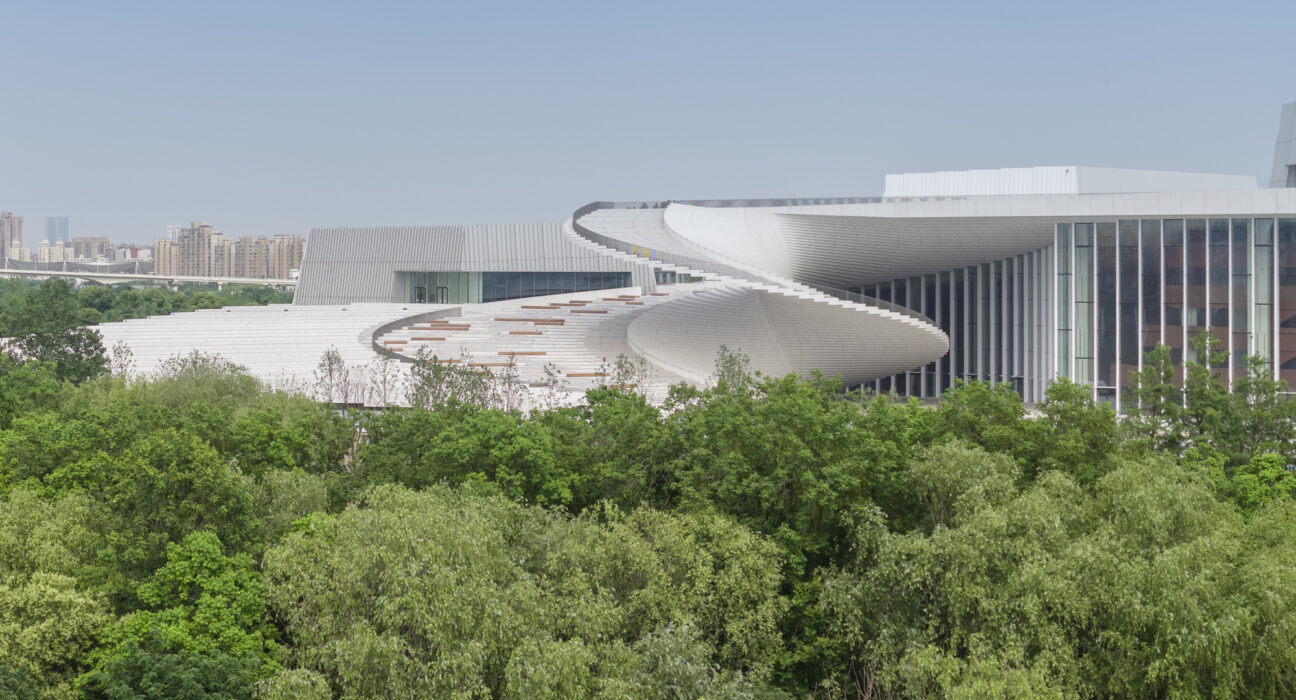
Among the most compelling aspects of this architecture news update is the building’s sculptural form. The 146,786-square-metre complex sits along a curved stretch of the Huangpu River, and its sweeping geometry is designed to echo movement itself. According to the architects, the shape draws from the fluid motions of dance and theatre while responding to the natural flow of the river.
Rather than presenting a static monument, Snøhetta has designed a building that feels kinetic and immersive. Its helical roof is the defining gesture, curling upward and outward to create a dynamic silhouette on the skyline. This roof does more than complete the architecture aesthetically; it transforms the building into an active public landscape.
Key architectural highlights
- A spiraling roofscape accessible to the public year-round
- Panoramic views toward the city and riverbanks
- A radial landscape plan that mirrors the building’s geometry
- Night lighting that turns stage towers into glowing lantern-like forms
In luxury architecture terms, this is a powerful example of experiential design. The building extends beyond performance halls to offer atmosphere, spectacle, and public engagement at an urban scale.
Inside the Shanghai Grand Opera House
This architecture news development is especially notable for the sophistication of the interior planning. The complex combines three advanced performance venues within one unified shell, allowing the opera house to support a wide variety of programming and audience experiences.
The three auditoriums
- Main auditorium: 2,000 seats, intended as the grand centerpiece of the complex
- Second stage: 1,200 seats, designed for more intimate productions
- Flexible stage: 1,000 seats, adaptable for experimental and contemporary performances
This mix gives the building unusual versatility. It can host large-scale opera and orchestral productions while also making room for innovative work aimed at younger and more diverse audiences. That adaptability is increasingly essential in modern performing arts architecture, where cultural institutions must balance prestige with accessibility.
Inside, the sweeping movement of the exterior continues through sculptural deep-red volumes that wind through circulation spaces. Expansive glass introduces natural light into the main hall, creating a softer and more contemporary atmosphere than traditional enclosed opera houses.
Material choices further reinforce the project’s luxury design credentials:
- Soft silk interior lining for visual and tactile warmth
- Oak gallery floors and hall interiors for acoustic performance
- Dark red wood staining that complements the dramatic interior palette
- A crisp white exterior that contrasts with the rich interior tones
The result is a layered interior environment that feels both theatrical and refined, blending technical precision with the sensibility of luxury decor and high-end cultural design.
A Public Roofscape That Redefines Civic Space
One reason this architecture news story matters beyond the design world is the opera house’s public mission. The rooftop stair and accessible roofscape are conceived as civic infrastructure as much as architectural spectacle. Residents and visitors will be able to move from the ground plane to an elevated public realm that functions as observation deck, gathering place, and informal stage.
This approach reflects a major shift in contemporary architecture: iconic buildings are no longer expected to be admired from afar only. They must also create shared social value. By making the roof open 24 hours a day, year-round, the project blurs the line between institution and city.
The surrounding district is planned to reinforce that openness with restaurants, galleries, museums, exhibitions, education centers, libraries, and small cinemas. Together, these elements position the opera house as the anchor of a larger cultural ecosystem rather than a standalone object.
Why This Architecture News Matters Globally
In the wider world of architecture news, Shanghai Grand Opera House stands out because it captures several defining trends at once:
- Mixed-use cultural programming: one destination serving multiple audiences and art forms
- Public-first landmark design: architecture that doubles as urban space
- Luxury materiality with high performance: acoustics, craftsmanship, and atmosphere working together
- City branding through architecture: cultural buildings as international identity markers
It also joins a growing roster of major cultural projects by globally recognized firms, alongside developments such as Frank Gehry’s Dar al Funoon Abu Dhabi and BIG’s National Juneteenth Museum. These projects demonstrate that major institutions increasingly use architecture not only to house art, but to express civic ambition and social relevance.
For readers interested in luxury home, luxury decor, and luxury design, the opera house offers inspiration beyond the public realm. Its use of contrast, flowing geometry, rich red tones, timber finishes, and tactile materials shows how drama and restraint can coexist beautifully within a single design language.
Conclusion
This architecture news update confirms that Snøhetta’s Shanghai Grand Opera House is poised to become one of 2026’s most significant cultural openings. With its riverfront setting, spiraling public roof, high-performance auditoriums, and richly crafted interiors, the project represents far more than a new venue. It is a bold statement about how architecture can unite luxury design, public access, and cultural prestige in one unforgettable form.
As the October opening approaches, Shanghai Grand Opera House is emerging as a defining example of contemporary cultural architecture done at the highest level—and one of the year’s most important pieces of architecture news.