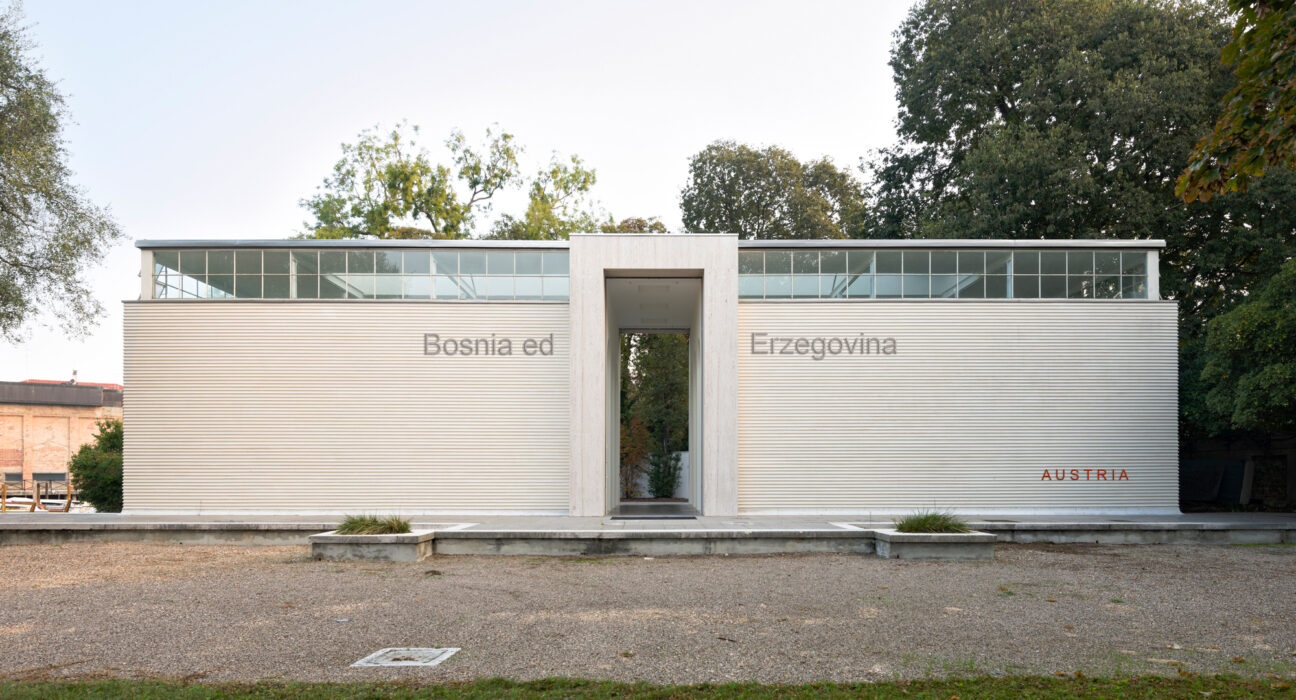
In standout architecture news from Europe, Austria’s proposal for the 2027 Venice Architecture Biennale is shifting the conversation far beyond exhibition design. Rather than presenting a conventional national showcase, the Austrian Pavilion will become a shared platform with Bosnia and Herzegovina, turning one of the Biennale’s most symbolically charged spaces into a live experiment in cooperation, memory, and cultural diplomacy.
The project, titled Koncesija / Konzession / Concession(e), was selected through Austria’s open competition process and will be curated by architects Adna Babahmetović and Ajna Babahmetović alongside curator Sebastian Höglinger. For readers following luxury architecture, luxury design, and global cultural movements, this is a powerful reminder that architecture’s highest value often lies not only in aesthetics, but in the social and political worlds buildings help shape.
Architecture News: Why Austria’s 2027 Pavilion Matters
This piece of architecture news is especially significant because it challenges the very premise of national pavilions at the Venice Biennale. Austria is proposing to temporarily grant its pavilion to Bosnia and Herzegovina through a cooperative concession, a curatorial move that addresses the absence of a Bosnian pavilion in the Giardini, where many of the Biennale’s historic national buildings are located.
Instead of reinforcing rigid national boundaries, the pavilion asks what representation can look like when it is shared, negotiated, and opened to others. That makes the project relevant not only to architecture professionals, but also to anyone interested in luxury home culture, high design, and the evolving relationship between place, identity, and prestige.
A Curatorial Framework Rather Than a Static Display
One of the most compelling aspects of the proposal is that it is not conceived as a fixed exhibition. It is described as an evolving curatorial framework, using the pavilion itself as a space for dialogue. In practical terms, that means the installation is designed to host:
- Public discussions and talks
- Film screenings
- Workshops and research activities
- Collaborative gatherings across institutions
This approach reflects a broader trend in contemporary architecture news, where exhibitions are increasingly becoming active platforms for participation rather than passive displays of drawings and models.
A Pavilion Built Around Sarajevo’s Hotel Holiday
At the heart of the exhibition is a reconstruction of the lobby of Sarajevo’s Hotel Holiday Inn, designed by Ivan Štraus for the 1984 Winter Olympics. Recreated inside Austria’s historic pavilion by Josef Hoffmann, the lobby will serve as the exhibition’s main social and intellectual gathering space.
This design decision is rich with meaning. Hotel Holiday is associated with international exchange, modernist ambition, and the traumatic memory of the Bosnian War. By bringing that interior reference into the Austrian Pavilion, the curators create a layered architectural conversation between Vienna and Sarajevo, between optimism and conflict, and between heritage and present-day realities.
For audiences drawn to luxury decor and luxury home decor, the gesture also highlights how interiors can carry political and cultural significance. A lobby is not just a beautifully designed room; it can be a stage for history, encounter, and collective memory.
The Symbolism of Reconstructing a Lobby
The choice of a lobby is especially telling because lobbies are transitional spaces. They are where people arrive, meet, wait, negotiate, and move on. In this context, the reconstructed lobby becomes a metaphor for coexistence and exchange, echoing the Biennale’s 2027 theme, Do Architecture — For the Possibility of Coexistence Facing a Real Reality, curated by Wang Shu and Lu Wenyu.
That symbolism makes this architecture news particularly resonant in today’s climate, where architecture is increasingly asked to respond to migration, postwar recovery, and cross-border collaboration.
Austria, Bosnia and Herzegovina, and a Shared Architectural History
The pavilion will also explore the historical, cultural, and economic ties between Austria and Bosnia and Herzegovina. These connections include migration patterns, diaspora communities, and postwar reconstruction, all of which have shaped architecture and urban life in both places.
Rather than treating architecture as an isolated design discipline, the curatorial team is positioning it within a wider network of social realities. That perspective is especially valuable for readers in luxury architecture and luxury design, where there is growing interest in homes and spaces that embody narrative, heritage, and authenticity rather than surface-level opulence alone.
Key Themes the Pavilion Will Explore
- National representation: Who gets visibility at international cultural events?
- Diplomacy through design: How can architecture support institutional cooperation?
- Spatial memory: How do buildings preserve and activate collective histories?
- Architectural exchange: What happens when one nation’s pavilion becomes a platform for another?
The Team Behind the Project
This architecture news also draws attention to a curatorial team with strong interdisciplinary credentials. Adna and Ajna Babahmetović, co-founders of the practice Adna i Ajna, are known for work that examines housing, migration, and spatial memory through both professional practice and academic research. Sebastian Höglinger contributes extensive experience in cultural programming, film, and exhibition-making.
That blend of architecture, research, and public programming suggests the Austrian Pavilion will operate as more than a design installation. It will likely function as a civic and cultural platform, expanding the role of the pavilion into something more open, discursive, and collaborative.
What This Means for the 2027 Venice Architecture Biennale
The 20th International Architecture Exhibition – La Biennale di Venezia will run from May 8 to November 21, 2027. In the context of the broader event, Austria’s proposal stands out as one of the more conceptually ambitious contributions announced so far.
It also includes a future-facing goal: supporting Bosnia and Herzegovina’s participation in the 2029 Venice Architecture Biennale through a Biennale Participation Request. That gives the project lasting relevance beyond a single exhibition cycle and positions it as a catalyst for institutional change.
For followers of architecture news, this is the kind of pavilion that can set the tone for larger debates at the Biennale. It asks whether architecture exhibitions should simply represent nations, or whether they can actively reimagine the structures of representation themselves.
Conclusion
This major piece of architecture news shows Austria using the 2027 Venice Architecture Biennale not just to present architecture, but to test a new model of cultural exchange. By sharing its pavilion with Bosnia and Herzegovina, Austria is transforming a prestigious architectural venue into a platform for dialogue, memory, and coexistence.
The takeaway is clear: in an era when design is increasingly expected to address real social conditions, the most compelling architecture may be the kind that creates space for others. Austria’s 2027 pavilion proves that representation, like architecture itself, can be redesigned.