
Architecture news rarely captures the global imagination quite like the FIFA World Cup. As the 2026 tournament closes and attention shifts to 2030, the real story is not only about football, but about how elite stadium design, urban infrastructure, and long-term civic planning are redefining the future of sports architecture.
The latest cycle of World Cup venues reveals a striking change in priorities. Instead of relying solely on monumental new construction, host nations are increasingly balancing prestige with practicality: upgrading existing arenas, improving transportation links, and shaping mixed-use districts that can thrive long after the final whistle. For readers interested in luxury architecture, luxury design, and the built environments that symbolize national ambition, these stadiums offer a compelling lens into how global events influence citymaking.
Architecture News and the Shift From Iconic Builds to Smart Adaptation
For decades, World Cup architecture was often defined by brand-new signature stadiums. Yet the 2026 edition, hosted across Canada, Mexico, and the United States, marked a clear pivot. Rather than constructing a whole portfolio of new landmarks, organizers leaned heavily on existing venues and adapted them to FIFA standards.
This matters because it reflects broader changes in contemporary architecture. Adaptive reuse, operational efficiency, and sustainable performance are now central to high-profile sports projects. Existing stadiums were retrofitted with:
- Natural grass playing surfaces
- Upgraded accessibility systems
- Improved hospitality and VIP areas
- Enhanced security and media infrastructure
- Better circulation for players, staff, and spectators
In practical terms, the 2026 World Cup became a case study in how architecture can evolve without starting from scratch. That approach also aligns with growing pressure on cities to justify the long-term value of mega-event spending.
The Standout Stadium Strategies of World Cup 2026
The most notable venues of 2026 demonstrate how design excellence can emerge through adaptation as much as through new construction. This is where architecture news intersects with performance, flexibility, and luxury-scale spectator experience.
SoFi Stadium: Entertainment Architecture at Full Scale
Designed by HKS, SoFi Stadium represents the new era of multipurpose sports venues. Its vast roof canopy, indoor-outdoor character, and integration into the wider Hollywood Park development make it much more than a stadium. It functions as a lifestyle and entertainment destination, illustrating how sports architecture increasingly overlaps with luxury urban development.
The project is also significant because it sits within a broader master-planned environment, where public space, retail, hospitality, and event programming reinforce the venue’s value year-round.
Mercedes-Benz Stadium: Flexibility as a Design Luxury
Atlanta’s Mercedes-Benz Stadium, designed by HOK, remains one of the most sophisticated examples of flexible stadium design. Its retractable roof and adaptable event programming support football matches, concerts, and civic gatherings, proving that modern venue design must be multifunctional to remain economically and culturally relevant.
In luxury design terms, flexibility itself has become a premium feature. The ability to host different kinds of experiences within a single architectural envelope is now part of what defines a world-class venue.
Estadio Azteca: Historic Legacy Meets Modernization
In Mexico City, Estadio Azteca entered another major renovation phase ahead of 2026, reinforcing its iconic place in football history. As the first stadium set to host matches in three separate FIFA World Cups, it stands as an example of how heritage architecture can remain competitive through targeted upgrades.
Its evolution reflects one of the most important themes in current architecture news: preserving cultural significance while enhancing operational standards for a global audience.
Looking Ahead: What World Cup 2030 Means for Global Stadium Design
If 2026 emphasized adaptation, 2030 expands the conversation into a far more distributed and complex architectural model. The tournament will span Europe, Africa, and South America, with major hosting responsibilities shared by Spain, Morocco, and Portugal, while Uruguay, Argentina, and Paraguay will stage opening commemorative matches.
This geographically dispersed format changes the design brief. Instead of a single national building program, the 2030 World Cup will assemble a network of historic stadiums, renovated venues, and ambitious new projects across multiple urban contexts. That makes architecture news around the event especially dynamic.
Morocco’s Hassan II Stadium: Monumentality With Cultural Reference
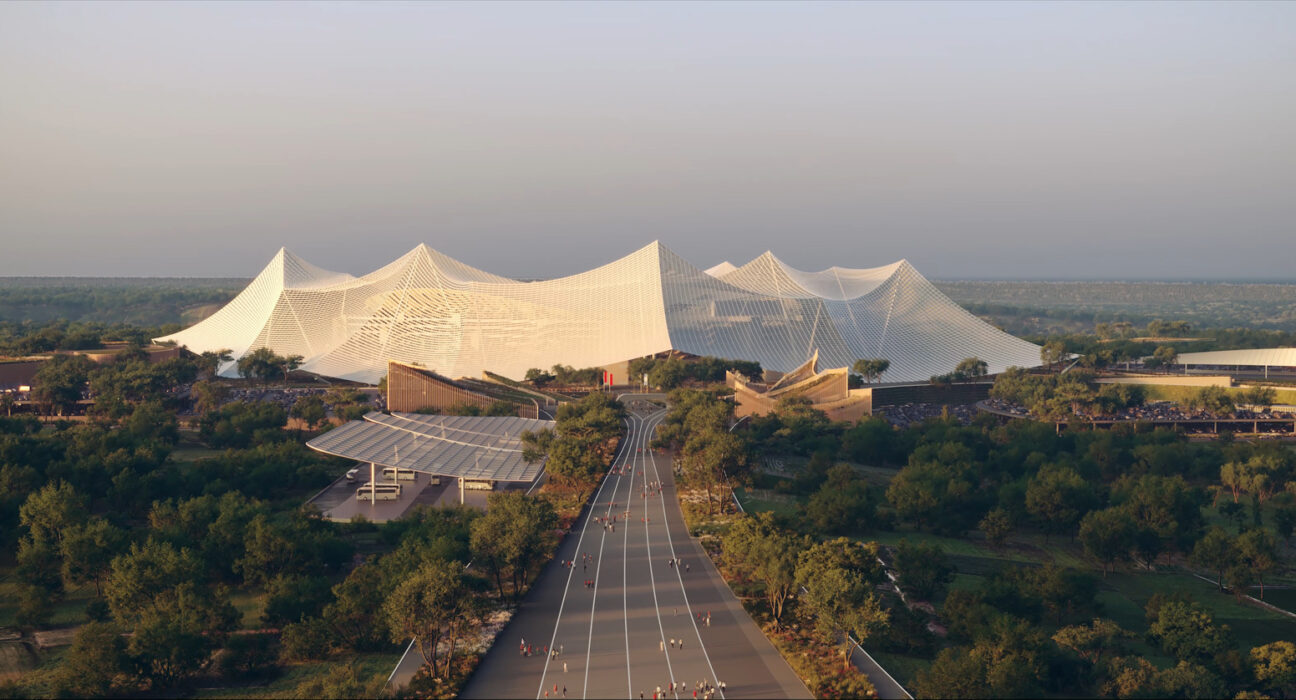
Among the most watched proposals is the Grand Stade Hassan II near Casablanca, designed by Oualalou + Choi with Populous. Planned for roughly 115,000 spectators, it would rank among the largest football stadiums in the world.
What elevates the project architecturally is its sweeping tensile roof, inspired by the traditional Moroccan moussem tent. This gesture ties monumental scale to local identity, creating a structure that is both internationally legible and regionally grounded. It is precisely the kind of project that dominates architecture news because it merges spectacle, symbolism, and infrastructure investment.
Elsewhere in Morocco, upgrades to Prince Moulay Abdellah Stadium, Adrar Stadium, Grand Stade de Marrakech, Fez Stadium, and Ibn Batouta Stadium are focused on capacity expansion, roof additions, facade renewal, and improved sightlines.
Spain and Portugal: Redevelopment Over Replacement
Spain’s preparations continue a trend toward extending the life of established venues. The transformation of Santiago Bernabeu and the ongoing work at Camp Nou show how flagship stadiums can be reinvented through advanced engineering, hospitality enhancements, and mixed-use integration. Other venues, including La Cartuja and Gran Canaria Stadium, are also being modernized.
Portugal is pursuing a similar strategy with Estadio da Luz and Estadio Jose Alvalade, where flexibility, spectator comfort, and urban regeneration are central goals. In both countries, stadium projects increasingly operate as catalysts for wider neighborhood improvement rather than isolated sporting monuments.
Why This Architecture News Matters Beyond Football
The most important lesson from the 2026 and 2030 World Cups is that sports architecture is no longer judged only by visual drama. Today, success depends on legacy, adaptability, and integration with the city.
Key trends shaping this evolution include:
- Adaptive reuse over excessive new build to reduce waste and improve long-term value
- Mixed-use planning that combines stadiums with retail, hospitality, landscape, and public amenities
- Cultural storytelling through forms and materials tied to local identity
- Infrastructure-led development connecting venues to transit and regional growth strategies
- Year-round programming that keeps stadiums active beyond tournament schedules
For luxury architecture and luxury home audiences, there is also a broader design lesson here: the best contemporary spaces, whether stadiums or private residences, are increasingly expected to be beautiful, flexible, experiential, and deeply connected to place.
Conclusion
The latest architecture news from the FIFA World Cup shows a discipline in transition. World Cup 2026 proved that existing stadiums can be intelligently reworked for global performance, while World Cup 2030 points toward a richer mix of redevelopment, cultural expression, and landmark ambition.
The takeaway is clear: the future of stadium design lies not just in building bigger, but in building smarter. From SoFi Stadium to the proposed Hassan II Stadium, the most influential projects are those that combine spectacle with legacy, luxury with utility, and global visibility with local meaning.