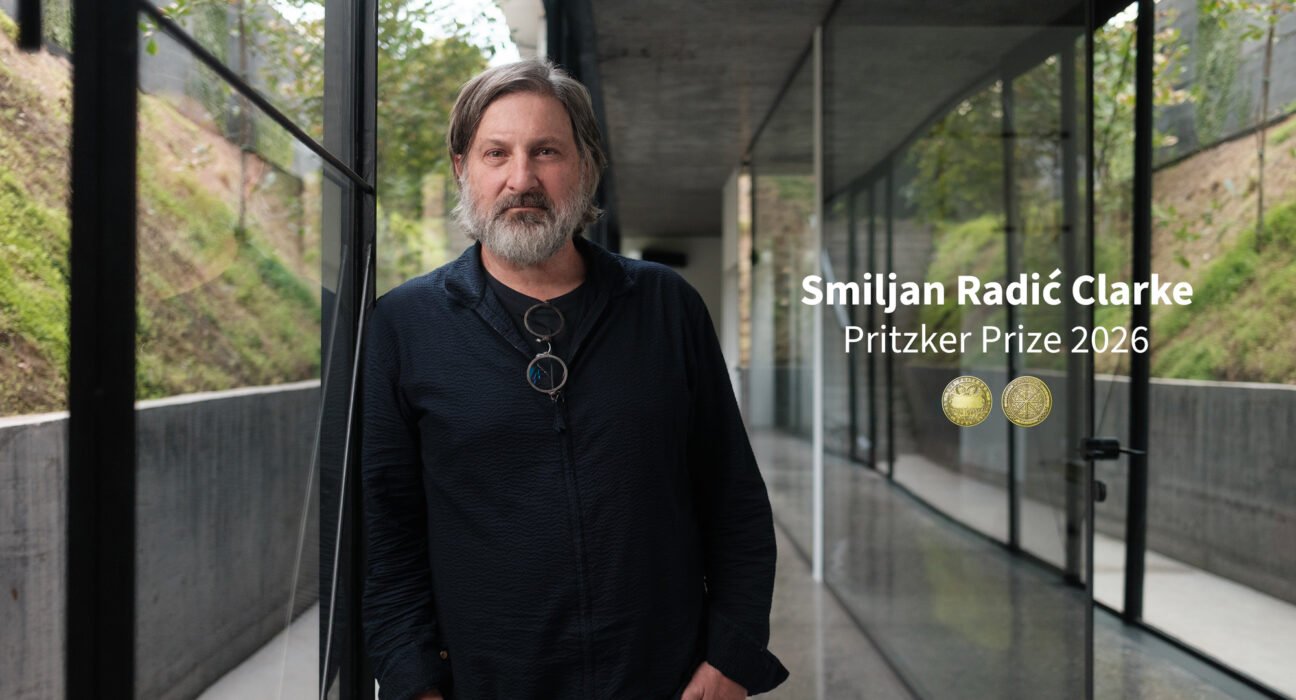
Architecture news rarely feels this poetic. The 2026 Pritzker Architecture Prize has been awarded to Chilean architect Smiljan Radić Clarke, honoring a body of work that has quietly reshaped contemporary architecture through atmosphere, material experimentation, and a deeply emotional relationship with landscape.
For readers of luxury architecture, luxury design, and elevated living environments, Radić’s recognition is especially significant. His projects prove that refinement does not depend on spectacle alone; it can emerge from restraint, tactile materials, and spaces that unfold slowly through light, silence, and movement. As the second Chilean architect to receive the profession’s highest distinction, Radić now stands among architecture’s most influential global voices.
Architecture News: Why Smiljan Radić’s Pritzker Win Matters
This major moment in architecture news celebrates more than an individual career. It signals a broader appreciation for architecture that privileges experience over image and emotional resonance over obvious formal gestures.
Based in Santiago, where he founded his studio in 1995, Smiljan Radić Clarke has built a practice known for:
- Careful responses to site and topography
- Unexpected combinations of raw and industrial materials
- Buildings that feel both monumental and fragile
- Spatial experiences driven by perception, light, and atmosphere
- A resistance to overly polished or formulaic architectural language
In an era often dominated by instantly shareable visuals, Radić’s work stands apart. His architecture asks people to slow down, look again, and inhabit space more consciously. That approach makes his Pritzker Prize a defining story in this year’s architecture news cycle.
An Architect of “Unspoken” Space
Radić is frequently described as creating an “unspoken architecture,” and the phrase captures his sensibility well. His buildings do not always explain themselves immediately. Instead, they reveal meaning gradually through bodily movement, changing weather, filtered daylight, and the tactile presence of materials.
This sensibility has roots in his own background. Born in Santiago in 1965, Radić grew up within a family shaped by migration, with Croatian and British heritage informing an identity built through cultural layering rather than a single fixed narrative. He studied architecture at the Pontificia Universidad Católica de Chile and later continued his intellectual development in Venice, an experience that helped sharpen his interest in memory, construction, and the poetic potential of built form.
His long-running dialogue with sculptor Marcela Correa also played an important role. That artistic exchange encouraged an architectural practice that blurs boundaries between sculpture, installation, and building design—an approach that continues to resonate across contemporary architecture news and criticism.
Projects That Define Radić’s Vision
House for the Poem of the Right Angle
One of Radić’s most celebrated residential works, this house in Vilches turns domestic life into a contemplative experience. Thick walls, carefully framed openings, and a forest setting create a home shaped by shadow, silence, and the passing of time. For luxury home readers, it offers a compelling lesson: true exclusivity often comes from atmosphere, not excess.
Serpentine Gallery Pavilion 2014
Radić’s London pavilion introduced many international audiences to his work. A translucent fiberglass shell appeared to hover above the landscape while resting on large stones, merging geological heaviness with visual lightness. The project became one of the most memorable temporary structures in recent architecture news, showing how ephemeral design can still feel timeless.
Teatro Regional del Bío-Bío
At this riverside cultural building in Concepción, a glowing polycarbonate skin transforms the theater into a lantern-like civic presence after dark. The project demonstrates Radić’s ability to create public architecture that is expressive without resorting to grandiose symbolism.
Restaurant Mestizo
Set within Santiago’s Bicentenario Park, this project uses massive stone supports and a hovering horizontal roof to create a luxurious yet grounded dining environment. It is a strong example of how luxury decor and luxury design can be embedded in architectural structure itself rather than added superficially.
Pite House and Vik Winery
From a coastal house embedded into rocky terrain to a winery stretched across a valley, Radić’s larger portfolio reveals a consistent commitment to integrating buildings with natural systems. These projects are particularly relevant in today’s architecture news landscape, where sustainability, site sensitivity, and place-driven design are increasingly central.
Material Intelligence and the Luxury of Restraint
What makes Radić so compelling for luxury-focused audiences is his understanding that material richness does not require decorative overload. His work often juxtaposes:
- Quarry stone with slender structural elements
- Polycarbonate and steel with atmospheric light effects
- Raw surfaces with finely calibrated spatial sequences
- Heavy mass with a sense of hovering delicacy
This creates a rare kind of luxury—one based on sensory depth, craftsmanship, and emotional memory. In high-end residential and hospitality design, that philosophy is increasingly influential. The most sophisticated spaces today are not merely expensive; they are immersive, site-specific, and capable of making occupants feel something lasting.
That is one reason this Pritzker announcement has traveled so widely across architecture news, luxury home, and design media alike.
What Radić’s Pritzker Means for Contemporary Design
Radić’s selection reflects several important shifts in global architecture:
- Experience matters more than spectacle. Buildings are being valued for how they feel, not just how they photograph.
- Landscape is no longer secondary. Site integration has become a core design principle.
- Material experimentation is central to innovation. Architects are finding new meaning in the tension between rawness and precision.
- Luxury is evolving. Quiet confidence, spatial calm, and authenticity increasingly define premium design.
For professionals and enthusiasts following architecture news, Radić’s win reinforces the idea that architecture’s future may be less about iconic signatures and more about nuanced encounters between people, materials, and place.
Conclusion
Among the year’s most important architecture news stories, Smiljan Radić Clarke’s 2026 Pritzker Prize stands out as a powerful recognition of architecture that whispers rather than shouts. His work shows that luxury architecture can be fragile yet memorable, minimal yet emotionally rich, and deeply contemporary without losing its connection to memory and landscape.
The clearest takeaway is this: the best design is not always the loudest. In today’s architecture news, Radić reminds us that the most enduring spaces are often the ones that leave room for silence, sensation, and wonder.