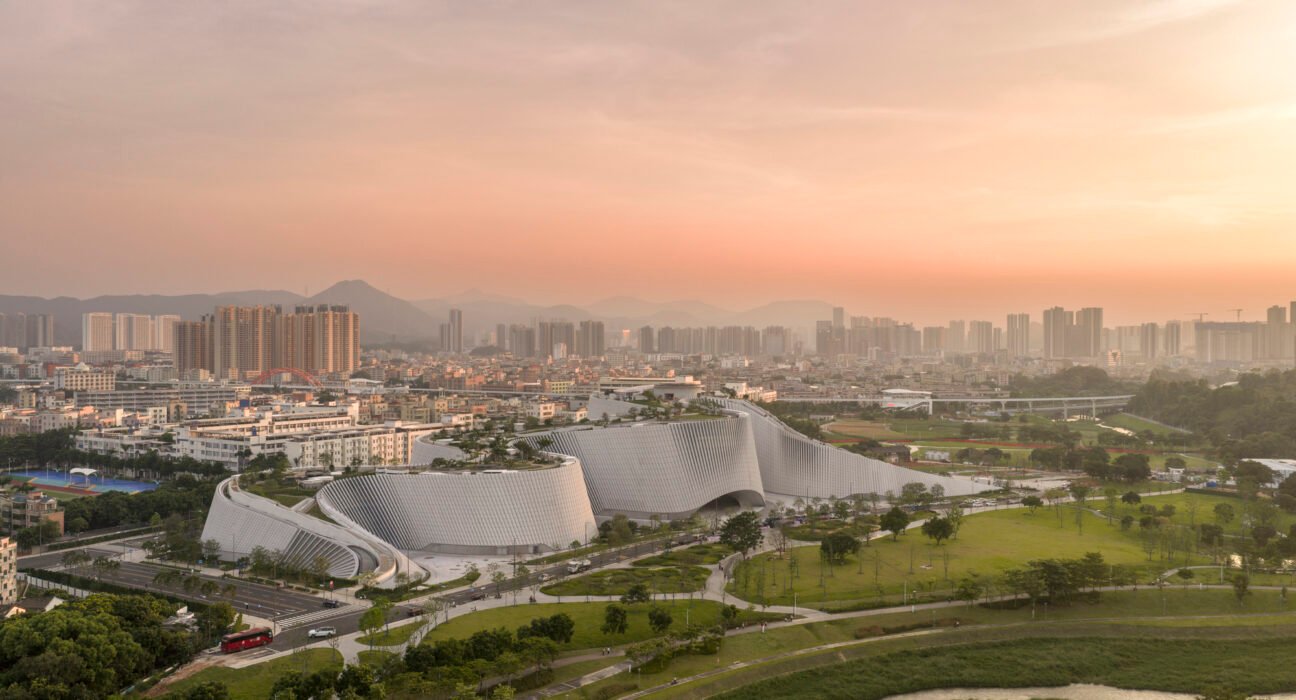
In major Architecture news, Shenzhen has unveiled a museum that feels less like a standalone building and more like a sculpted extension of the land itself. The newly opened Shenzhen Natural History Museum, designed by 3XN, B+H Architects, and Zhubo Design, is a powerful example of how civic architecture can merge luxury-scale ambition, environmental storytelling, and public experience in one sweeping destination.
Spanning more than 100,000 square meters, the museum is now the largest natural history museum in South China and one of the most significant newly completed museums of its kind worldwide. For readers tracking luxury architecture, luxury design, and the future of cultural spaces, this opening marks an important moment in global Architecture news.
Architecture News: A New Cultural Icon for Shenzhen
The Shenzhen Natural History Museum was conceived as part of the city’s growing cultural infrastructure, bringing together exhibitions, scientific research, education, and public gathering space under one roof. Rather than creating a monumental object disconnected from its surroundings, the design team developed a museum that flows into the site beside Yanzi Lake and responds directly to the river-delta landscape.
This approach is what makes the project so compelling in today’s Architecture news cycle. The museum is not only large in scale, but also generous in civic intent. Its roofscape, terraces, and sloping exterior surfaces are publicly accessible, transforming the building into an extension of the adjacent park. That fusion of architecture and landscape gives the institution a refined, almost resort-like quality that aligns with the sensibilities of luxury architecture without sacrificing public accessibility.
A consortium-led design vision
The project was delivered through a collaboration between international and local experts:
- 3XN led the architectural design
- B+H Architects served as lead consultant, executive architect, and landscape architect
- Zhubo Design provided local technical expertise and regulatory coordination
This cross-disciplinary model reflects a growing trend in Architecture news: high-profile cultural projects increasingly rely on integrated global partnerships to balance design ambition, technical performance, and local execution.
A Museum Shaped by Topography and Water
One of the most distinctive aspects of the Shenzhen Natural History Museum is its landscape-first concept. Instead of appearing as a sealed cultural box, the structure continues the topography of the site. The roof becomes a public terrain of plazas, ramps, and terraces, inviting visitors to experience the building from above as well as within.
The granite-clad exterior draws inspiration from regional geology and hydrology, grounding the architecture in the physical identity of South China. Openings cut into the envelope allow daylight to enter the interior while also revealing glimpses of the exhibition halls. The result is a carefully orchestrated dialogue between solid mass, natural light, and movement.
For those interested in luxury home decor and luxury design, there is also a lesson here: materiality matters. The museum’s restrained palette and sculptural form show how natural stone, curved geometry, and integrated light can create a sophisticated atmosphere without visual excess. It is a monumental building, but one that communicates elegance through clarity rather than ornament.
Five conical volumes define the interior
Inside, five conical volumes organize the museum’s primary galleries. These forms do more than create a dramatic silhouette; they structure circulation, frame courtyards, and establish varied viewing points throughout the complex. Visitors move through a sequence of interconnected spaces rather than isolated rooms, making the museum feel immersive and continuous.
That spatial strategy is central to why this project stands out in current Architecture news. The architecture is not simply a container for exhibits. It is an active part of the storytelling experience.
Exhibition Design That Turns Science Into Space
The museum’s permanent exhibition is arranged across eight thematic galleries tracing the story of Earth from the formation of the universe to contemporary ecological systems. Fossils, minerals, plants, and zoological displays are presented alongside multimedia installations and large-scale immersive environments.
Importantly, the exhibition content is framed through the lens of South China’s landscapes and biodiversity, giving the institution both global relevance and local specificity. Exhibition design was developed with Atelier Brückner and Museum Studio, ensuring that scenography and architecture work as one integrated experience.
Key highlights of the museum experience include:
- Eight thematic galleries spanning natural history and ecology
- Large-scale exhibition environments with multimedia components
- Curved circulation routes that support continuous discovery
- Visual connections between interior galleries and the surrounding landscape
- Public spaces that extend the visit beyond the exhibition program
In luxury design terms, this is experiential design at its best. Every transition, volume, and view has been calibrated to elevate how visitors move, learn, and connect with the setting.
Why This Opening Matters in Global Architecture News
The opening of the Shenzhen Natural History Museum arrives at a time when museums are evolving beyond static repositories into civic ecosystems. In the most influential Architecture news stories today, successful cultural buildings are expected to do several things at once: anchor neighborhoods, create year-round public use, support education, and deliver memorable architecture.
This project achieves that balance with unusual confidence. It preserves the conceptual ambition of the original competition-winning proposal while addressing the practical demands of a complex building at enormous scale. More importantly, it expands Shenzhen’s network of cultural institutions with a destination that functions equally as a learning environment and public landscape.
The opening also sits within a wider museum conversation worldwide. Other major developments include the forthcoming Guggenheim Abu Dhabi, the newly commissioned Museo Nacional del Ecuador in Quito, and the Crystal Bridges expansion in Arkansas. Together, these projects show that museum architecture remains one of the most dynamic sectors in global design.
The Luxury Takeaway
For audiences drawn to luxury architecture, luxury home, and luxury decor, the Shenzhen Natural History Museum offers inspiration far beyond the museum category. Its success lies in the disciplined combination of natural materials, flowing geometry, site integration, and experiential planning. These are the same principles increasingly shaping high-end residential and hospitality environments.
As a standout piece of Architecture news, the museum proves that true design luxury is not just about scale or spectacle. It is about creating spaces that feel deeply connected to place, beautifully resolved in material, and generous in how they serve people. Shenzhen’s new museum does exactly that, setting a new benchmark for cultural architecture in China and beyond.