Architecture news rarely delivers a proposal that feels equally civic, sculptural, and dreamlike, but MAD Architects’ Shenzhen Bay Culture Park does exactly that. Unveiled as a major new waterfront destination in Shenzhen, the masterplan blends cultural institutions, immersive landscape design, and elevated public space into a project that speaks directly to the future of luxury architecture and urban life.
Designed by Beijing-based MAD Architects under the leadership of Ma Yansong, the Shenzhen Bay Culture Park is planned as a 51,000-square-meter site with a total built area of 182,000 square meters. Set in Shenzhen’s Houhai district in Nanshan—often described as China’s Silicon Valley—the project positions itself between the fast energy of the city and the calm edge of the sea, creating a landmark that is as much about atmosphere as it is about function.
Architecture News: A New Cultural Icon for Shenzhen Bay
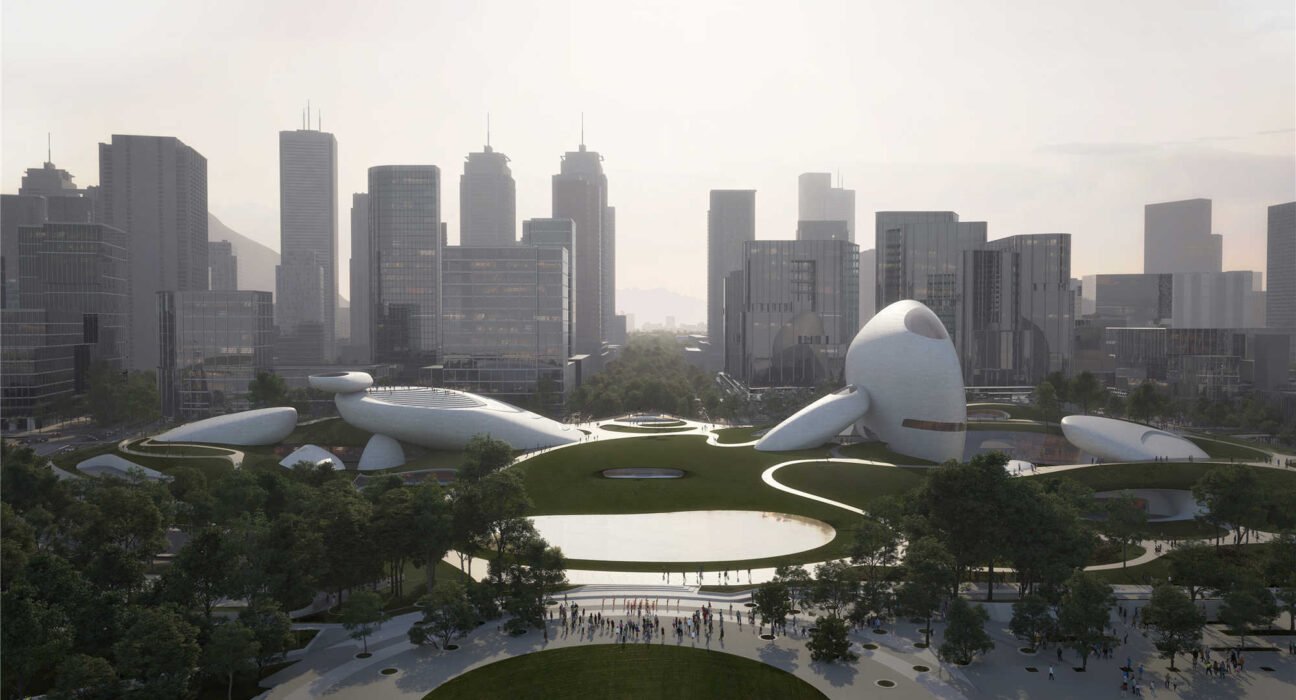
At its core, the Shenzhen Bay Culture Park is a large-scale cultural complex anchored by two major institutions: the Creative Design Hall and the Shenzhen Science and Technology Museum. Yet the scheme is far more than a collection of buildings. MAD’s masterplan treats the entire site as a continuous civic landscape, where architecture folds into topography and public space becomes the true luxury.
This approach is especially notable in today’s luxury design conversation, where value is increasingly defined not only by material richness, but also by experience, access to nature, and spatial freedom. The park’s waterfront setting allows the development to function as a destination for culture, leisure, and public gathering, while also strengthening Shenzhen’s identity as a global design city.
A masterplan shaped by city and sea
MAD describes the project as positioned between youthful urban intensity and the timelessness of nature. That contrast informs the overall composition:
- A sprawling green plaza that opens the site to the public
- Sunken cultural spaces integrated into the landscape
- Green sloping roofs that double as accessible pedestrian terrain
- Courtyards and recessed open-air spaces for year-round use
- A dramatic central water feature that functions as a seaside amphitheater
The result is a three-dimensional public park that remains active throughout the day and evening, a concept that aligns with broader trends in contemporary urban architecture and luxury home-adjacent lifestyle planning, where seamless indoor-outdoor living is increasingly influential.
Landscape as Luxury Architecture
One of the most compelling aspects of this architecture news story is how clearly the project reframes monumentality. Instead of relying solely on towers or iconic façades, MAD creates impact through terrain, movement, and atmosphere. The architecture appears to rise from the earth, allowing visitors to move from city streets to rooflines, courtyards, exhibition halls, and waterfront platforms in one fluid sequence.
For readers interested in luxury architecture and luxury design, this is a powerful example of how public projects are borrowing the emotional language of high-end residential environments. Concepts often associated with luxury homes—wellness, privacy within openness, reflective water, curated views, and sculpted landscapes—are translated here into a civic scale.
Key design features
The masterplan includes an impressive range of functions tucked within the earth-art landscape:
- Reception and arrival areas
- Standard exhibition halls
- Public education spaces
- A library
- An auditorium and theater
- A café and supporting commercial amenities
Rather than separating these uses into isolated boxes, the design weaves them into the park itself. This strategy enhances both usability and visual calm, offering a softer and more human interpretation of a large cultural campus.
A Waterfront Park Designed for Public Experience
In the best architecture news, the most memorable feature is often the one that changes how people use a city. Here, pedestrian pathways lead directly from the urban fabric into the green waterfront zone, extending Shenzhen’s movement network toward the bay. The site becomes not just a destination, but a connector.
The park also introduces multiple outdoor performance venues and public art areas, reinforcing its role as an open cultural platform. At the center, a mirrored pool serves as an open-air amphitheater with capacity for 10,000 people, creating an extraordinary venue for events against the backdrop of the sea and skyline.
That kind of civic generosity matters. In luxury urban development, exclusivity has long been associated with prestige. But increasingly, the most forward-thinking projects define luxury through meaningful public engagement, environmental integration, and memorable spatial experiences.
Two monumental pavilions
On opposite sides of the site, two pavilion-like volumes act as sculptural anchors for the project. These structures bring a more formal architectural presence to the landscape while maintaining MAD’s signature fluidity.
The south pavilion is especially striking. Visitors will be able to move through exhibition spaces and continue upward to a viewing platform overlooking Shenzhen Bay and the city skyline. This elevated sequence transforms the museum visit into an immersive journey, combining art, architecture, and panorama.
The gallery spaces are designed to support:
- Large-scale installations
- Video and multimedia works
- Live performances
- High-volume exhibition environments with soaring heights up to 30 meters
These proportions allow the architecture itself to become part of the cultural experience, something that sophisticated museum design increasingly prioritizes.
Why This Architecture News Matters for Luxury Design Trends
This architecture news item resonates beyond Shenzhen because it reflects several major trends shaping global design:
- Nature-integrated architecture: Buildings increasingly merge with landscape rather than dominate it.
- Experience-led planning: Emotional impact, movement, and atmosphere are now central to design value.
- Mixed civic programming: Culture, recreation, and education are being combined into all-day destinations.
- Waterfront regeneration: Prime coastal sites are becoming stages for iconic public architecture.
- Luxury through space: Expansive views, wellness-oriented outdoor access, and flexible gathering areas define modern prestige.
For those following luxury decor, luxury home decor, and high-end lifestyle environments, the park also offers inspiration in its visual language: reflective surfaces, sculpted green forms, minimalist spatial drama, and a balance between serenity and spectacle.
Final Takeaway
In a crowded cycle of architecture news, MAD Architects’ Shenzhen Bay Culture Park stands out for its ambition and clarity. Rather than designing a static landmark, the firm has envisioned a living cultural landscape—one that merges museum space, public park, performance venue, and waterfront escape into a single architectural experience.
For Shenzhen, it signals a stronger cultural identity. For the wider design world, it demonstrates how luxury architecture can be defined by openness, imagination, and a deep connection to nature. If this project fulfills its vision, it will be remembered not just as an icon on the bay, but as a model for the next generation of civic design.