
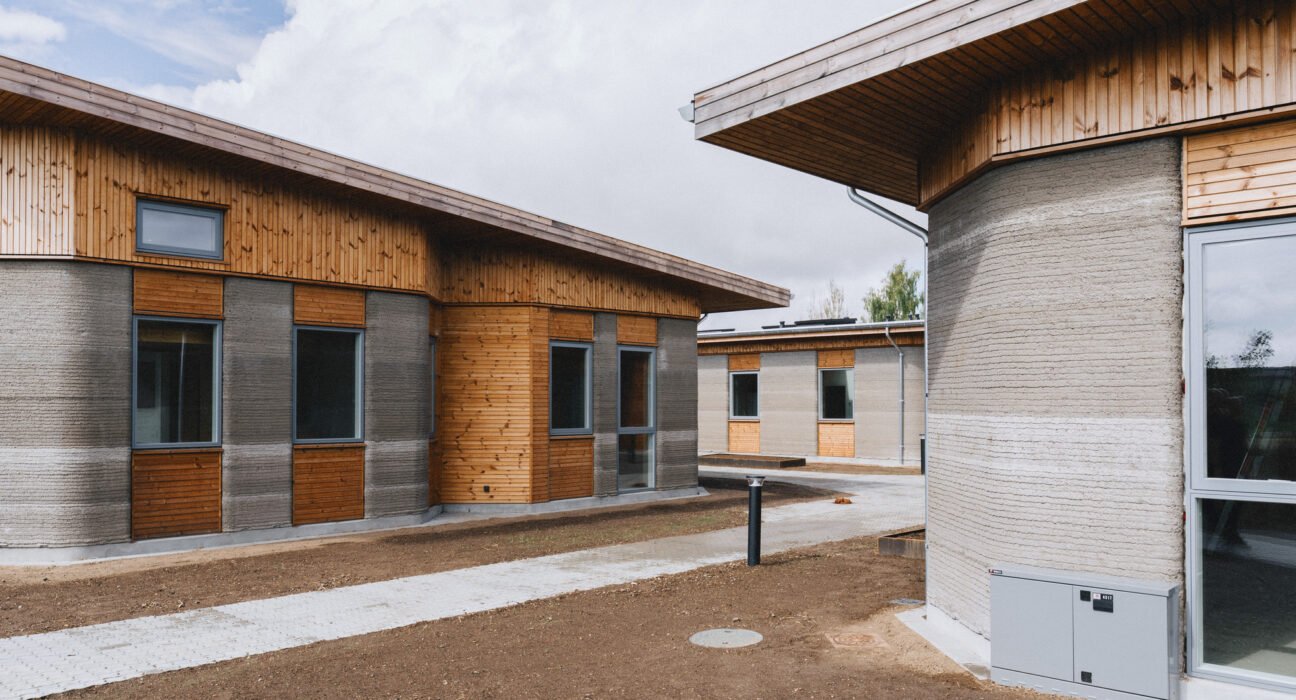
Architecture news rarely captures a shift in building technology and lifestyle design as clearly as Skovsporet in Holstebro, Denmark. Completed by 3DCP Group with SAGA Space Architects and MS+, this 36-unit 3D-printed student village shows how advanced construction can deliver homes that are efficient, landscape-sensitive, and unexpectedly refined.
Developed for NordVestBO near VIA University College, the project spans 1,650 square meters and was built over 12 months. More than a technical milestone, Skovsporet demonstrates how 3D concrete printing can move beyond one-off prototypes and into the realities of residential development, where timing, budget, regulation, and livability matter just as much as innovation. For readers interested in luxury architecture, luxury design, and elevated home environments, the project offers an intriguing look at how future housing can blend performance with spatial quality.
Architecture News: Why Skovsporet Matters
At first glance, a student housing project may not seem aligned with the world of luxury architecture. Yet Skovsporet makes a compelling case that thoughtful planning, material innovation, and strong landscape integration are the real hallmarks of premium design. Rather than building vertically or maximizing density at the expense of experience, the design team created a low-rise village organized into six clusters of ground-level apartments.
This arrangement creates a more intimate and residential atmosphere, with shared courtyards, landscaped gardens, pathways, and integrated bicycle parking. The result is a campus-adjacent community that feels human in scale and carefully composed, not simply mass-produced. In today’s architecture news, that is significant: innovation is no longer only about what is built, but how people live within it.
A 3D-Printed Residential Development at Real Scale
One reason this project stands out in architecture news is its scale. Skovsporet is not a pavilion, demonstration wall, or speculative prototype. It is a completed residential development designed to house students immediately. That distinction matters because it places 3D printing under the pressures of real construction conditions.
The project combines large-scale 3D concrete printing with conventional building methods. Printed structural elements were produced directly on site, then coordinated with standard building systems and components. This hybrid model reflects a practical future for the industry, where digital fabrication supports mainstream construction rather than replacing it outright.
What makes the project notable
- 36 completed student apartments across six clusters
- 1,650 square meters of total built area
- On-site printing for key concrete elements
- Completion within a 12-month construction timeline
- Delivery within Denmark’s subsidized housing regulations and financial framework
For architects, developers, and design-conscious homeowners watching the latest architecture news, this signals that 3D-printed housing is becoming more credible, scalable, and buildable.
Landscape-Led Planning Creates a More Luxurious Experience
Perhaps the most sophisticated aspect of Skovsporet is not the printer itself, but the way the village is positioned within the existing site. The building clusters were laid out between mature trees already on the property, and the design team reports that roughly 90 percent of the existing trees were preserved during construction.
That decision adds immediate character and environmental value. Instead of clearing the land and imposing a new visual order, the project works with the established landscape. This approach aligns with a growing direction in luxury home and luxury decor culture: spaces feel more exclusive when they are rooted in place, softened by nature, and connected to outdoor living.
The courtyards and gardens also elevate the daily experience for residents. Shared exterior space is not treated as leftover land, but as part of the architecture itself. In current architecture news, this type of outdoor-centered planning is increasingly associated with wellness, community, and long-term design value.
Lower-Carbon Materials and Smarter Construction
Sustainability is another reason Skovsporet deserves attention. The printed concrete includes FUTURECEM, a lower-carbon cement developed by Aalborg Portland. The development also incorporates cement-free 3D-printed elements created by 3DCP Group using MEVOcem, supported by the Innovation Fund Denmark.
Rather than relying on a single material formula, the project uses multiple concrete approaches to test how 3D-printed construction can evolve in a more environmentally responsible direction. This makes the development especially relevant in architecture news, where the conversation has shifted from whether new technology is possible to whether it can be practical and lower impact.
Key sustainability takeaways
- Lower-carbon concrete was used for on-site printed elements.
- Cement-free printed components were integrated into the broader development.
- Existing vegetation was largely retained, reducing site disruption.
- The low-rise layout supports a calmer, greener living environment.
For the luxury design sector, sustainability is no longer separate from quality. Material responsibility, site sensitivity, and enduring usability are increasingly seen as part of modern premium living.
What This Means for Luxury Architecture and Future Homes
Skovsporet may be student housing, but its lessons extend far beyond that category. The project suggests that the future of residential architecture may be defined by a blend of digital precision and lifestyle-driven planning. In other words, the most exciting homes may not be the ones with the most ornament, but the ones that use technology to create better spatial experiences.
There are several ideas luxury architects and developers can draw from this project:
- Customization at scale: 3D printing can potentially allow more design variation without the same labor intensity as traditional methods.
- Site-responsive layouts: Homes can be arranged around existing landscape features instead of erasing them.
- Material experimentation: New concrete systems may support both performance and reduced carbon impact.
- Hybrid construction: Printed elements can work alongside conventional systems for more realistic delivery.
As architecture news continues to spotlight innovation, projects like this reveal a broader shift in design thinking. Advanced construction is not just about futuristic aesthetics. It is about making housing more adaptive, efficient, and experientially rich.
Denmark Continues to Lead Design Conversations
This project also fits into a larger Danish design story. Denmark continues to gain international attention for urban livability, cultural investment, and architectural experimentation. From major museum expansions to adaptive heritage interventions and now 3D-printed residential development, the country remains a strong reference point for contemporary architecture.
That broader context strengthens Skovsporet’s relevance in architecture news. It is not an isolated experiment, but part of an ecosystem that values innovation, public benefit, and high design standards.
Conclusion
In a year full of ambitious architecture news, Skovsporet stands out for turning 3D printing into a livable, landscape-aware residential reality. The Danish student village proves that digitally fabricated housing can be practical, sustainable, and architecturally compelling at the same time.
The clear takeaway is this: the future of luxury architecture and residential design may be less about excess and more about intelligence—smarter materials, better site planning, and homes designed around real human experience. If Skovsporet is any indication, 3D-printed living is no longer a concept to watch from a distance. It is already taking shape on the ground.