Architecture news rarely arrives with this much cinematic drama. In Los Angeles, the long-anticipated Lucas Museum of Narrative Art has officially broken ground, bringing MAD Architects’ boldly futuristic vision one step closer to reality.
Conceived as a sculptural landmark at the edge of Exposition Park, the museum is more than a cultural building—it is intended to be a destination, a public landscape, and an architectural statement. Backed by George Lucas, the project blends art, storytelling, urban design, and ambitious form in a way that places it firmly within the conversation around luxury architecture and contemporary museum design.
Architecture News: A Landmark Museum Takes Shape in Los Angeles
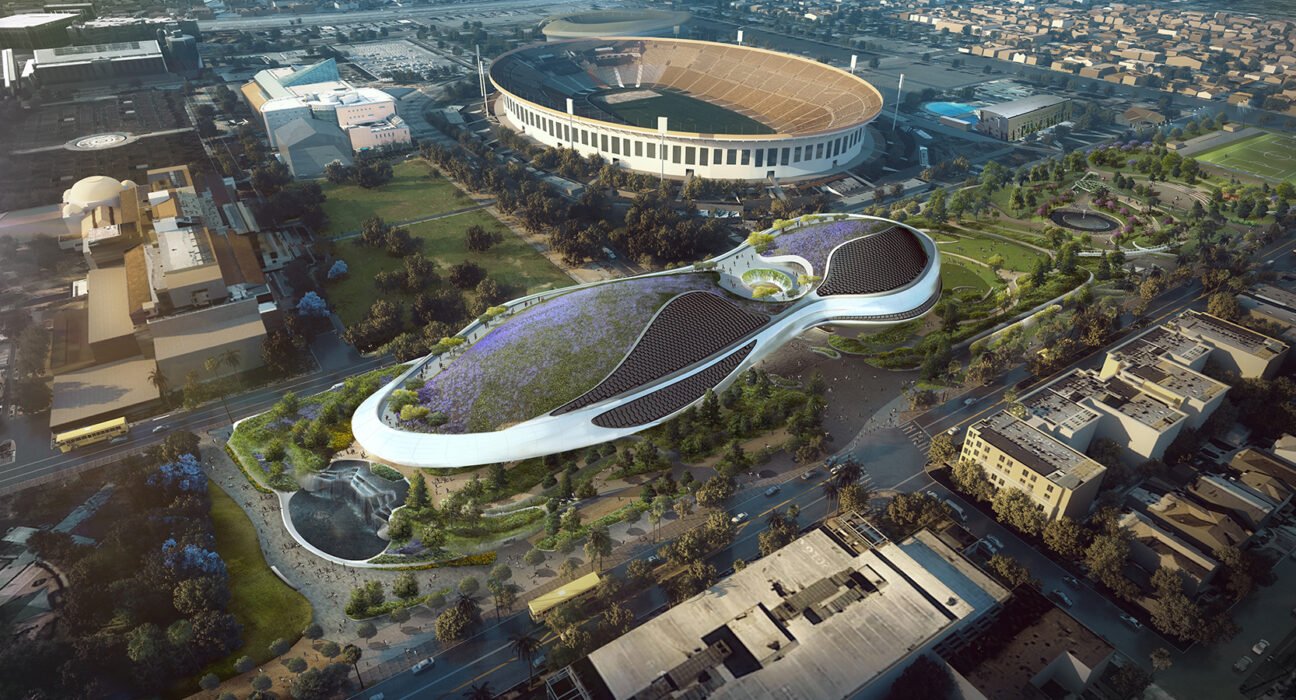
The Lucas Museum of Narrative Art is designed by Beijing-based MAD Architects, led by Ma Yansong. The project has been described as a structure resembling a futuristic spaceship settled into the natural landscape, a concept that aligns with MAD’s signature interest in fluid forms and emotionally expressive architecture.
Located at the gateway to Exposition Park, the museum is positioned to become a major architectural landmark in Los Angeles. Its smooth, organic exterior departs from conventional institutional design, favoring a highly sculpted silhouette that feels almost aerodynamic. In a city known for visual culture and creative experimentation, the building aims to stand out not just as a museum, but as a work of art in its own right.
This is precisely why the project has generated so much attention in architecture news circles: it represents the convergence of celebrity patronage, high-value collections, and a daring architectural identity.
A Futuristic Design Rooted in Nature
One of the most compelling aspects of the Lucas Museum is how it balances its futuristic image with a strong connection to landscape. Rather than creating a sealed-off monument, the design incorporates public outdoor areas and emphasizes access to nature within an urban setting.
Key design highlights include:
- An open, cave-like interior shaped to feel expansive and immersive
- Natural light from overhead skylights to soften the monumental spaces
- Public first-floor and rooftop zones intended for relaxation, recreation, and gathering
- An organic architectural language that visually merges building and environment
This mix of sculptural form and accessible public space reflects broader trends in luxury design, where iconic buildings are increasingly expected to serve both aesthetic and civic roles. The museum’s roof and ground-level spaces are not merely circulation zones—they are designed as destinations for visitors to engage with the city and its landscape.
What the Lucas Museum Will House
Beyond the striking architecture, the institution itself is poised to become a significant cultural asset. The museum is expected to house at least $400 million worth of art, including more than 10,000 objects spanning paintings, illustrations, and movie memorabilia.
The collection reflects George Lucas’s long-standing interest in narrative art—creative works that tell stories, shape public imagination, and reveal cultural values. This includes forms of visual expression that have often been overlooked by traditional art institutions.
According to Lucas’s public comments, the museum will champion what he once called “orphan arts,” celebrating popular and narrative-based works that resonate deeply with audiences even if they have not always been centered in fine art spaces. That mission gives the museum a distinctive identity in the broader museum design landscape.
A Long Road From Chicago to Los Angeles
This chapter in architecture news is especially notable because the Lucas Museum has had a complex development journey. MAD Architects was first selected for the project in 2014 and created multiple schemes in response to changing site conditions and city approvals.
The path included several major milestones:
- An initial proposal for Chicago in 2014
- Public controversy over placing a private museum on the city’s lakefront
- Alternative design proposals for Los Angeles and San Francisco in 2016
- Approval of the Los Angeles scheme in 2017
- Groundbreaking that confirmed the project’s move into construction
This evolution underscores how major cultural projects are shaped not only by design ambition, but also by politics, public space debates, and urban priorities. In the end, Los Angeles emerged as the right fit—both culturally and architecturally—for a museum dedicated to narrative art and visual storytelling.
Why This Project Matters in Luxury Architecture
The Lucas Museum belongs in conversations about luxury architecture not simply because of its budget, but because of its level of design ambition, public visibility, and curated experience. With a reported price tag of $1.5 billion, the project reflects the increasing overlap between landmark architecture, cultural investment, and lifestyle-driven urban development.
Its significance can be understood through several lenses:
- Architectural authorship: MAD Architects brings a globally recognized design perspective
- Cultural prestige: The museum will house an exceptionally valuable and distinctive collection
- Urban impact: Its location at Exposition Park strengthens a major cultural corridor
- Experiential design: The building is intended to be explored, not just observed
For readers interested in luxury home trends, luxury decor, and luxury design, the museum also reflects a broader aesthetic movement toward fluid lines, immersive environments, and emotionally driven spaces. Those same ideas increasingly appear in high-end residential interiors and custom homes, where architecture is expected to create atmosphere as much as function.
MAD Architects and the Power of Iconic Form
MAD Architects has built an international reputation for projects that challenge rigid architectural conventions. Rather than relying on purely rectilinear geometry, the studio often explores soft, landscape-inspired forms that feel dynamic and futuristic.
In the Lucas Museum, that philosophy is fully on display. The building’s flowing shell suggests movement and imagination, qualities that resonate strongly with the storytelling mission of the institution. It also helps explain why this project continues to attract attention in architecture news: it is visually unforgettable.
Ma Yansong has emphasized the importance of innovative buildings in open, inclusive cities. The Lucas Museum appears to embody that belief, aiming to contribute not just a new venue, but a defining symbol for Los Angeles.
Conclusion: A Defining Moment in Architecture News
The groundbreaking of the Lucas Museum of Narrative Art marks a major moment in architecture news, signaling the arrival of a museum designed to be as compelling as the collection it will contain. With its futuristic form, public-centered landscape, and strong narrative identity, the project has the potential to become one of Los Angeles’s most memorable cultural landmarks.
For anyone following luxury architecture, museum design, or the evolution of iconic urban spaces, the Lucas Museum is a project worth watching. Its greatest achievement may be that it transforms architecture itself into part of the story.