
Architecture news rarely captures the energy of live music, literature, landscape design, and temporary urbanism all at once. Yet BIG’s new Macondo Park in Madrid does exactly that, transforming Shakira’s residency into an immersive cultural destination that feels as ambitious as it is fleeting.
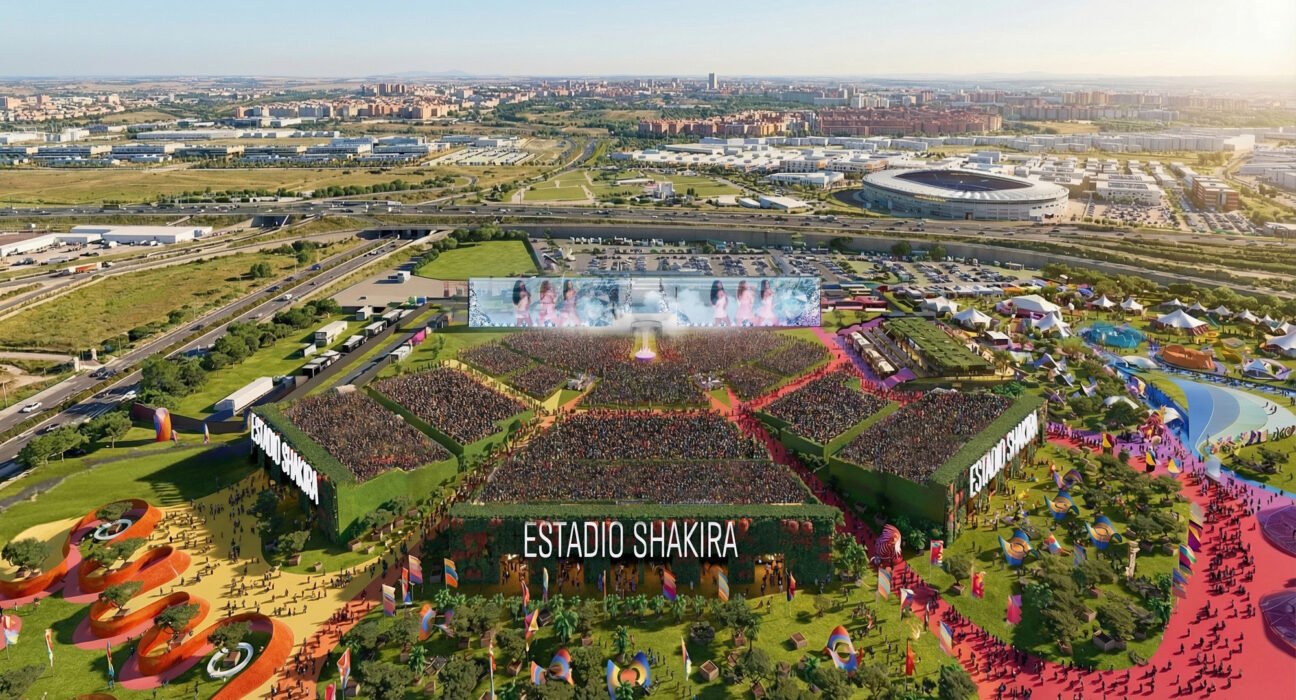
Opened at the Iberdrola Music venue in Villaverde, Madrid, Macondo Park is a 185,000-square-meter temporary environment designed by Bjarke Ingels Group (BIG) in collaboration with Komodo and Vampire. Created to surround the concert venue for Shakira’s 12-show Madrid residency, the project extends far beyond a performance backdrop. Instead, it operates as a richly programmed cultural landscape inspired by Macondo, the fictional town from Gabriel García Márquez’s One Hundred Years of Solitude, offering visitors a layered spatial experience that blends event architecture, public space, and narrative design.
Architecture News Spotlight: What Makes Macondo Park So Unique?
At its core, Macondo Park is a temporary cultural campus built to expand the concert experience into a full-day destination. Rather than treating the music venue as a standalone object, BIG and its collaborators developed a broader environment where guests can move through themed spaces dedicated to art, dance, gastronomy, literature, cinema, and fashion.
This approach reflects a growing shift in architecture news, where major event venues are increasingly expected to deliver not just capacity and spectacle, but also public engagement, placemaking, and memorable design identity.
The park is organized around:
- A central public plaza
- Twelve thematic pavilions
- Color-coded circulation routes
- Shaded gathering zones created by more than 500 trees
- Daily cultural programming running alongside the concerts
For luxury-minded audiences interested in luxury architecture and luxury design, the appeal lies in the project’s ability to create exclusivity through atmosphere rather than permanence. The temporary setting is still highly designed, immersive, and emotionally resonant—qualities increasingly valued across high-end residential and hospitality design.
A Temporary Landscape With Lasting Design Ideas
One of the most compelling aspects of this architecture news story is the way Macondo Park uses temporary architecture without sacrificing spatial quality. The structures were assembled in roughly 10 days using lightweight fabric systems, modular scaffolding, and reusable components typically associated with large-scale events.
That construction strategy allowed the team to create a flexible family of pavilions that share a common structural logic while still offering distinct identities through their layout, enclosure, and material expression. It is a smart example of modular design at an urban scale.
Why the project matters for contemporary design
Macondo Park demonstrates several ideas shaping current conversations in architecture and luxury environments:
- Experience-led design: Spaces are curated around emotional journey, not just function.
- Fast, adaptable construction: Modular systems allow high-impact builds within tight timelines.
- Narrative placemaking: Literary inspiration gives the project cultural depth and visual cohesion.
- Landscape as infrastructure: Trees and shaded routes are integral to comfort and movement.
- Design for disassembly: Temporary does not have to mean wasteful.
These principles are especially relevant to luxury home decor, luxury home, and luxury decor audiences, where curated atmosphere, adaptability, and storytelling increasingly guide design decisions. While Macondo Park is public and event-focused, its lessons can easily translate into premium residential gardens, entertainment zones, and outdoor living concepts.
Sustainability and Reuse in the Latest Architecture News
In a design era increasingly concerned with carbon impact and material waste, Macondo Park stands out for planning its afterlife from the very beginning. The project was conceived with dismantling and reuse in mind, ensuring that its temporary buildings and landscape elements will not simply be discarded once Shakira’s residency ends.
After the final concert, the structures will be disassembled and their components reused or repurposed elsewhere. Even the planting strategy reflects that same logic: the more than 500 tropical and Mediterranean trees distributed across the site are intended to return to local nurseries after the event.
This gives the project unusual relevance in architecture news, because it shows how temporary spectacle can align with circular design thinking. Instead of treating the event as a one-off installation, the team has approached it as a material system with multiple future lives.
Key sustainability takeaways
- Reusable structural components reduce unnecessary waste
- Modular assembly supports quicker installation and easier disassembly
- Trees are temporarily deployed rather than permanently consumed by the site
- The landscape strategy prioritizes shade, comfort, and ecological sensitivity
For readers tracking premium design trends, this is important. Sustainable thinking is no longer separate from luxury; it is increasingly central to what defines modern high-end architecture.
What Macondo Park Signals for BIG and Event Architecture
This project also reinforces BIG’s growing influence in shaping hybrid cultural venues. The firm continues to blur boundaries between architecture, entertainment, and public life, and Macondo Park is a striking case study in that evolution. It functions as venue extension, temporary city, branded experience, and cultural programming platform all at once.
In the wider architecture news landscape, the project arrives alongside other major BIG developments, including the EVE Music Hall in Croatia, the planned Tennessee Performing Arts Center in Nashville, and the newly opened Suzhou Museum of Contemporary Art in China. Together, these projects show how the studio is advancing a design language that is both iconic and operationally flexible.
Macondo Park may be temporary, but its influence could last much longer. It suggests a future where event architecture becomes greener, more immersive, and more culturally layered—qualities that are equally influential in luxury residential, hospitality, and lifestyle design.
Conclusion
As a piece of architecture news, Macondo Park is more than a celebrity-linked installation. It is a thoughtful experiment in temporary urbanism, modular construction, cultural storytelling, and reusable landscape design. By turning Shakira’s Madrid residency into a richly programmed environment, BIG has shown that short-lived architecture can still deliver depth, beauty, and lasting design insight.
The clearest takeaway is simple: the future of exceptional design may not always be permanent, but it should always be purposeful.