Architecture news rarely delivers a project this ambitious, civic, and visually striking all at once. As Snøhetta’s Shanghai Grand Opera House moves toward completion ahead of its anticipated 2026 opening, the project is emerging as one of the year’s defining cultural landmarks—an elegant fusion of luxury design, public space, and world-class performance architecture.
Set along the Huangpu River in Shanghai’s evolving Houtan district, the opera house is more than a venue for music and theater. It is a large-scale urban gesture that connects the city’s cultural ambitions with its riverfront redevelopment strategy. With a dramatic spiraling roof, multiple state-of-the-art performance halls, and a public realm designed for daily use, the building reflects how contemporary architecture can shape not only skylines, but civic life itself.
Architecture News: Why Shanghai Grand Opera House Matters
Among the most closely watched cultural projects in recent architecture news, the Shanghai Grand Opera House stands out for both its scale and its urban significance. Designed by Snøhetta after winning an international competition, the project has been developed in collaboration with East China Architectural Design & Research Institute, Theatre Projects, and Nagata Acoustics.
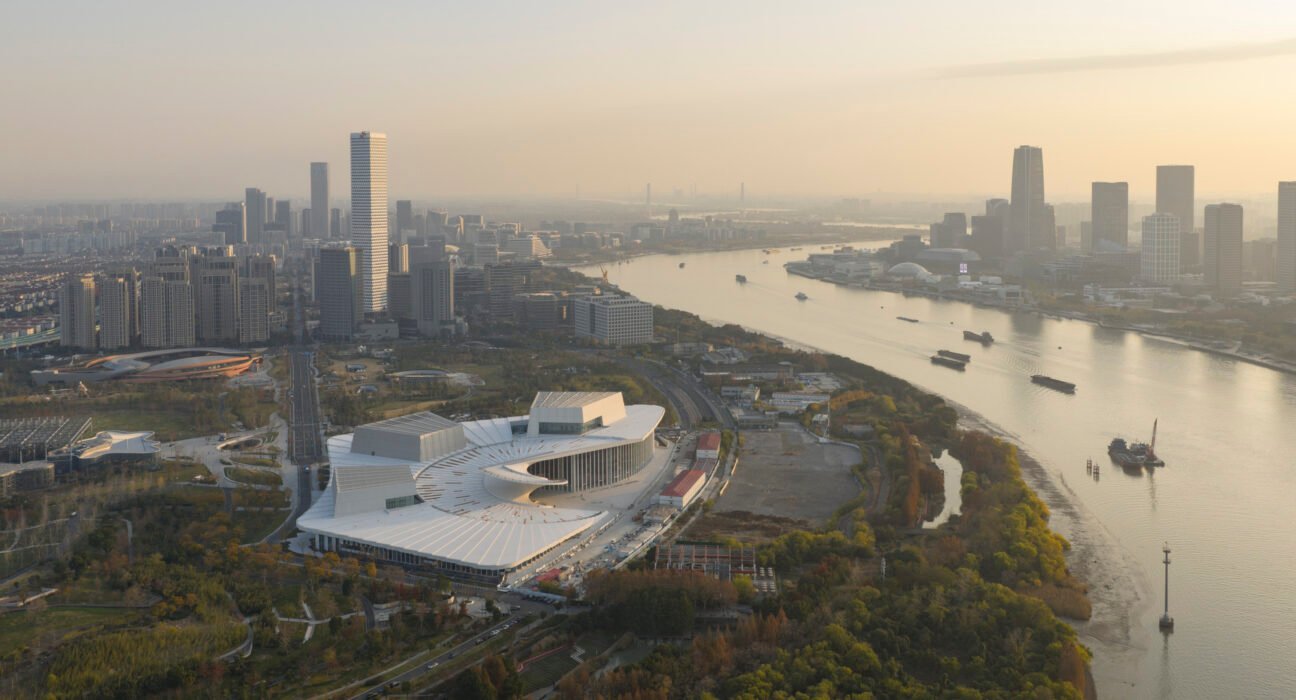
Its location is critical to understanding its impact. Positioned on the convex edge of the Huangpu River, the building anchors a broader master plan intended to strengthen Shanghai’s identity as a global center for culture, innovation, and forward-thinking urban development. The Houtan area, already transformed since the 2010 Expo, continues to evolve with a strong ecological and low-carbon agenda. In that context, the opera house acts as a civic centerpiece rather than a standalone icon.
The project also resonates strongly with readers interested in luxury architecture and luxury design because it pairs monumental form with refined user experience. Every major move—from the riverfront placement to the public roofscape—has been conceived as part of a larger lifestyle and cultural ecosystem.
A Helical Roof That Redefines Public Space
The defining visual feature in this chapter of architecture news is the opera house’s sweeping helical roof. Rather than serving as a conventional cap over enclosed spaces, the roof wraps around the site in a continuous movement, blurring the boundary between building and landscape.
This is where the design becomes especially compelling. The roof is not simply sculptural; it is fully accessible. A spiraling pathway carries visitors from ground level to an elevated observation deck, offering panoramic views of the Huangpu River and the Shanghai skyline. That move transforms the project into a public destination even for people who are not attending a performance.
Key features of the roof concept include:
- An elevated civic promenade open throughout the year
- A viewing platform overlooking river and skyline vistas
- A continuous architectural gesture that links landscape and structure
- Flexible outdoor space for informal gathering and programmed events
For followers of luxury home, luxury decor, and luxury home decor trends, this public roofscape also reflects a growing design principle seen across premium architecture: beautiful spaces must be experiential, not merely photogenic.
Inside the Performance Spaces
Another reason the project is dominating architecture news is the sophistication of its internal program. Beneath the sculptural roof, the building contains three major venues designed to support a broad range of cultural programming.
Main Auditorium
The principal hall will seat 2,000 guests and is intended for opera and large-format productions. Developed with Nagata Acoustics, the auditorium is expected to meet leading international acoustic standards, placing it among the most technically advanced performance environments in the region.
Secondary Hall
A 1,200-seat venue provides a more intimate setting for mid-scale performances. This hall expands the opera house’s programming potential, making it suitable for concerts and productions that benefit from a closer audience relationship.
Flexible Theater
The 1,000-seat flexible theater introduces adaptability into the complex. With reconfigurable staging and seating, it can host experimental works, interdisciplinary performances, and alternative formats that respond to evolving cultural tastes.
Together, these venues position the building to welcome:
- Traditional Chinese opera
- Symphonic performances
- Contemporary and experimental productions
- Cross-disciplinary cultural programming
That diversity is central to the building’s value. It is not simply a luxury cultural destination; it is infrastructure for a broader public audience.
Interior Design Balancing Warmth and Monumentality
In today’s architecture news, the most memorable projects are often those that pair dramatic exteriors with interiors that feel deeply considered. The Shanghai Grand Opera House appears to do exactly that.
Inside, the formal language of the exterior continues through curving circulation routes and sculptural public foyers. Expansive glazed facades bring daylight deep into the lobby spaces, allowing the atmosphere to shift throughout the day. This interplay of light, movement, and material elevates the visitor experience well beyond the functional requirements of a performance building.
The material palette is especially noteworthy. The crisp white outer envelope contrasts with warm interior finishes, including oak flooring and darker wood-lined auditoriums. This combination creates a refined sensory balance: serene and monumental from afar, intimate and acoustically tuned within.
Additional amenities reinforce the project’s role as an all-day destination, including:
- Restaurants and hospitality spaces
- Exhibition areas
- Educational facilities
- Smaller screening and gathering rooms
For audiences drawn to luxury design and luxury decor, these details matter. They suggest a building conceived not only for spectacle, but for comfort, atmosphere, and repeat visitation.
A Riverfront Landmark in Shanghai’s Cultural Future
This development in architecture news also points to a bigger trend: the return of major cultural buildings as engines of urban identity. The Shanghai Grand Opera House is not just one of the most anticipated architectural completions of 2026; it is a case study in how cities are using design to express openness, prestige, and long-term public ambition.
Its role within Shanghai’s riverfront transformation is especially important. By establishing visual corridors between the waterfront and the city, and by integrating architecture with accessible landscape, the project strengthens the connection between cultural infrastructure and everyday urban life.
That makes the opera house relevant across multiple luxury categories. It embodies luxury architecture through bold form, luxury home decor values through material richness, and luxury design through the seamless integration of experience, technology, and place.
Conclusion
As this latest architecture news confirms, Snøhetta’s Shanghai Grand Opera House is shaping up to be far more than a new performance venue. It is a landmark of civic ambition, a riverfront destination, and a sophisticated example of how architecture can unite culture, landscape, and public access in one unforgettable form.
With construction nearing completion and opening expected in the second half of 2026, the project already looks poised to become one of the year’s most influential additions to the global cultural scene. For anyone tracking the future of luxury architecture and major international architecture news, Shanghai’s grand new opera house is a development worth watching closely.