

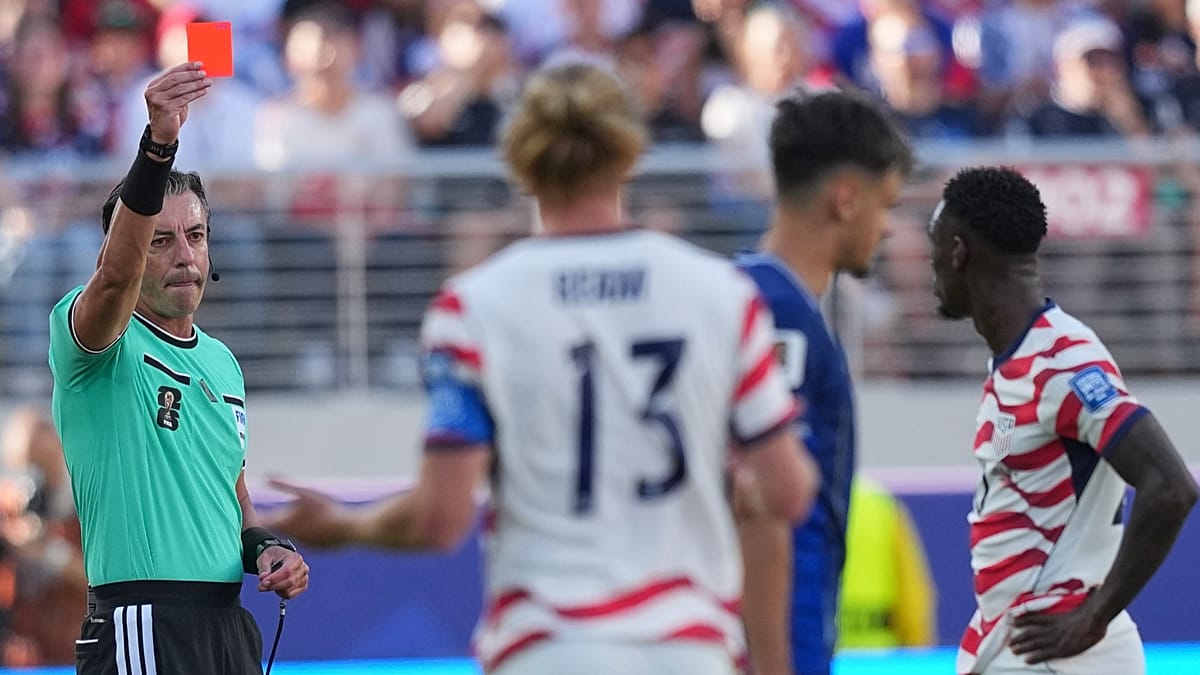
Few sports controversies reveal the power of image, influence and perception as sharply as this one. The FIFA Balogun suspension reversal has quickly become more than a football story: it is now a global case study in authority, symbolism and the fragile architecture of trust.
Originally set to miss the United States’ World Cup knockout match against Belgium after a straight red card, striker Folarin Balogun was suddenly cleared to play when FIFA suspended his one-match ban for a one-year probationary period. The move followed reports that US President Donald Trump personally called FIFA President Gianni Infantino to review the case, triggering immediate backlash from Belgian officials and reigniting debate over fairness, governance and the design of elite institutions.
Why the FIFA Balogun Suspension Reversal Matters Beyond Sport
At first glance, the FIFA Balogun suspension reversal appears to belong squarely in football’s disciplinary arena. Yet for readers interested in luxury architecture, luxury design and luxury interiors, the controversy offers a striking parallel to the worlds of high-end space-making and brand building.
Luxury environments depend on invisible systems as much as visible beauty. A penthouse, private gallery or five-star hospitality project succeeds not only because of exquisite finishes, but because the underlying framework feels coherent, fair and intentional. The same principle applies to sport’s governing institutions. Once the structure appears selectively flexible, confidence in the whole experience starts to weaken.
That is exactly why the FIFA Balogun suspension reversal has resonated so widely. It raises a broader cultural question: when rules can be reinterpreted at the highest level, what happens to public faith in the institution itself?
The Decision: How FIFA Changed Balogun’s Ban
Balogun had received a straight red card after video review for stepping on the foot of a Bosnian defender in the United States’ 2-0 round-of-32 win. Under standard FIFA procedure, that offense carries an automatic one-game suspension.
FIFA later announced that the sanction would be suspended under Article 27 of its disciplinary code, allowing the punishment to be held in abeyance for a probationary period of one year. In practical terms, Balogun became available for the Belgium match and would only serve the ban if he committed a similar offense within the next 12 months.
The FIFA Balogun suspension reversal was especially explosive because no detailed public rationale accompanied the shift beyond the reference to the disciplinary code. Reports that Trump personally lobbied Infantino only intensified scrutiny.
Key facts behind the controversy
- Balogun was initially banned after a straight red card.
- FIFA cited Article 27 to suspend the sanction for one year.
- Trump reportedly called Infantino to ask for a review.
- Belgian football authorities condemned the move.
- The decision came just before the high-stakes last-16 match.
Belgium’s Response and the Optics of Fair Play
Belgium reacted with open disbelief. Its football federation said it was astonished by what it viewed as a contradiction of FIFA’s own rules, while coach Rudi Garcia mocked the timing and questioned the integrity of the process. Goalkeeper Thibaut Courtois also noted that such a late decision affected Belgium’s preparation.
From a luxury design perspective, this is a reminder that timing and transparency shape perceived value. In premium residential design, clients expect not only flawless outcomes but also clear process. Sudden changes made behind closed doors can damage confidence, even if technically permissible.
The FIFA Balogun suspension reversal illustrates this perfectly. The issue is not merely whether a rule existed to allow the outcome. It is whether the process felt principled, consistent and equally accessible to all participants.
What This Means for Institutional Design
In architecture and interiors, the most admired spaces are those where every element serves both aesthetics and logic. Great institutional design works the same way. Rules must be robust enough to guide behavior, yet flexible enough to account for context. The challenge lies in applying that flexibility without making the system feel arbitrary.
The FIFA Balogun suspension reversal reveals the dangers of discretionary power when communication is weak. Even if precedent exists, as critics noted in previous high-profile cases involving elite players, selective leniency can make the institution appear designed for exceptions rather than principles.
Lessons that luxury sectors understand well
- Consistency creates trust: Premium brands protect credibility by applying standards evenly.
- Transparency elevates value: Clients and audiences accept difficult decisions more readily when reasoning is clear.
- Optics matter: Perception is part of the product, whether the subject is a flagship residence or a World Cup.
- Governance is design: Systems, not just surfaces, determine lasting prestige.
The Role of Star Power in Elite Systems
Balogun is a central figure in the United States’ World Cup campaign, with three goals and growing symbolic importance for the co-host nation. His absence would have been a major sporting blow. That reality makes the FIFA Balogun suspension reversal even more sensitive, because it sits at the intersection of merit, commercial pressure and political visibility.
Luxury culture knows this dynamic well. Star architects, celebrity designers and marquee names often shape decision-making in ways that smaller players cannot. While influence is not unusual in elite ecosystems, the real test is whether institutions can preserve legitimacy while handling high-value personalities.
In this case, FIFA’s move may have protected a headline player and heightened tournament drama, but it also amplified concerns that access and stature can reshape outcomes.
A Luxury Lens on Power, Prestige and Process
For audiences drawn to luxury architecture and interiors, the real relevance of the FIFA Balogun suspension reversal lies in its demonstration of how prestige structures operate. Whether in global sport, luxury real estate or design patronage, elite systems are judged not only by spectacle but by the integrity of the framework underneath.
Beautiful spaces fail when their planning is incoherent. Prestigious institutions falter when their governance appears opaque. In both worlds, the most enduring value comes from disciplined structure paired with thoughtful flexibility.
The FIFA Balogun suspension reversal is therefore more than a sporting footnote. It is a vivid reminder that influence may shape access, but trust is built through process.
Conclusion: The Real Cost of the FIFA Balogun Suspension Reversal
Ultimately, the FIFA Balogun suspension reversal may help the United States on the pitch, but it leaves FIFA facing a larger reputational question off it. When institutions change outcomes at the last minute, especially amid reports of political intervention, they test the very legitimacy that gives their decisions meaning.
For luxury-minded readers, the lesson is familiar and timeless: true prestige is never just about star power or surface impact. It depends on the credibility of the structure behind the experience. That is the lasting takeaway from the FIFA Balogun suspension reversal.