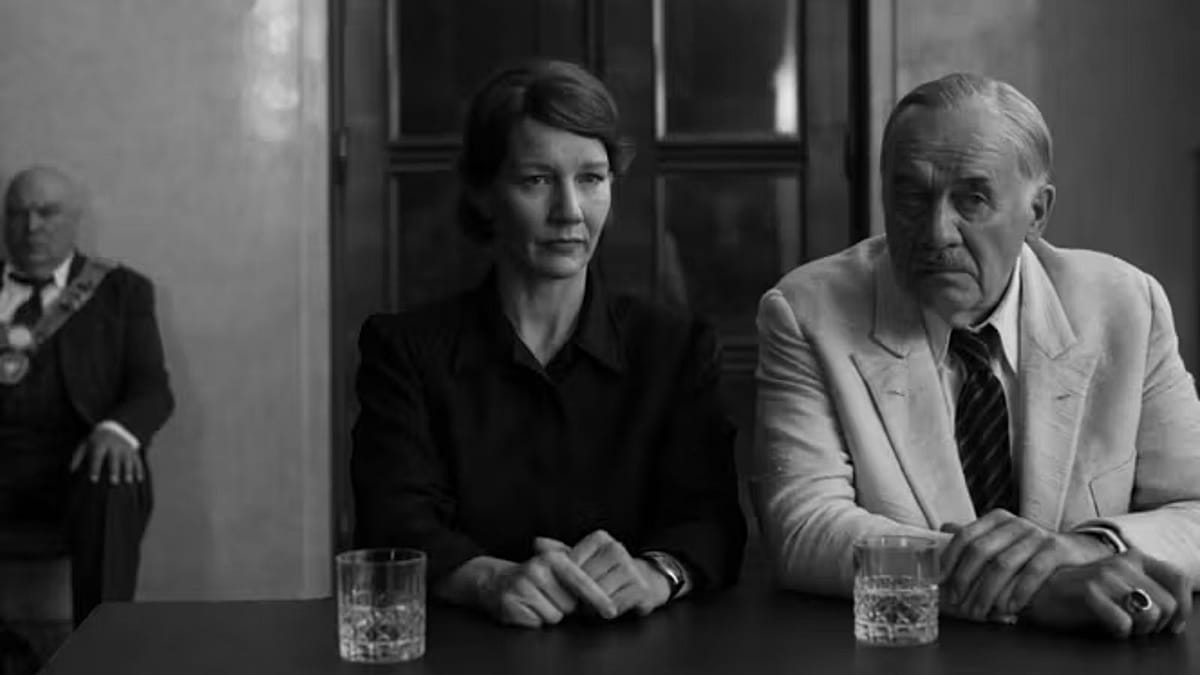
What can an 82-minute black-and-white film teach us about refined spaces? Quite a lot, as Fatherland design inspiration emerges from Paweł Pawlikowski’s Cannes-winning drama in ways that feel unexpectedly relevant to luxury architecture, luxury interiors and collectible design.
Set against postwar, divided Germany, Fatherland follows Thomas Mann and his daughter Erika on a road trip through a homeland transformed by ideology, loss and memory. While the film is foremost a historical drama, its visual language offers a striking lesson in how restraint, proportion, texture and atmosphere shape emotional experience. For designers, architects and aesthetes, this is not simply cinema to watch; it is cinema to study.
Fatherland Design Inspiration: Why This Film Matters Beyond Cinema
The power of Fatherland design inspiration lies in its ability to turn absence into beauty. Pawlikowski, working again with cinematographer Łukasz Żal, uses stark monochrome, still compositions and tightly controlled framing to evoke a world where every wall, road and ruin carries emotional weight.
That visual discipline connects naturally with today’s most sophisticated interiors. Across luxury design, there is renewed interest in spaces that feel quiet rather than crowded, layered rather than loud, and meaningful rather than merely expensive. Fatherland captures exactly that sensibility.
Key design ideas embedded in the film include:
- Intentional minimalism that never feels empty
- Architectural contrast between grandeur and decay
- Monochrome palettes enriched by light and shadow
- Emotional materiality where surfaces seem to hold memory
- Compressed spatial framing that creates intimacy and tension
In an era when luxury interiors often lean toward sculptural calm and museum-like curation, the film’s aesthetic feels remarkably current.
Black-and-White as a Luxury Interiors Masterclass
One of the clearest forms of Fatherland design inspiration comes from its black-and-white photography. Monochrome, when handled well, is never flat. Instead, it magnifies texture, silhouette and form. In the film, shadow does as much storytelling as dialogue.
That principle translates beautifully into luxury interiors. A restrained palette allows craftsmanship to take center stage, from veined stone and brushed metal to smoked oak, limewash plaster and hand-finished textiles. Rather than relying on color for drama, spaces can create depth through tonal gradation.
How to translate the look at home
- Choose a palette of charcoal, ivory, ash, taupe and soft black
- Layer tactile finishes such as bouclé, wool, travertine and patinated bronze
- Use directional lighting to create contrast and shadow play
- Limit visual clutter so each object has presence
- Emphasize strong architectural lines and negative space
This kind of visual editing is where Fatherland design inspiration aligns with high-end residential design: luxury is expressed through control, not excess.
Ruins, Memory and the New Language of Luxury Architecture
The film’s journey through scarred landscapes and damaged buildings also speaks to a deeper trend in luxury architecture: the embrace of memory. The most compelling contemporary homes and hospitality spaces are increasingly those that preserve traces of the past rather than erasing them.
In Fatherland, buildings are not passive backdrops. They are witnesses. Crumbling churches, austere institutions and war-marked urban spaces shape the emotional temperature of each scene. This relationship between architecture and memory offers rich Fatherland design inspiration for architects working with heritage structures, adaptive reuse and historically layered sites.
Architectural lessons from the film
- Let imperfections remain visible. Age can add dignity and emotional depth.
- Balance monumentality with intimacy. Large spaces feel richer when softened by human scale.
- Use emptiness strategically. Unfilled space can heighten atmosphere.
- Create narrative through sequence. Movement from room to room should reveal mood gradually.
This approach reframes luxury as cultural intelligence. A restored villa, a converted monastery or a minimalist penthouse can all benefit from design that acknowledges time, silence and provenance.
The Emotional Precision of Curated Interiors
Another aspect of Fatherland design inspiration is the film’s emotional restraint. Sandra Hüller’s performance as Erika Mann is measured, composed and deeply affecting. That same calibrated intensity is a useful benchmark for luxury interiors, where the strongest schemes often avoid overstatement.
Curated interiors do not need dozens of focal points. They need one or two unforgettable moments: a sculptural chair framed by a tall window, a vintage writing desk under a pool of light, a stone basin in an otherwise quiet bathroom. In the film, every composition feels deliberate. Designers can borrow that discipline by editing harder and choosing pieces with narrative presence.
Think of interiors influenced by Fatherland design inspiration as spaces that whisper rather than shout. They feel collected, intellectual and slightly melancholic—in the best possible way.
Why Designers Should Pay Attention to Cinematic Framing
Pawlikowski is known for meticulous framing, often using the Academy ratio and static compositions to make characters appear small within larger historical forces. For interior designers, this offers a fresh perspective on how people inhabit rooms.
Rooms should not only look beautiful in photographs; they should stage experience. Sightlines, ceiling height, window placement and furniture scale all affect how a person feels in a space. The best Fatherland design inspiration comes from understanding that mood is built through proportion.
Consider these cinematic takeaways:
- Frame statement pieces with architectural clarity
- Use vertical volume to create emotional emphasis
- Allow pauses between decorative elements
- Design around how light enters and recedes throughout the day
In luxury design, atmosphere is often the ultimate differentiator. This film shows how precision can make atmosphere unforgettable.
A Refined Aesthetic of Beauty and Decay
Perhaps the most resonant image in the film is its union of beauty and decay. That tension has become central to contemporary collectible design and elevated interiors, where raw stone, oxidized metal, antique wood and artisanal plaster are prized precisely because they feel lived-in rather than sterile.
Fatherland design inspiration reminds us that elegance does not require perfection. It requires honesty, composition and emotional coherence. A room with patina, a historic shell with modern insertions, or a quiet palette animated by natural light can feel more luxurious than a flawless but characterless interior.
For brands, hoteliers and homeowners operating at the top end of the market, this is a useful lesson: timelessness often comes from depth, not decoration.
Conclusion: What ‘Fatherland’ Teaches Us About Designing With Soul
More than a celebrated art-house release, Fatherland offers a compelling visual manifesto for luxury architecture and interiors. Its monochrome beauty, haunted spaces and disciplined compositions reveal why Fatherland design inspiration matters: it champions mood, memory and material honesty over spectacle.
The clearest takeaway is simple. The most enduring spaces, like the most powerful films, are the ones that make us feel something. For anyone shaping homes, hotels or collectible interiors, Fatherland design inspiration is a reminder that true luxury lives in restraint, atmosphere and soul.