

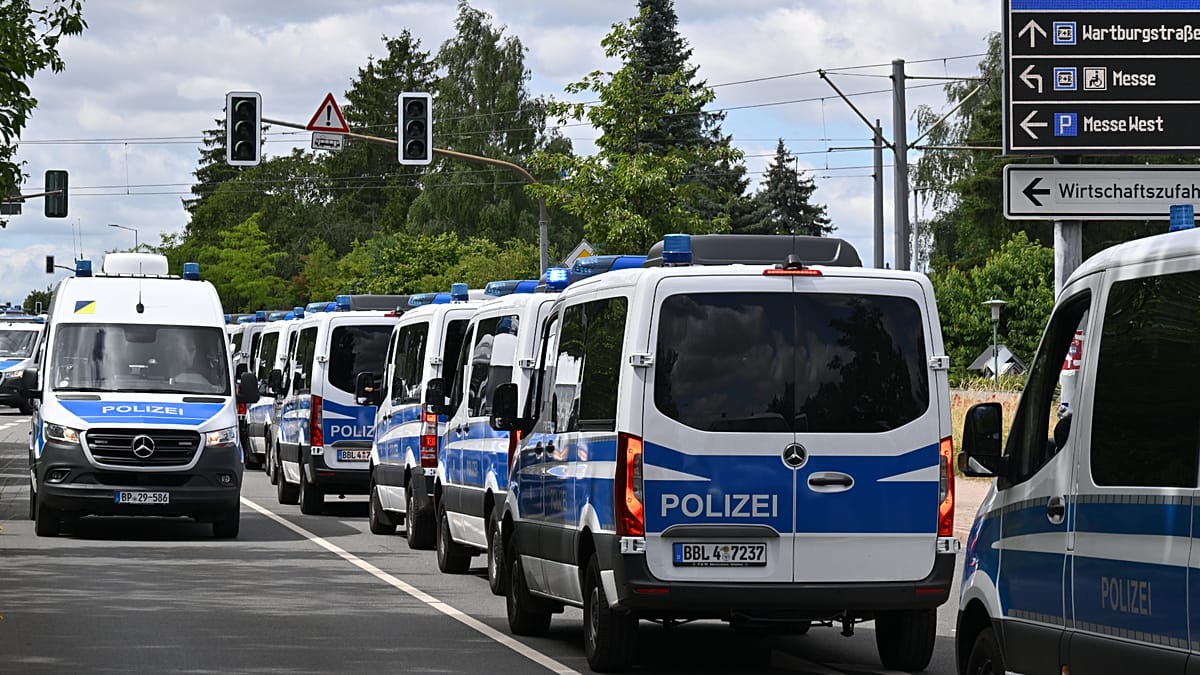
When tens of thousands of people fill a city’s streets, they do more than make a political statement—they reveal how urban space is designed, controlled, and experienced in real time. The recent AfD protest in Germany, which brought around 20,000 demonstrators to Erfurt, is also a powerful case study in how civic architecture, mobility systems, and public space design respond under pressure.
While the event was rooted in politics, its visual and spatial impact speaks directly to readers interested in luxury architecture, luxury design, and luxury interiors. From the way roads and tram lines were disrupted to how civic buildings and party venues became focal points, the AfD protest in Germany highlights a broader truth: great cities are defined not only by how they look, but by how they function during moments of tension, assembly, and change.
Why the AfD Protest in Germany Matters Beyond Politics
According to reports from Erfurt, anti-far-right demonstrators gathered in large numbers around the Alternative for Germany party’s annual conference. Police in Thüringen described the protest as legitimate, even as they reported isolated attacks involving paint bombs and fireworks directed at officers and an AfD constituency office. Despite the disruption, the conference proceeded as planned.
For design-minded observers, the AfD protest in Germany underscores how public spaces serve multiple roles at once:
- Transit corridors become zones of political visibility.
- Civic buildings transform into symbolic landmarks.
- Streets and squares shift from circulation routes to sites of collective expression.
- Security infrastructure temporarily reshapes the urban experience.
This intersection of politics and the built environment is especially relevant in European cities, where historic cores, dense transport networks, and ceremonial architecture often converge within a compact footprint.
Civic Architecture Under Pressure
How public buildings become symbols
In moments like the AfD protest in Germany, architecture becomes more than backdrop. Party offices, conference venues, police lines, and government-adjacent spaces all carry symbolic weight. Their materials, setbacks, entrances, and visibility influence how crowds gather and how authorities manage movement.
Buildings designed for administrative efficiency can suddenly be tested for:
- Crowd resilience
- Access control
- Perimeter security
- Emergency circulation
- Visual openness versus defensibility
These concerns are not only relevant to government structures. High-end mixed-use developments, cultural institutions, and landmark commercial properties increasingly adopt design strategies that balance elegance with resilience.
The urban choreography of protest
Erfurt’s blocked roads and tram lines show how quickly a city’s normal choreography can change. Protest movements expose where infrastructure is flexible and where it is fragile. Wide boulevards, station forecourts, tram intersections, and pedestrian plazas all take on new importance when thousands of people arrive at once.
The AfD protest in Germany illustrates that successful city planning depends on more than aesthetics. It also requires contingency thinking—how public realms perform during demonstrations, festivals, security incidents, or large-scale gatherings.
What Luxury Design Can Learn From Public Space Tensions
At first glance, political demonstrations may seem far removed from luxury interiors or premium real estate. Yet the lessons are surprisingly relevant. The best luxury design today is not simply about exclusivity; it is about adaptive, human-centered environments that feel calm, intuitive, and secure.
Urban events like the AfD protest in Germany reinforce several principles that also matter in high-end design:
- Flow matters. Whether in a city square or a penthouse, movement should feel natural and unobstructed.
- Layered access is essential. Privacy, openness, and security must coexist without visual heaviness.
- Material durability counts. Surfaces in prominent spaces need to withstand intensive use while retaining visual appeal.
- Emotional atmosphere shapes experience. Lighting, scale, and sightlines influence whether a place feels welcoming or confrontational.
In luxury architecture, these ideas often appear in subtle ways: recessed entrances, protected courtyards, acoustically softened lobbies, and multi-use common areas that can flex according to need.
Erfurt as a Lens on European Urban Identity
Historic cities and modern civic stress
Erfurt, like many German cities, combines historic character with functioning contemporary infrastructure. That blend makes it especially revealing. In heritage-rich urban environments, every large demonstration becomes a test of how old and new systems interact—cobbled streets, tram routes, civic facades, and modern policing strategies all operating simultaneously.
The AfD protest in Germany also arrives at a moment of rising support for the far-right party in national polling. With AfD leaders expected to be re-elected at the conference and regional elections ahead, the political stakes are high. But so too are the spatial stakes: city authorities must preserve democratic freedoms while maintaining accessibility, safety, and continuity in the urban core.
Designing for democracy
One of the clearest takeaways from the AfD protest in Germany is that democratic life depends on physical space. Public assembly requires streets, squares, transit links, and visible civic venues. If those spaces are poorly designed, social tension intensifies. If they are legible, well-connected, and resilient, they can better accommodate disagreement without collapse.
For architects, planners, and developers, that means prioritising:
- Generous pedestrian infrastructure
- Clear wayfinding
- Robust public transport integration
- Flexible event-ready plazas
- Security features integrated discreetly into the design language
The Future of Urban Luxury Is Resilience
Luxury is increasingly defined by intelligence rather than ornament alone. In architecture and interiors, that means spaces that are serene but prepared, beautiful but durable, open yet controlled. The AfD protest in Germany is a reminder that every built environment exists within a broader social landscape.
Developers of premium residential towers, boutique hotels, cultural venues, and civic-adjacent real estate can all learn from these public moments. A truly exceptional space does not ignore the complexity of city life—it anticipates it.
As European cities continue to navigate political division, migration debates, transit pressures, and public demonstrations, the design world has an opportunity to respond with smarter, more humane environments. The AfD protest in Germany may have been political in origin, but its deeper lesson is architectural: space matters most when society is under strain.
In the end, the clearest takeaway is this: resilient design is no longer a technical afterthought. It is central to how cities, buildings, and interiors express safety, dignity, and democratic life—and the AfD protest in Germany makes that impossible to ignore.