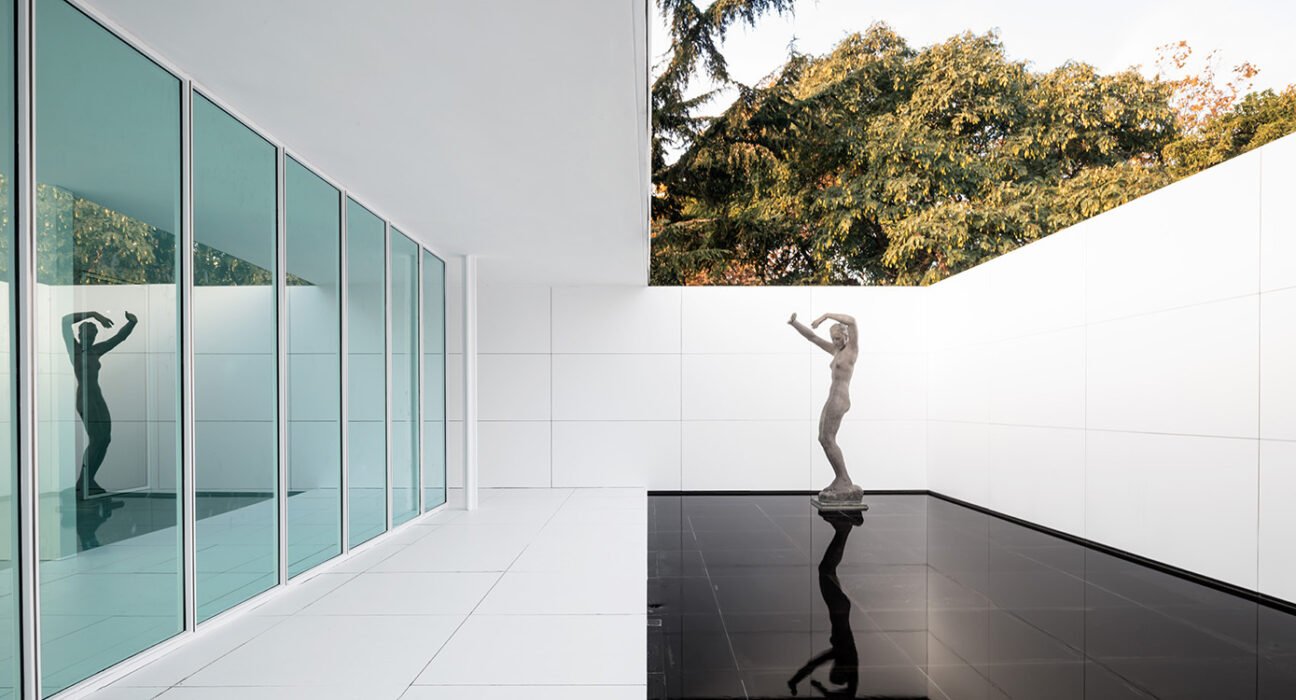
Architecture news rarely lingers as powerfully as the ongoing dialogue around the Barcelona Pavilion. Nearly a century after Ludwig Mies van der Rohe and Lilly Reich created the German Pavilion for the 1929 International Exposition, this modernist icon continues to inspire new interventions that challenge how we see materiality, space, memory, and luxury design today.
More than a historic landmark, the Barcelona Pavilion remains a living instrument of architectural expression. Its restrained geometry, lavish materials, and radical spatial fluidity make it especially relevant to audiences interested in luxury architecture, luxury home decor, and the evolution of high-end interiors. Recent artistic and architectural interventions have shown that the pavilion is not frozen in time; instead, it operates as a stage for contemporary reflection on what modern architecture still means.
Architecture News and the Enduring Power of the Barcelona Pavilion
The Barcelona Pavilion occupies a singular place in design history. Conceived as Germany’s national pavilion, it was intended for ceremony and representation rather than long-term occupation. Yet its influence far exceeded its original brief. Through its open plan, floating roof planes, polished stone surfaces, and seamless transitions between inside and outside, it reshaped the language of 20th-century architecture.
For today’s readers of architecture news, the pavilion matters not only because it is canonical, but because it continues to generate new questions:
- How do materials define experience?
- Can minimalism still feel sensuous and luxurious?
- What happens when artists alter or temporarily disrupt a masterpiece?
- How should contemporary architecture engage with its own history?
These questions resonate strongly across luxury residential design, where the balance between purity, texture, and atmosphere remains central.
Why the Pavilion Still Matters to Luxury Architecture
At first glance, the Barcelona Pavilion appears almost austere. But its power lies in its extraordinary refinement. Travertine, green marble, onyx, chrome, glass, and water are orchestrated with precision, proving that minimalism does not require visual coldness. In fact, this is one of the clearest precedents for today’s luxury architecture: a space where fewer elements create greater impact.
That lesson extends directly into contemporary luxury home and luxury decor. The pavilion demonstrates that elegance emerges from proportion, craft, and the emotional effect of materials. Rather than relying on ornament, it creates richness through reflection, tactility, and spatial sequencing.
Key design lessons for luxury interiors
- Material honesty: stone, glass, and metal are allowed to speak for themselves
- Spatial continuity: rooms flow visually instead of being rigidly enclosed
- Curated restraint: a limited palette can heighten sophistication
- Atmosphere over excess: luxury is expressed through calm, precision, and comfort
That is why the pavilion continues to appear in architecture news and design discussions far beyond academic circles.
10 Interventions That Invite Fresh Reflection
One reason the pavilion remains so culturally alive is that architects and artists repeatedly return to it, using temporary interventions to test new ideas. While each installation differs, together they reveal how a modern icon can be re-read across generations. In current architecture news, these interventions matter because they transform a familiar object into a critical platform.
1. Material disruption
Some projects alter or obscure familiar surfaces, forcing visitors to reconsider the role of marble, glass, and polished stone. By interrupting material expectations, they remind us that luxury is inseparable from sensory perception.
2. Spatial inversion
Other interventions challenge the pavilion’s famous openness by introducing barriers, fabrics, or new thresholds. These moves make visitors newly aware of movement, enclosure, and the choreography of arrival.
3. Absence as design strategy
Removing or minimizing recognizable elements can be as powerful as adding new ones. Such acts reveal how memory shapes architectural experience.
4. Temporary color fields
Because the original pavilion is often associated with neutral restraint, color-based installations can radically shift its mood. This offers valuable lessons for luxury home decor, where a single tonal intervention can redefine an entire interior.
5. Reflective experiments
Mirrors, polished surfaces, and visual distortions amplify the pavilion’s existing dialogue with reflection. These interventions deepen the sense of ambiguity between real and perceived space.
6. Acoustic reinterpretation
Not every architectural intervention is visual. Sound-based works reveal that atmosphere is built through resonance, silence, and movement as much as through form.
7. Performative occupation
Dance, staged events, or live activations shift attention from architecture as object to architecture as experience. In this reading, the pavilion becomes a luxury setting for human ritual.
8. Climatic awareness
Installations that engage light, heat, shadow, or weather remind audiences that modern architecture is never detached from its environment. This is increasingly relevant in contemporary sustainable design.
9. Historical critique
Some interventions treat the pavilion less as a sacred masterpiece and more as a cultural document open to political or social questioning. That critical stance keeps architecture news dynamic and forward-looking.
10. Digital and conceptual overlays
Virtual interpretations, projections, and conceptual reframings expand the pavilion beyond its physical boundaries, proving that architectural heritage can evolve through new media.
What Contemporary Designers Can Learn
The renewed attention on the Barcelona Pavilion offers practical insight for architects, interior designers, and luxury homeowners. In a market often crowded with visual noise, the pavilion stands as a reminder that clarity can be opulent. Its legacy is especially relevant for projects seeking a balance between modern minimalism and rich, tactile living.
For those working in luxury design, several takeaways stand out:
- Use fewer materials, but choose them exceptionally well.
- Create fluid transitions between interior and exterior space.
- Invest in craftsmanship rather than decorative excess.
- Design for mood, not just for photographs.
- Allow history to inform innovation without becoming trapped by nostalgia.
This is why the pavilion remains essential in architecture news: it is not simply a monument of the past, but a blueprint for thoughtful contemporary living.
Conclusion: Why This Architecture News Story Still Matters
The Barcelona Pavilion endures because it continues to change in the minds of those who visit, study, and reinterpret it. Through artistic interventions, its surfaces and spaces become tools for questioning the nature of modernism, luxury, and architectural expression itself.
For readers following architecture news, the lesson is clear: great architecture is never static. It invites re-reading, rewards restraint, and proves that true luxury lies in material depth, spatial intelligence, and emotional resonance. In a world of fast-moving trends, the Barcelona Pavilion remains a timeless reference for contemporary architecture and elevated design.