Architecture news rarely lands with the poetic force of a project that reinterprets one of modernism’s most revered buildings. At Barcelona’s legendary Pavilion, a new temporary installation by Ciro Najle and Josep Ferrando turns crystalline minimalism into an immersive maze, inviting visitors to experience transparency, reflection, and spatial ambiguity in an entirely new way.
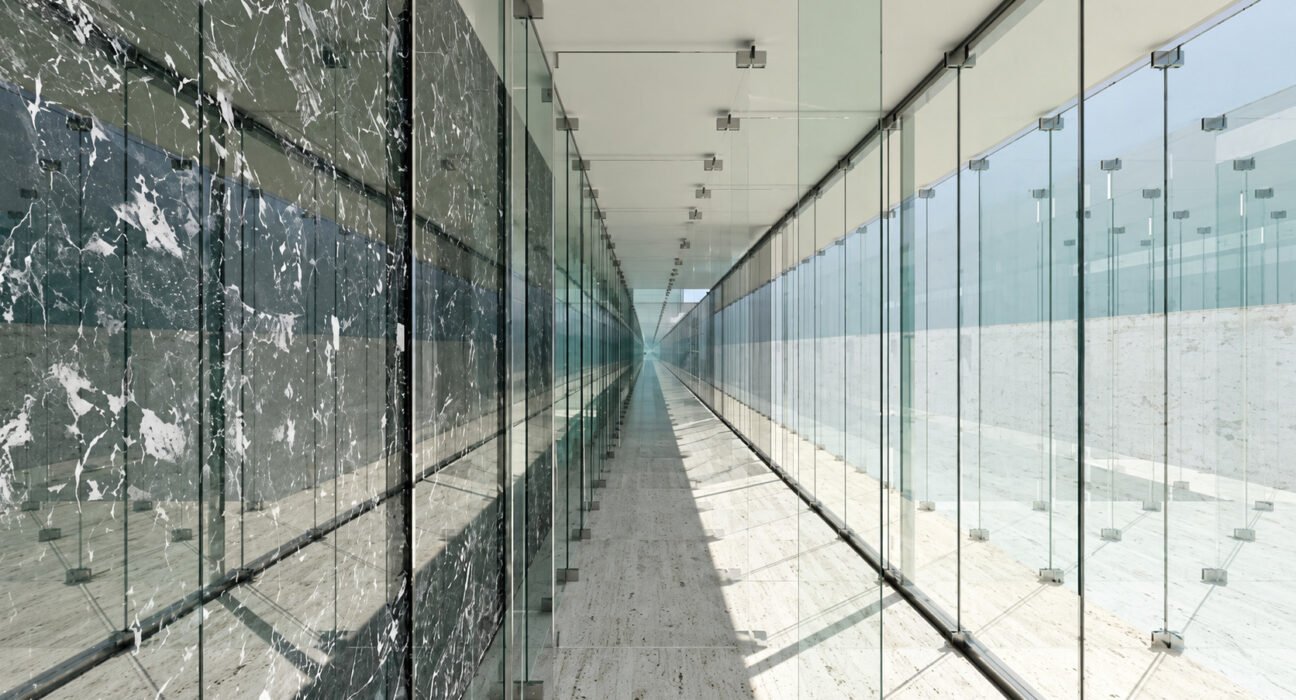
From November 12 to 22, 2026, the Barcelona Pavilion hosts Pavilion-Labyrinth, a glass intervention that overlays the historic travertine podium with a transparent maze. The result is not just an exhibition piece, but a sensory re-reading of a canonical work by Mies van der Rohe and Lilly Reich. For readers following luxury architecture, luxury design, and high-concept spatial installations, this is one of the most compelling stories in contemporary architecture news.
Architecture News from Barcelona: A Modernist Icon Reimagined
The Barcelona Pavilion occupies a singular place in design history. Originally conceived for the 1929 International Exposition in Barcelona, it was designed to represent modern Germany in a radically elegant language of openness, proportion, and refined materials. Although the original structure was temporary, it was later reconstructed under the stewardship of the Fundació Mies van der Rohe and has since become an architectural pilgrimage site.
That legacy makes any intervention especially significant. Rather than competing with the building, Pavilion-Labyrinth appears to amplify one of its defining qualities: transparency. By inserting a field of glass partitions across the pavilion’s podium, the installation intensifies the visual logic already embedded in the landmark. In today’s architecture news cycle, where spectacle often overshadows substance, this project stands out for its intellectual precision.
What Is Pavilion-Labyrinth?
Pavilion-Labyrinth is a temporary artistic intervention created by architects Ciro Najle and Josep Ferrando. Built entirely from glass, the installation forms a transparent labyrinth that guides visitors through a newly choreographed experience of the pavilion. Instead of reading the site as a static masterpiece, visitors move through shifting layers of reflection, refraction, and visual overlap.
The concept challenges a familiar assumption: that transparency equals clarity. Here, transparency becomes unstable, dense, and even disorienting. Boundaries appear and disappear. Interior and exterior begin to blur. Circulation becomes less predictable. This is where the installation excels, transforming a modernist icon into a living experiment in perception.
Key features of the installation
- A glass maze set over the pavilion’s travertine base
- Reinforced visual connections between materiality and movement
- Shifting reflections that alter the reading of walls, surfaces, and edges
- A temporary visitor route that reframes the original floor plan
- A curatorial focus on transparency as an active, contemporary condition
For anyone interested in luxury decor and luxury home design, the project also offers a broader lesson: minimal materials can produce extraordinary emotional and spatial complexity when used with rigor.
Why This Installation Matters in Contemporary Architecture
The most important architecture news stories do more than announce openings; they reveal where the discipline is headed. In that sense, Pavilion-Labyrinth is a marker of several larger conversations shaping architecture today:
1. Historic landmarks as platforms for new ideas
The Barcelona Pavilion is not being treated as a frozen artifact. Instead, it becomes a framework for dialogue between past and present. Temporary installations like this one prove that preservation and experimentation can coexist.
2. Transparency reconsidered
Glass in modern architecture has long symbolized openness and rationality. This intervention complicates that narrative. Here, glass produces uncertainty, doubling, and psychological depth. That shift reflects a more nuanced understanding of material experience in contemporary design.
3. Architecture as choreography
Rather than emphasizing form alone, the project foregrounds movement. The visitor’s body becomes central to the work, turning the pavilion into a sequence of encounters instead of a single image.
These themes make the installation especially relevant to current architecture news, where immersive environments and experiential design continue to reshape museums, galleries, and domestic interiors alike.
The Architects Behind the Glass Intervention
Part of what gives this project weight in architecture news is the caliber of its authors.
Josep Ferrando
Barcelona-born Josep Ferrando is known for a practice rooted in craftsmanship, geometry, efficiency, and monomateriality. Alongside his built work, he has played an influential role in architectural education and cultural programming. His work has been exhibited internationally, and his participation in the award-winning Spanish Pavilion at the 2016 Venice Architecture Biennale underscores his standing within the profession.
Ciro Najle
Argentine architect Ciro Najle brings a complementary intellectual framework. His work spans architecture, design, theory, and research, often exploring the intersection of digital culture, ecological thinking, and complexity theory. Through his practice and academic work, he has consistently engaged architecture as a field shaped by global transformation and material innovation.
Together, Najle and Ferrando bring both conceptual depth and formal restraint to Pavilion-Labyrinth, making it one of the more sophisticated entries in recent architecture news.
Lessons for Luxury Architecture and Design
Although the installation is temporary and institutional, its implications extend into luxury architecture, luxury home decor, and high-end interior design. The project demonstrates how a restrained palette can still feel dramatic, exclusive, and emotionally charged.
Design takeaways
- Material clarity matters: A single material, used thoughtfully, can generate powerful atmosphere.
- Spatial layering creates richness: Luxury does not always depend on ornament; it can emerge through perception and sequence.
- Reflection can be architectural: Mirroring, translucency, and visual depth can redefine how rooms are experienced.
- Movement shapes memory: Great spaces are not only seen, they are navigated.
For designers and homeowners alike, this is a reminder that sophisticated environments often rely less on excess and more on precision, proportion, and sensory intelligence.
A Broader Trend: Art and Architecture Continue to Merge
This installation also aligns with a wider movement in global architecture news: the increasing overlap between architecture, exhibition-making, and contemporary art. Across Europe and beyond, architects are using temporary interventions to test new ideas about public space, cultural identity, and material experimentation.
That matters because installations like Pavilion-Labyrinth often influence permanent design thinking. Concepts first explored in pavilions and galleries frequently migrate into residential architecture, hospitality projects, and luxury interiors. In that way, experimental work at the Barcelona Pavilion may shape tomorrow’s homes and design language far beyond the museum context.
Conclusion
In a crowded year of cultural openings, this Barcelona installation deserves attention not simply as an event, but as a meaningful piece of architecture news. Pavilion-Labyrinth shows how a historic modernist landmark can be reactivated through a temporary gesture that is both visually subtle and intellectually ambitious.
By turning transparency into something tactile, unstable, and deeply contemporary, Ciro Najle and Josep Ferrando have created an experience that resonates across luxury architecture, design culture, and material innovation. The clearest takeaway from this architecture news story is simple: great architecture still has the power to surprise us, especially when it invites us to see the familiar all over again.