
Architecture news rarely feels as timely as this. As cities everywhere grapple with density, housing pressure, mobility, and quality of life, the Danish Architecture Center in Copenhagen is marking urbanist Jan Gehl’s 90th birthday with an exhibition and public program that returns to a simple but transformative idea: cities should be designed for people first.
The tribute arrives at a fitting moment for Denmark’s capital. Copenhagen was once again named the world’s most livable city in the 2026 Economist Intelligence Unit Global Liveability Index, and Gehl’s influence is impossible to ignore. Through decades of research, writing, and consulting, he helped redefine what great urban design looks like—not as a showcase of monumental buildings or traffic efficiency, but as a network of places where people can walk, meet, rest, play, and belong.
Architecture News: Why Jan Gehl Still Shapes the World’s Best Cities
For anyone following architecture news, Jan Gehl is one of the most important voices in modern urbanism. Trained as an architect but widely respected as a researcher and planner, Gehl built his career around observing how people actually use public space. His work challenged the car-dominated planning logic that defined much of the 20th century and replaced it with a more human-scale framework.
That philosophy became globally influential through his landmark 1971 book Life Between Buildings, a text that remains essential reading in architecture, planning, and design circles. Inspired in part by the thinking of Jane Jacobs, Gehl argued that the spaces between buildings matter just as much as the buildings themselves. Streets, squares, parks, waterfronts, and sidewalks are not leftover areas; they are where urban life happens.
His later work, including A Good City – The Short Story, continued to refine this people-centered approach. Through Gehl Studio, he also helped cities around the world rethink their public realm strategies, pedestrian networks, cycling infrastructure, and everyday urban experience.
The Danish Architecture Center Exhibition: “Cities for People”
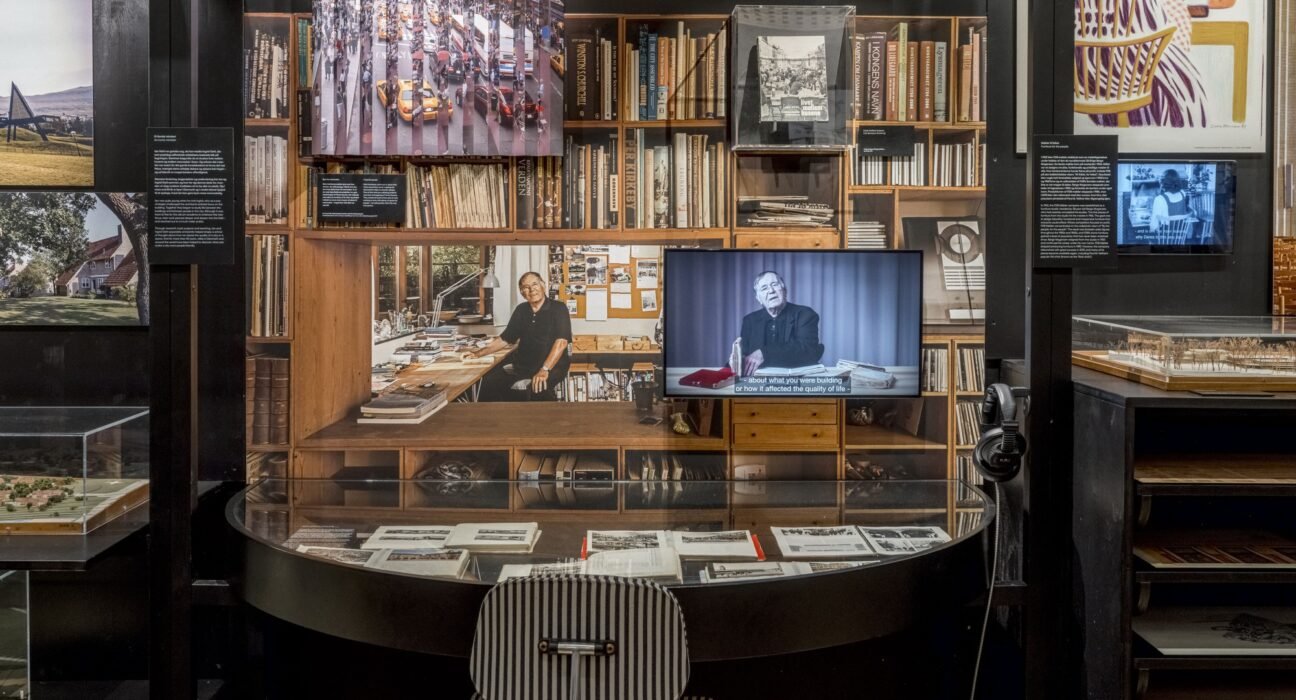
The centerpiece of this architecture news story is the Danish Architecture Center’s new main exhibition, Cities for People, opening on World Architecture Day, October 5. Developed in collaboration with Gehl Studio and Jan Gehl himself, the exhibition explores the principles that have defined his life’s work and asks how they can inform the next generation of urban development.
Rather than presenting urban planning as an abstract discipline, the exhibition is designed as an immersive, participatory experience. Visitors are invited to feel how a public space can seem welcoming or hostile, and how that perception changes depending on age, gender, mobility, or life situation. It is a powerful reminder that luxury in the built environment is not only about materials or prestige—it is also about comfort, safety, dignity, and delight in daily life.
The exhibition draws on Gehl’s 12 quality criteria for public urban spaces, highlighting how thoughtful design can improve:
- Health and well-being
- Social connection and community life
- Safety and perceived security
- Urban comfort across seasons
- Access to recreation and calm
- Overall quality of life
For readers interested in luxury architecture and luxury design, this matters because the most successful high-end places today increasingly balance visual refinement with human experience. A beautiful district, residential development, or cultural destination must work not only in photographs, but in lived reality.
How Gehl Changed the Conversation Around Urban Design
One reason this architecture news moment resonates so widely is that Gehl helped normalize ideas that once seemed radical. In the 1960s, urban planning often prioritized traffic flow, isolated towers, and broad road systems. Gehl, influenced by insights from psychologist Ingrid Gehl, shifted attention to human behavior: how people move, gather, pause, and interact in cities.
That shift can now be seen clearly in Copenhagen’s urban fabric. The city’s harbor baths, public squares, bike lanes, parks, and waterfront spaces show what happens when planners begin with everyday life instead of starting with vehicles or abstract land-use diagrams. The result is a city that feels both sophisticated and livable—a model frequently cited across global architecture news coverage.
Key principles behind Gehl’s approach
- Human scale matters: Cities should feel legible and comfortable at the level of the pedestrian.
- Public life is measurable: Observation and research can reveal what makes spaces active and inviting.
- Design shapes behavior: Small urban decisions influence walking, socializing, and civic life.
- Comfort drives use: Shelter, seating, protection from traffic, and microclimate all affect whether people stay.
- Community is spatial: Well-designed public space can strengthen social ties and shared identity.
Why This Architecture News Matters Beyond Copenhagen
This is not just a birthday tribute. It is a wider statement about the future of cities. With more than 70% of the global population expected to live in urban areas, the question is no longer whether cities will grow, but how they will grow well.
That gives this architecture news story international relevance. Gehl’s legacy intersects with many of today’s biggest design conversations, including:
- Walkable neighborhoods and 15-minute city planning
- Climate-responsive public space
- Healthy streets and active mobility
- Adaptive reuse and circular urban development
- Affordable, equitable, and socially resilient communities
Recent developments across Europe, London, New York, Brussels, and Beijing all point to a broader rethinking of how architecture and urban planning can support sustainable development. In that context, the Danish Architecture Center’s program feels especially important: it connects a foundational thinker’s legacy to urgent contemporary challenges.
It also offers a useful lens for luxury home, luxury decor, and luxury home decor audiences. The same principles that make a city feel humane—light, proportion, comfort, sensory richness, and social connection—also shape exceptional interior and residential design. Human-centered planning and human-centered living are deeply linked.
A Lasting Lesson From Jan Gehl’s 90th Birthday Celebration
The clearest takeaway from this architecture news story is that great cities are not accidental. They are created when architects, planners, institutions, and policymakers pay close attention to how people actually live. Jan Gehl’s career has shown that urban excellence is not defined only by skyline drama or iconic forms, but by the quality of life found in streets, squares, parks, and everyday encounters.
As the Danish Architecture Center celebrates his 90th birthday with Cities for People and a full calendar of talks and activities, it is also celebrating an idea that continues to shape the world’s best urban environments: when cities are designed for people first, everyone benefits. In a world full of fast-moving architecture news, that may be the most enduring design lesson of all.