
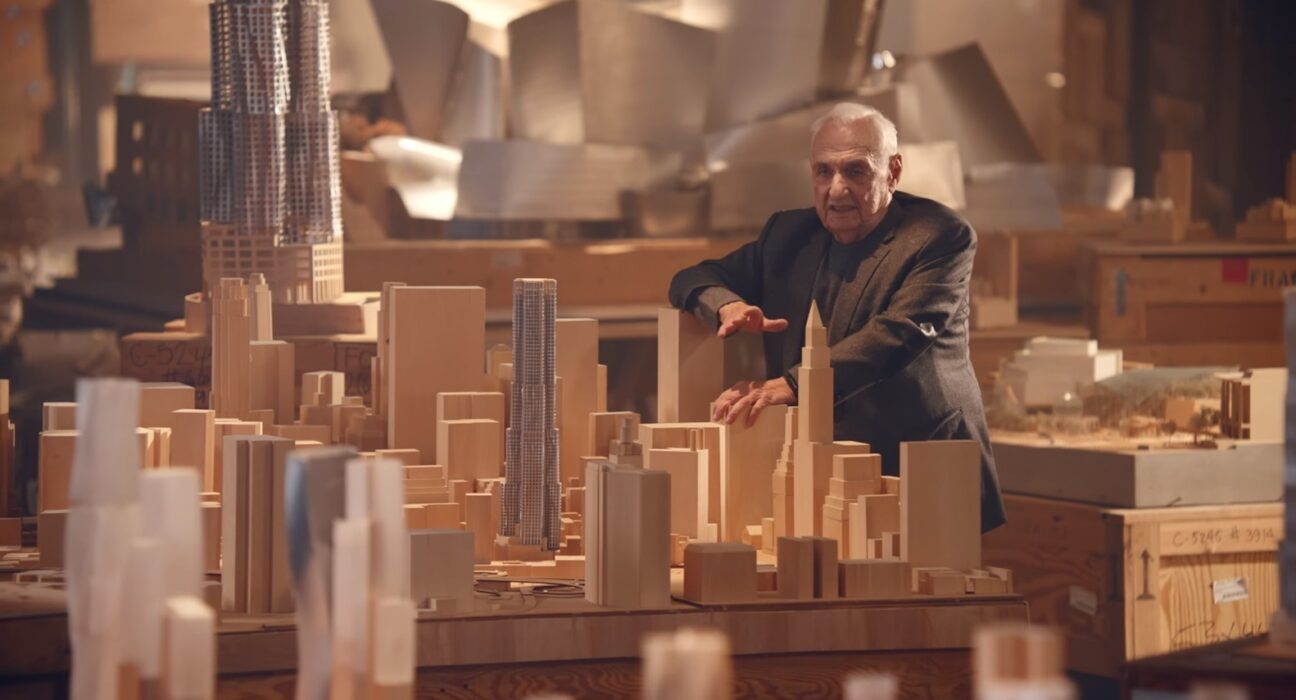
Architecture news rarely carries the weight of a true cultural turning point, but the death of Frank Gehry at 96 is one of those moments. Gehry did more than design famous buildings—he changed the visual language of luxury architecture, challenged how cities invest in culture, and proved that bold design could become a global economic force.
According to reports, Gehry died at his home in Santa Monica following a brief respiratory illness. For architects, designers, collectors, and anyone interested in luxury home and luxury design, his passing marks the end of a remarkable era. Yet his influence remains visible in skylines, museums, residences, and even the digital tools used to imagine complex forms today.
Architecture News: Why Frank Gehry Matters So Deeply
Frank Gehry was one of the most influential architects of the last six decades. Born Frank Owen Goldberg in Toronto in 1929, he later built his practice in Los Angeles, where he developed a design approach that broke from modernist restraint and embraced movement, fragmentation, and sculptural expression.
His early breakthrough came with the renovation of his own Santa Monica house in 1978. Instead of treating the home as a polished object, he transformed an ordinary bungalow with plywood, chain-link fencing, corrugated metal, and exposed edges. The result felt provocative, raw, and intellectually daring. In the world of luxury decor and luxury home design, that project remains a reminder that innovation does not always begin with expensive finishes—it begins with vision.
That house also helped define the spirit of early Deconstructivism, a movement that rejected predictable geometry in favor of tension, collision, and asymmetry. Gehry’s work quickly became synonymous with risk-taking architecture that invited emotion rather than mere admiration.
The Bilbao Guggenheim and the Birth of the “Bilbao Effect”
No discussion of architecture news surrounding Gehry is complete without the Guggenheim Museum Bilbao. Completed in 1997, the titanium-clad museum transformed not only Gehry’s career, but also the public’s understanding of what architecture could do for a city.
Its sweeping, fluid form gave Bilbao an instantly recognizable symbol. More importantly, it demonstrated that a single cultural building could drive tourism, investment, and international prestige. This phenomenon became known as the “Bilbao Effect,” a phrase still used in urban planning, real estate, and cultural development.
The museum’s legacy can be understood in three dimensions:
- Architectural innovation: It pushed formal experimentation into the mainstream.
- Urban regeneration: It helped reposition an industrial city as a cultural destination.
- Luxury design influence: It elevated sculptural architecture into a hallmark of premium public and private projects.
For the luxury architecture sector, Bilbao set a lasting benchmark. Developers, hoteliers, and homeowners increasingly sought spaces that were not simply functional, but memorable, iconic, and emotionally charged.
How Gehry Redefined Luxury Architecture and Interior Culture
Although Gehry is best known for museums and civic landmarks, his influence extends deeply into luxury home, luxury home decor, and luxury design culture. He made expressive architecture aspirational. Curved volumes, unconventional materials, dramatic light, and artistic silhouettes all became part of the high-end design conversation in new ways because of his work.
A New Standard for Statement Design
Before Gehry, prestige in architecture often leaned on symmetry, monumentality, or historical references. Gehry introduced a different kind of luxury—one rooted in originality. His buildings suggested that true exclusivity comes from singularity, not repetition.
That idea shaped the design world in several ways:
- Luxury residences began prioritizing sculptural form and custom geometry.
- Interior spaces embraced art-driven layouts and fluid circulation.
- High-end materials were used for sensory and visual drama, not just status.
- Clients became more willing to invest in architecture as a personal identity statement.
Materiality Beyond Convention
Gehry’s projects frequently challenged assumptions about what “refined” materials should look like. He could make metal feel soft, irregularity feel elegant, and industrial textures feel collectible. That sensibility filtered into luxury decor, where contrast, craftsmanship, and expressive surfaces now define many premium interiors.
In that sense, Gehry’s impact reached far beyond architecture news headlines. He changed the broader luxury aesthetic, encouraging designers to value experimentation as much as polish.
A Global Portfolio That Changed Contemporary Design
Over the decades, Gehry Partners delivered major projects around the world, including work for major cultural institutions, corporate clients, and foundations. His portfolio includes instantly recognizable works such as the Dancing House in Prague, as well as major ongoing and late-career commissions like Guggenheim Abu Dhabi.
His importance was never limited to iconic forms alone. Gehry also helped advance the use of digital modeling and architectural software, making it easier for designers to realize highly complex structures with precision. This technical legacy is enormous. Today’s adventurous luxury architecture—from bespoke villas to avant-garde towers—owes something to the workflows he helped normalize.
Key aspects of Gehry’s lasting influence include:
- Expanding the role of architecture in city branding
- Popularizing expressive, sculptural buildings in mainstream culture
- Influencing contemporary luxury home planning and bespoke design
- Accelerating digital innovation in architectural practice
- Inspiring generations of architects to challenge convention
What Frank Gehry’s Legacy Means for the Future
This chapter in architecture news is also a moment of reflection. Gehry’s career proved that daring architecture can attract public attention, create civic pride, and reshape design ambition across every scale—from museums to private homes. In today’s market, where luxury architecture increasingly intersects with art, wellness, sustainability, and global lifestyle branding, his ideas remain intensely relevant.
His work reminds us that memorable design is not about following trends. It is about creating places that surprise, move, and endure. For professionals in luxury decor and luxury design, that may be his greatest lesson: the most powerful spaces are those with a point of view.
Frank Gehry is survived by his wife, Berta, their sons Sam and Alejandro, his daughter Brina, and his sister Doreen Gehry Nelson. While the world reflects on his death, the buildings he leaves behind continue to speak with uncommon energy.
Conclusion
In architecture news, few figures have ever matched Frank Gehry’s ability to transform both the skyline and the cultural imagination. His legacy will live on through the Bilbao Guggenheim, his experimental homes, and the countless ways he elevated luxury architecture into an art form of global significance. The clearest takeaway is simple: Gehry showed that architecture can be fearless, emotional, and economically transformative all at once.