
Architecture news rarely arrives with this level of cultural weight, but the long-awaited Guggenheim Abu Dhabi is finally set to open on December 11, 2026. Designed by Frank Gehry and rising on Saadiyat Island, the museum is poised to become one of the most significant additions to the global art and design landscape in recent years.
For followers of luxury architecture, museum design, and landmark cultural development in the UAE, this opening marks more than the completion of a delayed project. It signals the near-final realization of Abu Dhabi’s ambitious cultural district, where architecture, art, and national identity intersect at a monumental scale.
Architecture News: Guggenheim Abu Dhabi Finally Sets an Opening Date
According to Abu Dhabi’s Department of Culture and Tourism, Guggenheim Abu Dhabi will welcome the public in December 2026, joining the Guggenheim network alongside New York, Venice, and Bilbao. The announcement closes a chapter that began two decades ago, when the project was first revealed in 2006 as part of Saadiyat Island’s master-planned cultural vision.
The road to completion has been lengthy. Construction started in 2011, then slowed and paused amid economic pressures and contract revisions before resuming in 2019. A previously projected 2025 opening did not materialize, making this latest date especially notable for those tracking international museum architecture and major UAE development projects.
In the context of architecture news, the museum’s opening is important not only because of its scale, but because it represents one of the last major pieces in Abu Dhabi’s carefully curated cultural district.
A Frank Gehry Landmark Defined by Sculptural Form
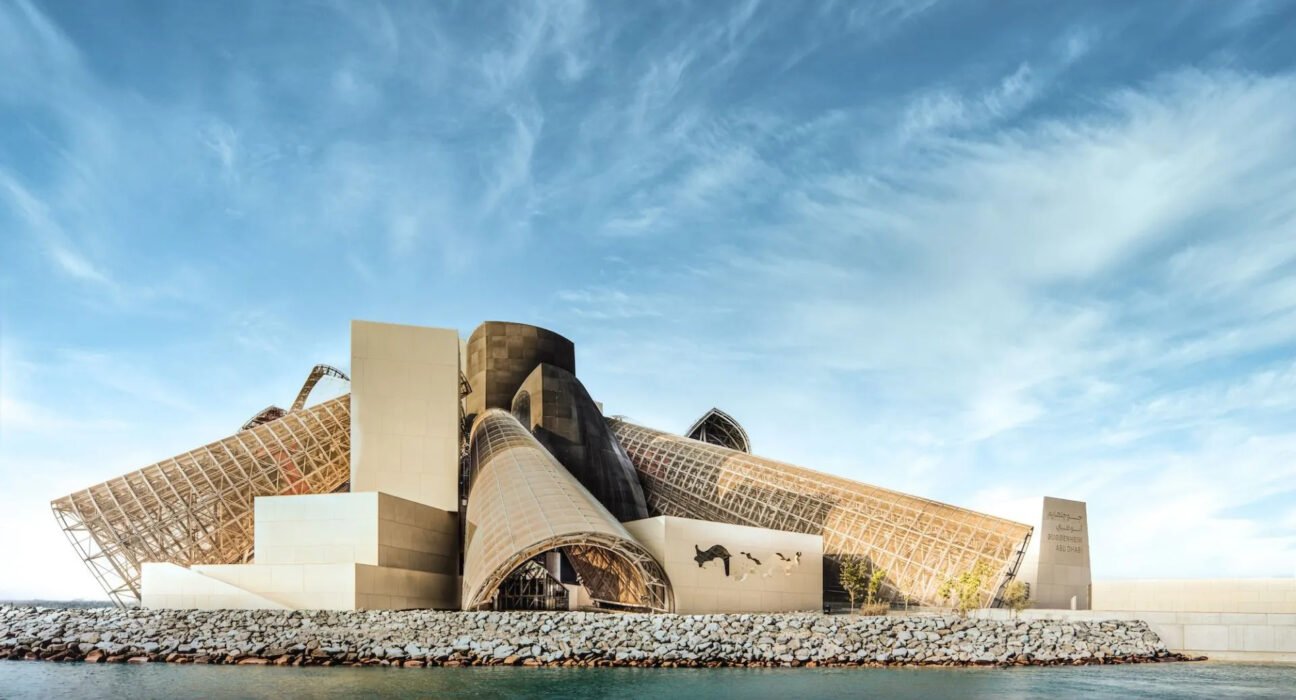
Frank Gehry’s design for Guggenheim Abu Dhabi continues his long exploration of expressive, sculptural architecture, but with a language adapted to the Gulf context. The museum is composed of ten dramatic cones that create an irregular skyline around a central atrium. Nine of these cones are wrapped in stainless steel mesh, while one features onyx and glass, giving the complex a distinctive material contrast.
Reaching heights of up to 88 meters, the cones are both iconic and functional, shaping the building’s profile while helping organize its internal program. The result is a museum that feels monumental without relying on a single uniform mass. Instead, the structure unfolds as a composition of volumes, voids, and layered surfaces—an approach that has long defined Gehry’s most celebrated work.
For readers interested in luxury design and statement architecture, the museum’s silhouette is likely to become one of the UAE’s most recognizable contemporary landmarks.
Key design highlights
- Ten sculptural cones forming the museum’s skyline
- Stainless steel mesh cladding on nine cones
- One cone finished with onyx and glass
- A central atrium anchoring the spatial experience
- Thirty galleries with varied heights and configurations
The Largest Guggenheim in the World
One reason this story stands out in architecture news is sheer scale. Guggenheim Abu Dhabi spans 80,000 square meters in total, making it the largest institution in the Guggenheim family. Of that footprint, 11,600 square meters are dedicated to interior galleries, while 23,000 square meters are reserved for outdoor exhibition space.
That combination positions the museum as more than a conventional gallery building. It is an expansive cultural campus designed to host diverse forms of artistic production, public programming, and large-scale installations. In addition to exhibition halls, the museum will include:
- A center for art and technology
- Children’s facilities
- Archives and a library
- A conservation laboratory
This broad mix of uses reflects how museums are evolving into multidisciplinary destinations—places where architecture supports education, research, performance, and community engagement alongside traditional exhibition functions.
A Collection Shaped by Region and Global Dialogue
Beyond the building itself, Guggenheim Abu Dhabi has been developing its collection since 2009. Rather than organizing works through a standard chronological timeline, the museum’s holdings are arranged thematically, with areas such as Abstraction, Popular Culture, and Land helping frame the curatorial approach.
This matters because the institution is aiming to offer a perspective distinct from other Guggenheim sites. Its collection is intended to be rooted in the Middle East while remaining globally connected, with substantial representation from Asia and North Africa as well. That regional emphasis may give the museum a stronger local identity than some satellite cultural institutions, while still benefiting from the global prestige of the Guggenheim name.
Another important distinction in this architecture news story is ownership and governance. The artworks belong to the government of Abu Dhabi, which has also funded construction at a reported cost of more than $1 billion. Major hiring decisions have been made jointly by the Guggenheim Foundation and the Department of Culture and Tourism, underscoring the project’s hybrid international-local structure.
Saadiyat Island’s Cultural District Nears Completion
The opening of Guggenheim Abu Dhabi is also a milestone for Saadiyat Island, which has been envisioned as a world-class cultural destination for years. The district already includes Jean Nouvel’s Louvre Abu Dhabi, which opened in 2017, and Foster + Partners’ Zayed National Museum, which opened in December 2025.
Together, these institutions have transformed the island into a showcase for contemporary museum architecture. Gehry’s museum adds another layer, bringing his signature formal experimentation into dialogue with Nouvel’s dome and Foster’s highly symbolic national museum design.
There is also a broader luxury lifestyle angle here. For audiences interested in luxury home, luxury decor, and luxury design, Saadiyat Island represents more than tourism infrastructure. It embodies the idea that architecture can elevate an entire destination, influencing hospitality, real estate, and high-end cultural experiences through design excellence.
Why this opening matters
- It completes a major chapter in Abu Dhabi’s cultural development strategy.
- It delivers the largest Guggenheim museum to date.
- It reinforces the UAE’s position in global architecture and art conversations.
- It adds a major late-career work by Frank Gehry to the region.
What Guggenheim Abu Dhabi Means for Global Architecture
In today’s architecture news cycle, landmark cultural buildings must do more than look spectacular—they must carry institutional purpose, urban significance, and international relevance. Guggenheim Abu Dhabi appears designed to do all three. It is a destination museum, a civic statement, and a strategic cultural investment wrapped into one project.
Its delayed delivery may have tested patience, but its eventual opening is likely to renew discussion around museum design, cultural diplomacy, and the role of iconic architecture in shaping cities. For Frank Gehry’s legacy, it also stands as a major project in the Middle East and a reminder of his lasting impact on global design culture.
As this chapter in architecture news unfolds, the key takeaway is clear: Guggenheim Abu Dhabi is not simply another museum opening. It is a defining moment for luxury architecture, for Abu Dhabi’s cultural ambitions, and for the future of museum design in the region.