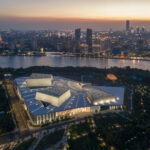

Architecture news rarely captures the public imagination quite like a building that invites people to climb, wander, and linger as part of the design itself. Heatherwick Studio’s West Bund Orbit in Shanghai does exactly that, transforming a waterfront exhibition hall into a sculptural civic landmark that feels as much like an urban promenade as it does a piece of architecture.
Documented in a striking new photo series by architectural photographer Paul Clemence, West Bund Orbit stands along the Huangpu River in Shanghai’s Xuhui District, where the city’s redeveloped waterfront continues to evolve into a destination for culture, leisure, and high-design public space. For readers following luxury architecture, luxury design, and elevated urban living, this project offers a compelling example of how contemporary architecture can create beauty, access, and experience all at once.
Architecture News Spotlight: West Bund Orbit on Shanghai’s Huangpu River
Set beside the West Bund riverside park, West Bund Orbit was conceived as more than a conventional exhibition venue. Heatherwick Studio designed the project as a cultural destination within Shanghai’s emerging financial hub, while also extending the public-space network that has become a signature of the renewed riverfront.
What makes this project especially notable in architecture news is its open-ended accessibility. Rather than presenting a sealed object to be viewed from a distance, the building welcomes movement from multiple directions. Visitors can approach it from the promenade, enter its pathways, ascend stairways, and experience terraces and elevated routes that continuously shift their view of the river and the city.
This design strategy aligns with a growing global interest in architecture that supports public life. In premium urban districts, the most memorable buildings are increasingly those that do more than house a program; they contribute to the daily rhythm of the city.
A Ribbon-Like Form That Blends Sculpture, Circulation, and Landscape
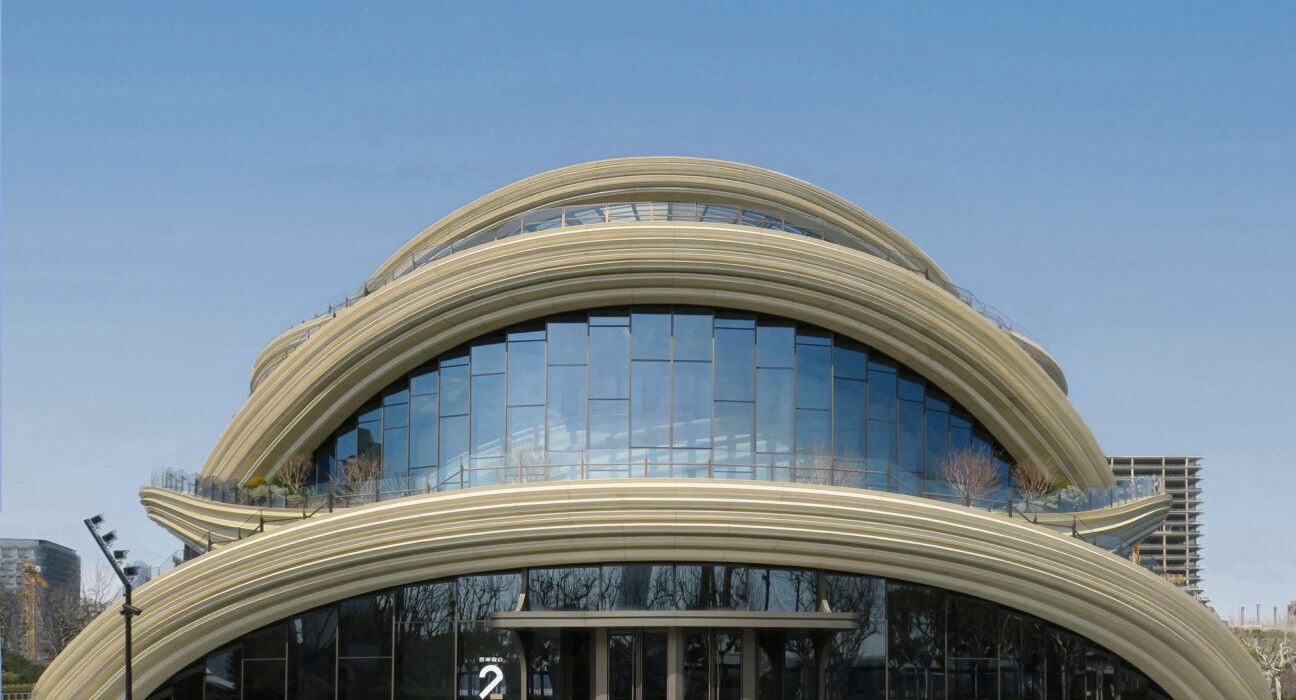
The defining feature of West Bund Orbit is its system of interwoven ribbons wrapping around a central exhibition volume. These curved elements form:
- Staircases connecting different levels
- Bridges and elevated walkways
- Terraces for pause and observation
- A rooftop garden overlooking the Huangpu River
Instead of acting as a traditional façade, the outer structure becomes an inhabitable landscape. That move is central to why this project stands out in current architecture news: it blurs the line between building envelope and public realm.
Heatherwick Studio has linked the design to the traditional Chinese moon bridge, reinterpreting its graceful curvature into a contemporary language of continuous movement. The result feels both rooted in cultural reference and unmistakably modern. In the luxury design world, that balance between heritage and innovation is often what elevates a project from impressive to iconic.
Why the Design Feels Luxurious Without Excess
Luxury in architecture is no longer defined only by rare materials or exclusivity. Increasingly, it is expressed through experience, generosity, and spatial quality. West Bund Orbit embodies that shift through:
- Layered movement: The building offers multiple paths rather than a single prescribed route.
- Riverfront views: Its elevated circulation creates premium vantage points open to the public.
- Architectural drama: The sculptural ribbons generate visual impact from every angle.
- Public accessibility: The design feels inclusive while remaining highly refined.
For audiences interested in luxury home decor and luxury home inspiration, there is a broader lesson here: sophistication often comes from fluidity, light, openness, and the orchestration of movement through space.
Paul Clemence’s Photography Reveals the Building in Motion
One reason this story is resonating in architecture news is the way Paul Clemence has captured the project’s changing identity. His images do not simply document the building as a static object. Instead, they emphasize relationships—between architecture and landscape, between pathways and structure, and between the waterfront and the city beyond.
Through changing vantage points, Clemence highlights how the overlapping ribbons alter the perception of form. At some moments, the building appears almost infrastructural, like a looping urban connector. From other angles, it reads as a monumental sculpture hovering over the promenade. This visual ambiguity is one of the project’s greatest strengths.
Clemence is known for photographing major contemporary works in ways that foreground context and lived experience. Here, that approach is especially effective because West Bund Orbit is a building meant to be discovered in sequence, not understood in a single glance.
Inside the Exhibition Hall: Transparency and Connection
At the center of the project sits the main exhibition hall, around which the rest of the program is arranged. Large glazed openings punctuate the exterior, allowing interior activity to remain visually connected to the public realm. A secondary gallery encircles the primary hall, reinforcing the dialogue between inside and outside.
This transparency is a critical component of the design. In the best contemporary cultural architecture, the threshold between city and institution is softened. Visitors are not confronted with an opaque boundary; instead, they are invited into a visual and spatial exchange.
That principle has become increasingly influential in architecture news coverage of museums, galleries, and cultural spaces around the world. Buildings that open themselves to the street tend to become more than destinations—they become part of the city’s everyday identity.
What West Bund Orbit Means for Luxury Architecture and Urban Design
West Bund Orbit reflects several wider themes shaping global architecture today:
- Experiential design: Buildings are increasingly conceived as journeys, not just enclosures.
- Mixed civic value: Cultural spaces are expected to function as public amenities.
- Waterfront revitalization: Prime riverfront districts are becoming showcases for ambitious design.
- Photogenic architecture: Projects are designed to be encountered in person and circulated visually.
For Shanghai, the project strengthens the West Bund’s identity as a design-forward destination where public life, culture, and prestige development intersect. For the wider design community, it demonstrates how architecture can create a sense of luxury through access, landscape integration, and memorable form rather than through ornament alone.
It also reinforces Heatherwick Studio’s reputation for producing buildings that prioritize human engagement. West Bund Orbit is not merely admired from afar; it is activated by the people who move across it.
Conclusion
In a moment when the best architecture news is focused on experience, public space, and emotional impact, West Bund Orbit feels especially relevant. Heatherwick Studio’s riverfront landmark turns circulation into spectacle, architecture into landscape, and a cultural venue into a civic destination. As captured by Paul Clemence, the project offers a powerful vision of contemporary luxury architecture—one where openness, movement, and connection define the experience as much as form itself.
The takeaway is clear: truly memorable design does not just occupy a site; it transforms how people engage with it. That is what makes West Bund Orbit one of the most compelling stories in architecture news today.