
Architecture news rarely captures a project that feels both sculptural and genuinely public, but West Bund Orbit in Shanghai does exactly that. Photographed by Paul Clemence, Heatherwick Studio’s riverfront exhibition hall emerges as more than a building—it reads as a walkable landscape of bridges, terraces, and elevated paths stitched into the city’s evolving waterfront.
Set in Shanghai’s Xuhui District along the Huangpu River, West Bund Orbit was conceived as a cultural anchor within the area’s growing Financial Hub. Yet its real distinction lies in how it expands the public realm. Instead of presenting a sealed architectural object, the project invites movement from every direction, turning circulation itself into an experience. For readers following luxury architecture, luxury design, and destination-making urban projects, this is one of the most compelling examples of how contemporary architecture can combine civic access with iconic form.
Architecture News Spotlight: West Bund Orbit on the Huangpu River
In the latest architecture news, West Bund Orbit stands out for its strategic placement beside the riverside park on Shanghai’s West Bund. The location gives the building a dual role:
- It functions as a public exhibition venue
- It extends the pedestrian network of the redeveloped waterfront
- It acts as a visual landmark within the district’s emerging skyline
Heatherwick Studio designed the project to be open and approachable rather than monumental in a conventional sense. Visitors are encouraged to pass through, climb upward, pause on terraces, and engage with views of the river and city. That idea of permeability is central to the building’s identity and helps explain why it resonates so strongly in current architecture news coverage.
The site also carries a subtle historical echo. It sits directly opposite the former location of Heatherwick Studio’s UK Pavilion, the celebrated Seed Cathedral from the 2010 Shanghai World Expo. This geographic connection gives West Bund Orbit an added layer of continuity in the studio’s relationship with Shanghai.
A Ribbon-Like Design That Turns Circulation Into Architecture
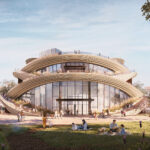
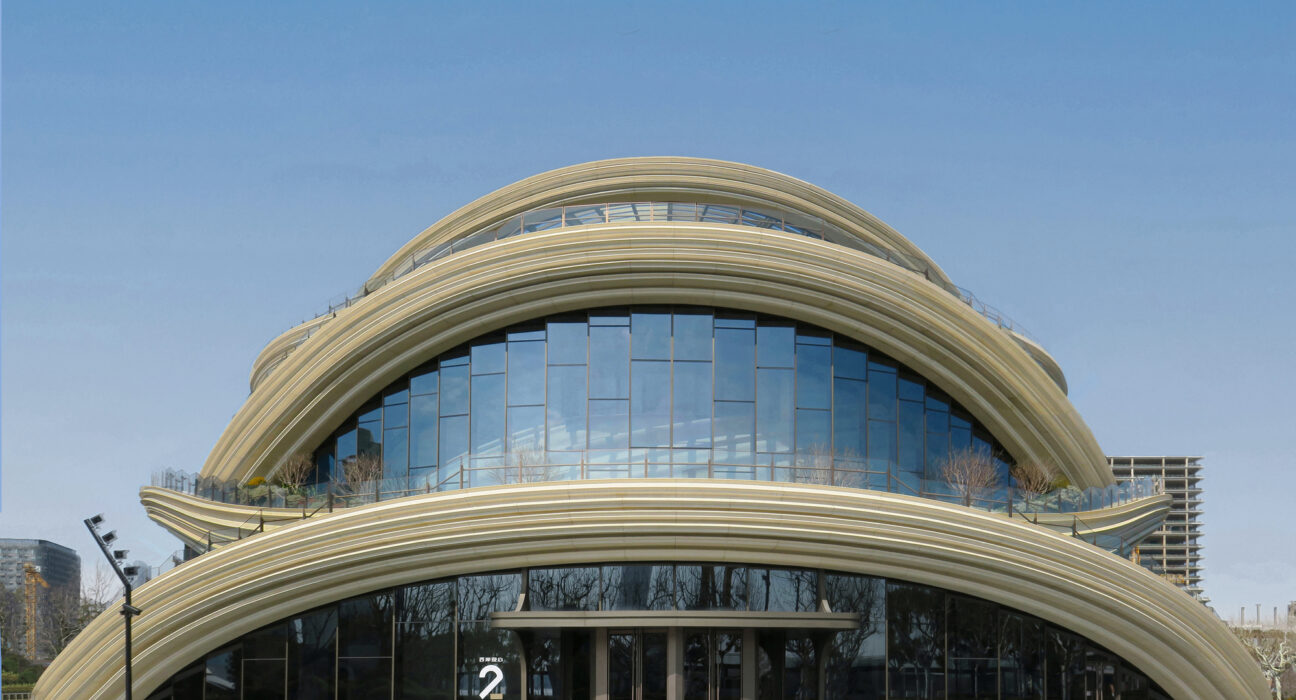
The defining feature of West Bund Orbit is its network of interwoven ribbon-like forms. These bands loop around the central volume, creating stairways, bridges, elevated walkways, and lookout points that continuously shift the visitor’s perspective. Rather than treating circulation as secondary, the design makes movement the primary architectural event.
This approach reflects a broader trend in architecture news: buildings are increasingly expected to deliver experience, not just enclosure. At West Bund Orbit, the exterior is not a static facade. It becomes a sequence of accessible public spaces that unfold vertically and horizontally.
Key architectural elements
- Layered pathways wrapping the main exhibition hall
- Bridges and stairs connecting multiple levels
- Terraces that open toward the Huangpu River
- A rooftop garden offering panoramic waterfront views
- Glazed openings that connect indoor exhibitions with outdoor public life
Heatherwick Studio has linked the design concept to the traditional Chinese moon bridge, translating its curved geometry into a contemporary form language. That inspiration can be felt in the project’s sweeping arcs and sense of continuous motion. The result is expressive but not arbitrary—a sculptural composition rooted in local cultural reference while clearly aligned with global contemporary design.
Paul Clemence’s Photography Reveals the Building in Motion
A major reason this story has gained traction in architecture news is the photographic treatment by Paul Clemence. His images do not simply document the building as a finished object. Instead, they emphasize relationships—between structure and landscape, architecture and infrastructure, public movement and framed views.
Clemence captures how the overlapping ribbons produce constantly changing geometries depending on where the building is viewed from: the promenade, the park, elevated paths, or across the riverfront. This makes West Bund Orbit particularly photogenic, but more importantly, it reveals the project’s spatial complexity.
For luxury design audiences, this matters because high-end architecture today is often judged by experiential richness. A building must be memorable in person, dynamic in photographs, and deeply connected to its setting. Clemence’s work underscores that West Bund Orbit succeeds on all three fronts.
Inside the Exhibition Hall: Transparency and Urban Connection
At the center of the project sits the main exhibition hall, around which the rest of the program is organized. Large glazed openings punctuate the building, allowing interior activity to remain visible from the outside. This transparency softens the boundary between gallery space and public promenade, reinforcing the idea that culture should feel accessible rather than isolated.
A secondary gallery wraps around the main hall, adding another layer of movement and visual exchange. This planning strategy strengthens the dialogue between inside and outside—a recurring theme in significant architecture news stories focused on civic and cultural architecture.
In practical terms, the building delivers several qualities that define successful contemporary public architecture:
- Accessibility: Entry and circulation are intuitive from multiple directions.
- Visibility: Interior spaces connect visually with the waterfront.
- Public engagement: Outdoor paths and terraces extend the project’s usefulness beyond exhibitions.
- Urban integration: The building contributes to the wider redevelopment of the West Bund.
Why West Bund Orbit Matters for Luxury Architecture and Urban Design
For those tracking architecture news through the lens of luxury architecture and luxury home-inspired design, West Bund Orbit offers a valuable lesson: luxury is no longer defined only by rare materials or exclusivity. Increasingly, it is expressed through space, experience, and the emotional quality of movement.
This project demonstrates how premium design thinking can enhance public life. Its layered walkways, elegant curves, river views, and garden-topped silhouette create a highly refined experience without severing the building from everyday urban use. That balance is especially relevant as waterfront regeneration projects around the world aim to blend cultural programming, public amenity, and landmark design.
West Bund Orbit also reinforces Heatherwick Studio’s reputation for creating architecture that is tactile, interactive, and unmistakably human-centered. In a global design landscape filled with formal spectacle, this building stands apart because its sculptural ambition is matched by usability.
Conclusion: A Defining Moment in Architecture News
In today’s architecture news, West Bund Orbit deserves attention not only as a striking new project in Shanghai, but as a model for how architecture can shape public life along the waterfront. Heatherwick Studio’s design transforms circulation into destination, while Paul Clemence’s photography captures the building’s fluid identity with unusual clarity.
The takeaway is simple: the most memorable architecture is no longer just something to look at—it is something to move through, inhabit, and experience from many angles. West Bund Orbit embodies that shift beautifully, making it one of the standout cultural projects on Shanghai’s Huangpu River.