Architecture news rarely captures a project as ambitious, polarizing, and visually arresting as Egypt’s New Administrative Capital. Rising from the Eastern Desert east of Cairo, this purpose-built city is more than a government relocation effort—it is a statement about power, urban expansion, luxury development, and the future image of the nation.
Photographer Manuel Álvarez Diestro documents the emerging metropolis with a pedestrian’s eye, revealing not only monumental buildings and broad avenues, but also the tension between landscape and construction. His images turn a vast urban megaproject into a close reading of space, scale, and aspiration, making the New Administrative Capital one of the most compelling stories in contemporary design discourse.
Architecture News Spotlight: Egypt’s New Administrative Capital
Located roughly 45 kilometers east of Cairo, Egypt’s New Administrative Capital, often abbreviated as NAC, was announced in 2015 as a long-term response to Cairo’s chronic congestion and population pressure. Positioned strategically between Cairo and Suez and within reach of Ain Sokhna and the Gulf of Suez, the city has been conceived as both an administrative hub and an economic catalyst.
While Cairo remains Egypt’s official capital, key government functions have already shifted to the new city. The first phase is largely complete, and the inauguration of the State Strategic Command Headquarters in July 2026 marked a major milestone. Official figures suggest that the city has begun attracting residents, though its governmental footprint currently outweighs its residential density.
In the wider world of architecture news, the project joins a notable group of purpose-built capitals and planned cities, inviting comparisons with Brasília as well as newer state-led urban developments in Indonesia, South Korea, and Equatorial Guinea.
A Desert Metropolis Built from the Ground Up
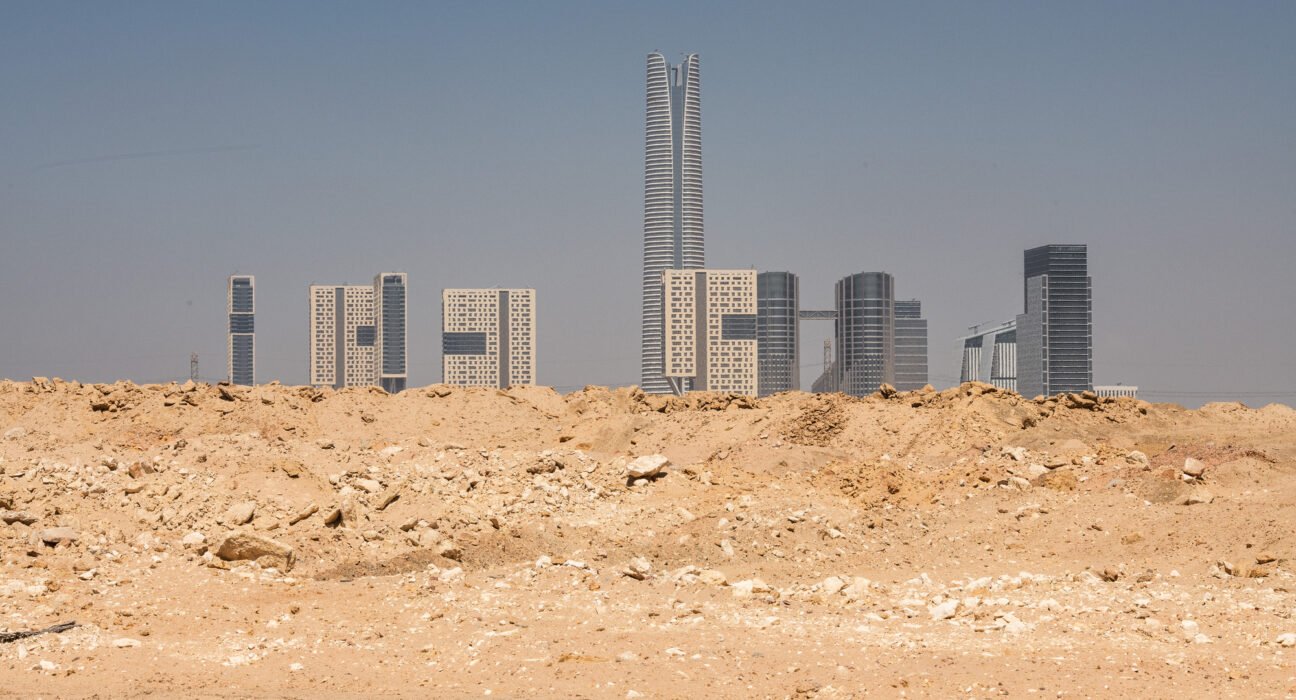
The most striking aspect of the New Administrative Capital is its setting. Unlike historic Cairo, shaped by centuries of life tied closely to the Nile, this new city extends into the desert with a logic of open land, speed, and horizontal growth. The contrast is not merely geographic—it is ideological.
Álvarez Diestro’s photography emphasizes that shift. His work frames the city not as an abstract master plan, but as a lived sequence of roads, construction zones, billboards, villas, gated compounds, and civic structures. That perspective matters in architecture news because it shows how megaprojects are experienced on the ground, not just announced in renderings.
Several themes emerge from this desert urbanism:
- Monumentality: Public buildings and infrastructure are scaled to project permanence and authority.
- Expansion: The city spreads outward across vast open land rather than upward in dense urban layers.
- Separation: Residential enclaves, government districts, and commercial areas appear carefully segmented.
- Reinvention: The project attempts to redefine Egypt’s modern identity through architecture and planning.
Luxury Architecture and the Visual Language of Aspiration
For readers interested in luxury architecture, luxury design, and luxury home trends, the city’s outer districts are especially revealing. As the journey from eastern Cairo unfolds, signs of high-end development become increasingly visible: promotional billboards, villa compounds, landscaped enclaves, and branded residential communities designed to signal status as much as shelter.
Álvarez Diestro notes the presence of work by international firms and a mix of stylistic references that range widely across geographies and eras. In these emerging neighborhoods, architectural identity appears eclectic and highly curated, with influences that include:
- Neo-classical motifs
- Pharaonic references
- Mediterranean villa language
- South American hacienda cues
- Imported ornamental elements reminiscent of East Asian temple forms
This blend reflects a familiar phenomenon in global luxury development: architecture becomes a catalog of prestige. In that sense, the New Administrative Capital offers more than an urban planning case study—it also reflects the aesthetics of luxury home decor and luxury lifestyle branding at a metropolitan scale.
Manuel Álvarez Diestro’s Photographic Perspective
One reason this story stands out in architecture news is the photographer’s approach. Rather than presenting polished icons in isolation, Álvarez Diestro examines the city as a process of conquest, movement, and expectation. His series, titled The Conquest, looks at what happens when architecture meets emptiness, and how human ambition redraws terrain.
His images suggest that building a city is both constructive and destructive. Roads cut through barren ground. Luxury compounds rise amid debris and stone. Monumental aspirations coexist with unfinished edges. This friction gives the work its power.
It also places the New Administrative Capital within a broader photographic tradition of documenting architecture as atmosphere rather than object. Similar contemporary photo essays have reinterpreted well-known and emerging works alike, proving that visual storytelling remains essential to how architecture news is understood by both professionals and the public.
Global Comparisons and Urban Questions
The New Administrative Capital naturally invites comparison to other master-planned urban centers around the world. Álvarez Diestro himself connects its feel to places such as Dubai’s marina districts, Chongqing’s new town developments, and the commercial zones rising along Guangzhou’s Pearl River. These parallels matter because they show how contemporary cities increasingly share a global vocabulary of scale, spectacle, and investment-driven growth.
Still, Egypt’s project raises distinct questions:
- Can a new capital genuinely relieve pressure on a historic megacity like Cairo?
- Will residential life catch up with administrative ambition?
- How will the city balance symbolism, livability, and long-term sustainability?
- What role will luxury housing play in shaping its social geography?
These are exactly the kinds of issues that keep the project at the center of international architecture news coverage.
Why This Project Matters for Design and Luxury Living
Beyond politics and planning, the New Administrative Capital matters because it reveals how architecture is being used today: as infrastructure, image-making, economic strategy, and lifestyle packaging all at once. It touches multiple sectors, from luxury architecture and luxury design to luxury home and luxury home decor, while also speaking to deeper concerns about urban identity.
For designers, developers, and architecture enthusiasts, the project offers a rare chance to observe a capital city being assembled in real time. For photographers, it provides a dramatic study in light, emptiness, materiality, and human ambition. And for anyone following architecture news, it is a reminder that the most important stories are often not just about buildings, but about the landscapes and societies they are trying to reshape.
In the end, Egypt’s New Administrative Capital stands as one of the defining subjects in contemporary architecture news: vast, controversial, luxurious, and undeniably consequential. Through Manuel Álvarez Diestro’s lens, the project becomes more than a development headline—it becomes a visual meditation on what it means to build a future in the desert.