
Architecture news rarely captures civic design with the same drama as Tbilisi Public Service Hall. Set above the Kura River in the heart of Georgia’s capital, this landmark by Studio Fuksas turns a government building into a bold statement about transparency, identity, and contemporary urban life.
Completed in 2012 and spanning roughly 42,000 square meters, the project rethinks what a town and city hall can look and feel like. Instead of relying on heavy, closed-off monumentalism, the building introduces a lighter architectural language that feels open, futuristic, and unmistakably public. For readers interested in luxury architecture, luxury design, and elevated civic spaces, Tbilisi Public Service Hall offers a compelling case study in how public buildings can achieve both spectacle and function.
Architecture News Spotlight: A Civic Landmark in Tbilisi
Located in central Tbilisi, the Public Service Hall occupies a highly visible urban position overlooking the Kura River. That siting is critical to understanding the project’s impact. Rather than disappearing into the city fabric, the building engages the skyline and the waterfront, asserting itself as a contemporary symbol of public access and institutional renewal.
Studio Fuksas, known for sculptural forms and expressive large-scale works, approached the commission with a vision that balances engineering ambition and civic presence. The result is a complex that feels both monumental and fluid, with a silhouette defined by its striking canopy-like roof structures.
In the context of architecture news, the project remains relevant because it demonstrates how government architecture can move beyond purely bureaucratic thinking. It can be inviting, technologically advanced, and visually memorable without losing practicality.
What Makes Tbilisi Public Service Hall Architecturally Distinct
A dramatic roofscape
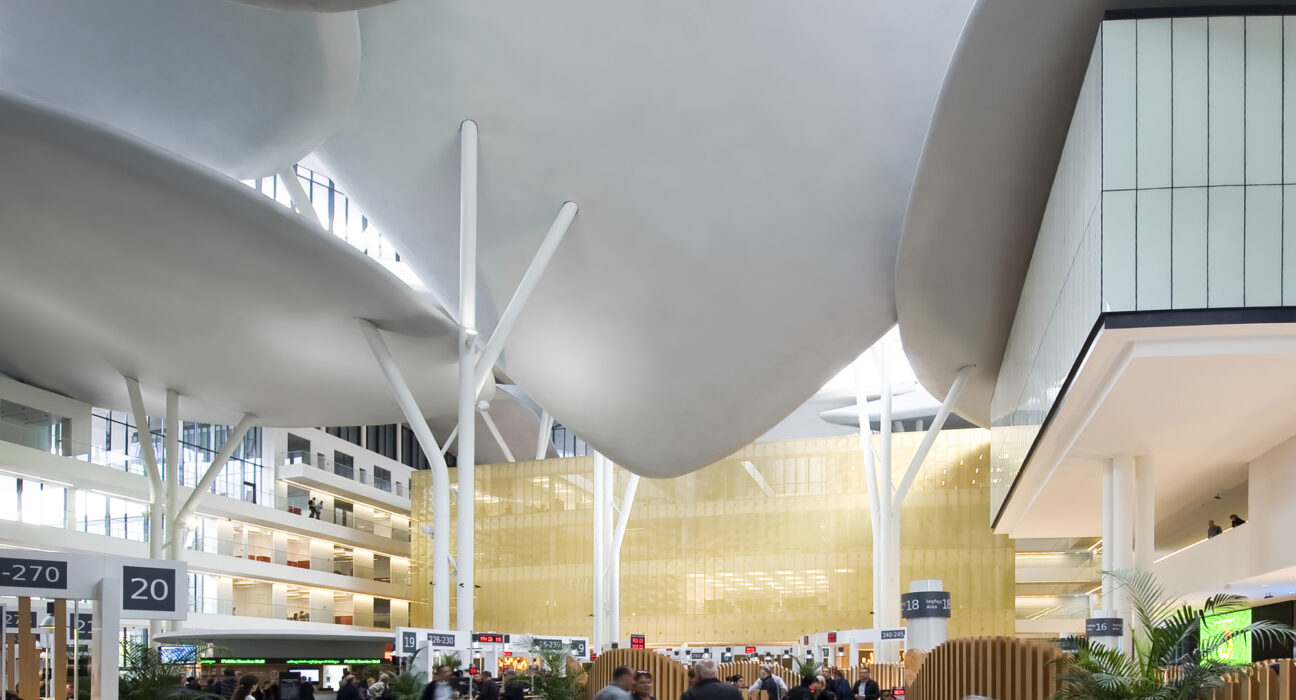
The building is best known for its series of organic roof forms that appear to float above the glazed structure below. These petal-like canopies create a sense of movement and lightness, softening the scale of a very large program. This roof design does more than provide visual identity:
- It creates shade and environmental comfort
- It breaks down the massing of the 42,000 m² complex
- It gives the project a recognizable civic iconography
- It establishes a futuristic yet elegant profile on the riverfront
For followers of luxury architecture, this level of formal ambition is often associated with museums, airports, and cultural institutions. Here, that same design confidence is applied to a public service building.
Transparency as a design principle
Glazing plays a major role in the project’s architectural identity. The extensive use of glass visually opens the interior to the city and helps communicate a message of accessibility. In civic architecture, transparency carries symbolic weight. It suggests accountability, openness, and a break from older models of intimidating institutional space.
This is one reason the building continues to appear in architecture news discussions focused on progressive public design. Its visual permeability reinforces the idea that architecture can shape how citizens relate to government.
Studio Fuksas and the Language of Contemporary Civic Design
Studio Fuksas has built an international reputation through projects that blend engineering complexity with expressive forms. In Tbilisi Public Service Hall, that approach is visible in the dialogue between structure, landscape, and urban placement. The building feels highly designed, but not detached from its public role.
Several characteristics define this architectural language:
- Fluid geometry: The canopies create a softer, more dynamic composition than a conventional government block.
- Urban visibility: The project uses its central location to establish a strong civic presence.
- Integrated experience: Exterior form and interior function are closely linked through openness and circulation.
- Symbolic modernity: The design reflects a city looking forward rather than backward.
For audiences drawn to luxury design and luxury home decor, there is also a broader lesson here: great design is not limited to private residences. Material clarity, sculptural form, and experiential planning can elevate all building types, including civic infrastructure.
Why This Project Still Matters in Architecture News
More than a decade after completion, Tbilisi Public Service Hall remains significant in architecture news because it sits at the intersection of design innovation and public purpose. It is not simply a striking object. It is a building that attempts to reshape the image of administration through architecture.
Its lasting relevance can be traced to a few key ideas:
- Civic buildings deserve design excellence. Public architecture has the power to influence daily life and collective identity.
- Iconic form can support function. Bold aesthetics do not have to come at the expense of usability.
- Location matters. A riverfront urban setting amplifies the project’s symbolic and visual impact.
- Contemporary architecture can humanize institutions. Light, openness, and organic geometry make large-scale public space feel more welcoming.
As cities around the world reconsider how public buildings should serve residents, this project offers a valuable reference point. It shows that civic architecture can aspire to the same elegance, innovation, and emotional resonance often reserved for luxury architecture and cultural landmarks.
Luxury Architecture Lessons from a Public Building
Although Tbilisi Public Service Hall is not a private residence, it shares qualities often celebrated in luxury architecture and luxury home design:
- Strong sculptural identity
- High-impact spatial experience
- Careful relationship between light and structure
- A sense of exclusivity achieved through design rather than ornament
That connection is especially important for design-conscious readers. The project proves that luxury is not merely about expensive finishes. It can also mean ambition, refinement, and the confidence to create memorable spaces that improve how people experience the built environment.
In that sense, the building resonates beyond its category. Whether you are interested in public institutions, contemporary urban landmarks, or luxury decor inspiration rooted in architectural form, Tbilisi Public Service Hall offers enduring design value.
Conclusion
In the world of architecture news, Tbilisi Public Service Hall stands out as a powerful example of civic architecture done with vision. Studio Fuksas transformed a government program into a riverfront landmark defined by transparency, fluid structure, and unmistakable identity.
The takeaway is clear: when cities invest in ambitious design, public buildings can become more than functional containers. They can become symbols of openness, progress, and architectural excellence. Tbilisi Public Service Hall remains a benchmark for anyone following architecture news, luxury architecture, and the future of civic design.