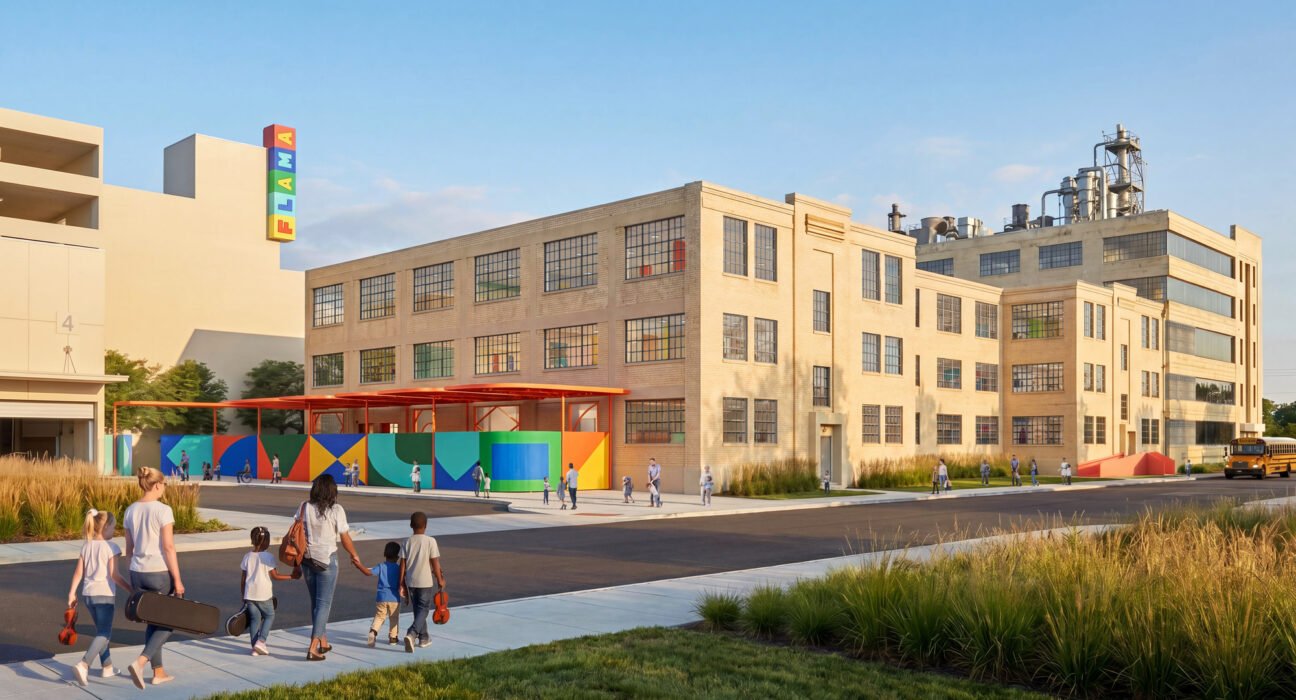
Architecture news rarely captures the imagination like a project that turns an industrial landmark into a cultural engine. In Houston, OMA led by Jason Long is doing exactly that, transforming the historic Folger Coffee Plant into a new music and arts school that promises to blend heritage, education, and design ambition in one powerful adaptive reuse story.
This redevelopment stands out not only because of the building’s past, but because it reflects a larger shift in luxury architecture and luxury design: preserving character while creating spaces that feel future-facing, civic, and deeply experiential. As industrial conversions continue to shape cities worldwide, Houston’s Folger Coffee Plant is becoming a compelling case study in how old structures can support new cultural life.
Architecture News: A New Future for a Houston Landmark
The Folger Coffee Plant has long held a recognizable place in Houston’s urban fabric. Rather than erase that identity, OMA/Jason Long’s vision appears centered on reinvention through respect. That approach is increasingly important in architecture news, where adaptive reuse projects are often judged by how well they preserve memory while delivering contemporary performance.
Turning a former coffee plant into a music and arts school is more than a change of use. It is a complete rethinking of how industrial space can serve the public. Large floor plates, robust structural systems, and dramatic volumes that once supported manufacturing now offer unique opportunities for:
- Performance halls and rehearsal spaces
- Art studios and flexible classrooms
- Gathering areas for students and the wider community
- Exhibition spaces that celebrate both culture and architecture
In the context of Houston, a city known for reinvention, this project speaks to a wider urban narrative. Historic industrial buildings can become catalysts for education, creativity, and neighborhood renewal when guided by a clear architectural vision.
Why Adaptive Reuse Continues to Dominate Architecture News
One reason adaptive reuse remains central to architecture news is that it addresses several priorities at once. It can conserve embodied energy, preserve local identity, and produce one-of-a-kind interiors that new construction often struggles to replicate.
The value of preserving industrial character
Industrial buildings carry a tactile richness that appeals to both designers and users. Exposed steel, concrete frames, expansive windows, and oversized interiors offer a raw architectural language that aligns naturally with arts programming. For a music and arts school, these qualities can create an inspiring atmosphere where creativity feels embedded in the building itself.
From a luxury design perspective, authenticity has become a defining value. Whether in luxury home decor, hospitality, or educational spaces, there is growing appreciation for materials and forms that reveal a building’s story rather than conceal it.
Sustainability through transformation
Another reason this project belongs in architecture news is sustainability. Reusing an existing structure can significantly reduce demolition waste and lower the carbon impact associated with building from scratch. While every renovation comes with technical challenges, the environmental benefits of retaining major structural components often make adaptive reuse a smart long-term strategy.
For cities pursuing more resilient development, projects like this demonstrate that sustainability and architectural distinction do not need to be separate goals.
How OMA/Jason Long May Shape the Experience
OMA is known for conceptual clarity and bold spatial thinking, and Jason Long has been associated with projects that negotiate urban complexity with intelligence and restraint. That makes this commission especially intriguing in current architecture news, because a music and arts school requires more than visual impact. It demands acoustic sensitivity, circulation logic, and a strong relationship between private learning spaces and public-facing cultural zones.
A successful transformation of the Folger Coffee Plant will likely depend on balancing several design priorities:
- Preservation: retaining defining industrial features that anchor the building’s identity
- Flexibility: creating multi-use spaces for education, rehearsal, performance, and events
- Accessibility: making the campus welcoming and easy to navigate
- Community presence: ensuring the project contributes to the city beyond its student population
These priorities also resonate with luxury architecture, where spatial quality is measured not just by finishes but by how elegantly a building supports human experience.
The Design Significance for Luxury Architecture and Interiors
Although the project is civic and educational in purpose, its broader influence extends into luxury architecture and luxury decor trends. High-end design increasingly borrows from adaptive reuse, especially the pairing of refined interventions with rugged original shells. This contrast can create interiors that feel elevated, dramatic, and memorable.
Industrial heritage meets contemporary refinement
Designers across luxury home and luxury home decor have embraced elements first popularized by industrial conversions, including:
- Double-height volumes and open-plan layouts
- Large-format windows and abundant natural light
- Exposed structural materials paired with warm textures
- Minimalist insertions within historic envelopes
That same design language could make the future music and arts school feel both grounded and aspirational. In other words, this is not simply preservation for preservation’s sake. It is the curation of atmosphere, identity, and cultural prestige through architecture.
What This Project Means for Houston
At a city scale, this story matters because landmark transformations can change how neighborhoods are perceived and used. The conversion of the Folger Coffee Plant into a music and arts school may strengthen Houston’s cultural infrastructure while giving new relevance to a historic site.
That is why this project deserves attention in architecture news. It intersects multiple themes shaping the profession today:
- Historic preservation
- Adaptive reuse
- Cultural investment
- Sustainable urban development
- Experiential design
If executed with care, the building could become a model for how legacy industrial properties can be repositioned for public benefit without losing their architectural soul.
Conclusion: A Standout Story in Architecture News
As architecture news continues to spotlight projects that fuse preservation with innovation, OMA/Jason Long’s reworking of Houston’s historic Folger Coffee Plant stands out as one of the most compelling examples. By converting an industrial icon into a music and arts school, the project points toward a richer future for adaptive reuse—one where design excellence, cultural purpose, and urban memory all work together.
The clear takeaway is this: the most meaningful architecture is not always about building anew. Sometimes, it is about seeing hidden potential in the structures a city already has and transforming them into places that inspire the next generation.