Architecture news rarely arrives with this much cultural, urban, and material ambition at once. In Greater Paris, RCR Arquitectes is preparing to open Large, a striking new contemporary art institution on Île Seguin that transforms a former industrial edge into one of the capital’s most compelling luxury design destinations.
Set to open in October 2026, Large marks the Pritzker Prize-winning Catalan studio’s first project in Paris. The building stands on La Pointe des Arts, part of the broader reinvention of Île Seguin from Renault factory grounds into a mixed-use cultural district. For readers following luxury architecture, luxury decor, and the evolution of high-design urban spaces, this project is a major addition to the European cultural map.
Architecture News: A New Cultural Landmark for Paris
This latest piece of architecture news centers on more than a museum opening. Large is conceived as a hybrid cultural institution embedded within a larger urban ecosystem. The 41,000-square-meter development combines:
- 5,000 m² dedicated to a contemporary arts center
- 7,000 m² of retail and foodservice
- 20,000 m² of office space
- An 8-screen Pathé cinema
- A 6,000 m² IMAX venue
- 1,200 m² of landscaped terraces
This layered program reflects the masterplan logic first established for the island’s regeneration. Rather than isolating art from everyday life, the scheme creates a porous destination where exhibition, leisure, commerce, and public circulation coexist. That approach aligns with current trends in luxury design, where experiential environments matter as much as the objects or art they contain.
From Renault Factory to Cultural District
Part of what makes this architecture news so resonant is the site’s history. Île Seguin was long defined by the Renault factory, which operated there from 1919 to 1992 and became a powerful symbol of French industrial production. After demolition in the mid-2000s, the island began a long transition toward a new identity.
Jean Nouvel was appointed master planner in 2009, helping shape the site’s transformation into an eco-conscious cultural hub. The opening of La Seine Musicale in 2017 signaled that the island’s future would be tied to architecture, performance, and public life rather than manufacturing alone.
Large extends that story with unusual sensitivity. Instead of erasing the memory of industry, the project translates it into form, material, and exhibition narrative. Its opening show, Imaginary Engine: From Masterpieces of the Collection Renault to Artists of Today, directly engages the relationship between humans and machines while honoring Renault’s artistic legacy.
RCR Arquitectes’ Design: Monumental Yet Contextual
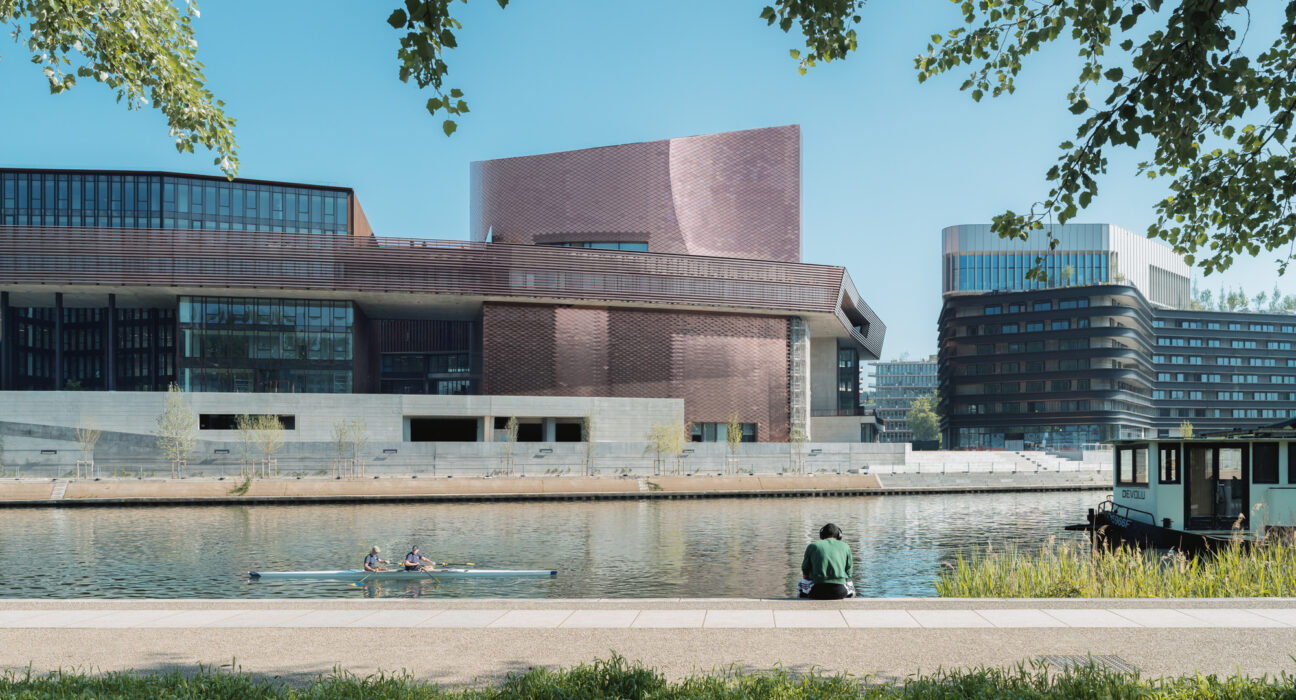
One reason this architecture news is drawing attention is the building’s sculptural massing. RCR Arquitectes organizes the first three floors in a U-shaped composition around an interior street, creating visual and spatial connections from the forecourt to the riverbanks. The architecture opens outward to the Seine, the adjacent park, and the distant hills of Meudon, giving the project a rare sense of breadth for an urban cultural building.
Key architectural features
- A west-facing orientation with expansive views and no direct facing buildings
- An elevated public square at bridge level animated by arts and retail uses
- A lower square at riverbank level linked to shops and hospitality functions
- An arts center volume that cantilevers over the Seine
- Garden terraces that visually merge office spaces with the surrounding landscape
This balance between monumentality and openness is where the project excels. It has the presence of a destination building, yet it avoids becoming overly self-contained. In luxury architecture, that ability to create grandeur without losing urban porosity is increasingly prized.
Material Palette: Corten Steel, Light, and Atmosphere
No piece of architecture news about Large is complete without discussing its materials. The building’s signature envelope is wrapped in Corten steel, whose weathering patina will continue to evolve over time. The rust-toned surface references the island’s industrial past while also giving the structure a rich, tactile identity.
Elsewhere, aluminum-clad elements capture reflections of sky and water, while unfinished concrete grounds the lower plinth in a more rugged, infrastructural language. Light is filtered through mashrabiya-like screens and concealed openings, softening the scale of the glazed surfaces and creating shifting interior atmospheres throughout the day.
For followers of luxury home decor and luxury design, this is an instructive palette: warm oxidized metal, reflective surfaces, textured concrete, and controlled daylight. It shows how industrial references can be elevated into refined, high-end spatial experiences.
Inside Large: Exhibition Design at an Epic Scale
The interior is equally compelling, and this is where the architecture news becomes especially relevant to design professionals. The main exhibition hall is pillar-free, with curved walls spanning roughly 1,000 m². It rises 14 meters high and 42 meters wide, creating a volume that is dramatic yet carefully calibrated.
Additional galleries on the fifth and sixth floors each offer 500 m² of exhibition space. Balconies overlook the main hall, turning circulation into part of the viewing experience. A central core doubles as an unconventional display surface, while a double-helix staircase and matching escalator sequence shape the visitor journey through the building.
Notable interior details include:
- Matte galvanized steel parquet flooring
- Curved gallery walls for fluid exhibition layouts
- Acoustic control designed to eliminate harsh echo despite the scale
- Large framed views to landscaped terraces and the river
The result feels less like a conventional museum and more like a choreographed architectural landscape, where movement, sound, and material finish are as important as the artworks themselves.
Why This Project Matters in Global Architecture News
In today’s architecture news cycle, cultural institutions are increasingly judged on their ability to regenerate neighborhoods, attract international audiences, and create lasting public value. Large appears positioned to do all three.
Its inaugural exhibition will bring together 55 artists from 23 countries, reinforcing the project’s global outlook from day one. At the same time, its curatorial concept remains rooted in local memory, using the factory, the engine, and the assembly line as metaphors for modern life. That fusion of international ambition and place-specific storytelling is exactly what many new art institutions aspire to achieve.
It also places Île Seguin in conversation with other major cultural developments worldwide, from new opera houses and museum renovations to emerging performing arts centers. In that broader context, this architecture news signals Paris’ continued investment in landmark cultural infrastructure with a contemporary, mixed-use twist.
Conclusion: A Defining Piece of Architecture News for 2026
As a work of luxury architecture and civic reinvention, Large stands out as one of the most important pieces of architecture news in 2026. RCR Arquitectes has created more than a new venue for contemporary art: the studio has designed a layered destination that links industrial memory, refined materiality, urban placemaking, and immersive exhibition design.
For anyone watching the future of Parisian cultural development, this architecture news is worth following closely. Large promises to be not just a new building on the Seine, but a powerful example of how post-industrial sites can be transformed into enduring icons of design, art, and public life.