
Architecture news rarely captures the full spectrum of what makes a building matter, but the 2026 RIBA Stirling Prize shortlist comes close. Marking the award’s 30th anniversary, this year’s selection highlights six projects that reflect where British architecture is headed: toward adaptive reuse, civic generosity, sustainable housing, and refined contemporary design.
Presented by the Royal Institute of British Architects, the Stirling Prize honors the UK building judged to have made the greatest contribution to the evolution of architecture. The 2026 shortlist ranges from a forest-edge family home to a major transport-led urban intervention in London, proving that architectural excellence can emerge at every scale. For readers following luxury architecture, luxury home design, and elevated contemporary living, this year’s lineup offers plenty of inspiration.
Architecture News: What the 2026 Stirling Prize Shortlist Reveals
This year’s shortlist is notable not just for its quality, but for its breadth. The six projects span residential architecture, civic infrastructure, higher education, and cultural reuse. Together, they suggest that the most compelling architecture today is less about spectacle and more about long-term value, material intelligence, and public benefit.
- Adaptive reuse remains central to sustainable design
- Housing quality is being treated as an architectural priority
- Public realm is increasingly tied to major mixed-use development
- Heritage interventions are becoming more spatially inventive
- Low-carbon construction is shaping both form and material choices
That makes this round of architecture news especially relevant for anyone tracking luxury design trends, premium residential planning, and the future of the built environment in the UK.
The Six Shortlisted Projects at a Glance
House at Fairmead by Sergison Bates
Set on the edge of Epping Forest, House at Fairmead is a deeply considered family residence that transforms compact planning into a rich spatial experience. Rather than relying on conventional corridors, the home is organized as a sequence of interlinked rooms, with thick walls and deep thresholds incorporating storage, services, and even a discreet lift.
The material palette is restrained yet luxurious in the architectural sense: brick, timber, lime plaster, and cement tiles. Its 650-millimeter insulating clay block walls enhance thermal and acoustic performance, while a dramatic double-height living space brings daylight into the heart of the home. For followers of luxury home and luxury home decor, this project is a reminder that refinement often comes through proportion, craft, and calm materiality rather than excess.
BEAM by Bennetts Associates
In Hertford, BEAM transforms a 1970s theatre into a contemporary cultural hub through adaptive reuse rather than demolition. The retained auditorium is reworked into a larger 550-seat venue, while new cinemas, dance studios, a studio theatre, and a café expand the building’s civic function.
Brick-clad cross-laminated timber volumes wrap around the original structure, preserving memory while introducing a lower-carbon future. This is the kind of architecture news that underlines a key shift in design thinking: existing buildings are increasingly being treated as assets to be reimagined, not obstacles to be removed.
Lion Green Road by Mary Duggan Architects with RUFF Architects
Located in Coulsdon, south London, Lion Green Road delivers 157 homes across a complex sloping site. Its landscape-led masterplan uses five residential pavilions to negotiate topography, protect nearby heritage, and create a connected public environment.
What stands out is the planning intelligence. Apartments are arranged to maximize daylight, natural ventilation, and dual-aspect living, while community gardens, planting, seating, and play areas make the development feel socially generous. In the context of luxury architecture, the project broadens the conversation by showing that quality of life, access to landscape, and spatial dignity are just as important as premium finishes.
Paddington Square by Renzo Piano Building Workshop with Adamson Associates
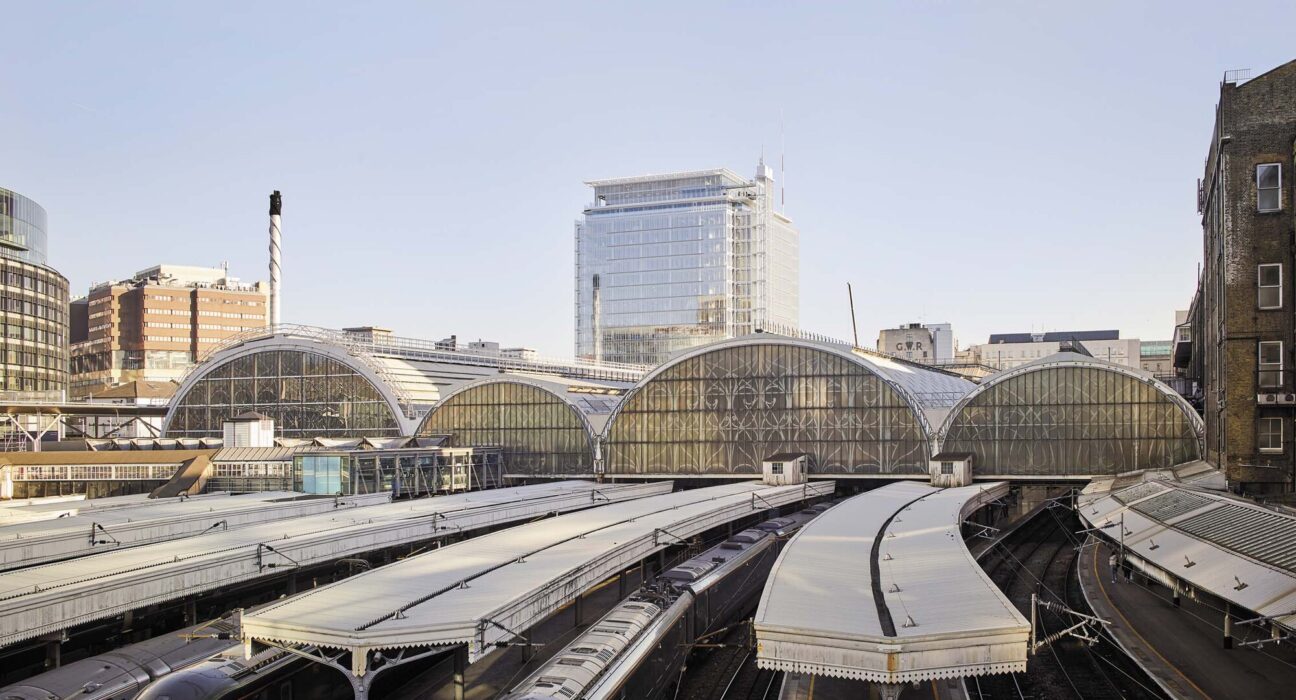
One of the most high-profile entries in this architecture news cycle, Paddington Square sits above one of London’s busiest transport interchanges. The project reconnects a previously fragmented site through a new public square, improved pedestrian circulation, and step-free access integrated with the station below.
The development’s mixed-use program is matched by a sophisticated public realm strategy, extending from street level to an accessible rooftop. Structurally complex yet visually restrained, the glass-clad building shifts between transparency and reflection depending on light conditions. It is an elegant example of how large-scale urban projects can deliver both commercial value and civic benefit.
Pembroke Mill Lane by Haworth Tompkins
In Cambridge, Pembroke Mill Lane combines heritage retrofit with carefully inserted new buildings to expand a college campus in the Historic Core Conservation Area. Six existing buildings are refurbished, including a former church converted into a flexible auditorium, while six new buildings introduce student housing, teaching spaces, and social areas.
The project’s success lies in permeability and integration. Courtyards, gardens, and timber-framed cloisters create a richer campus experience, while sustainability measures such as salvaged materials, triple glazing, photovoltaic panels, and air-source heat pumps demonstrate a serious environmental agenda. It is a strong example of architecture that respects history while meeting contemporary academic needs.
River Wing, Clare College by Witherford Watson Mann Architects
Also in Cambridge, River Wing at Clare College inserts new dining, circulation, and social spaces into a highly sensitive Grade I-listed setting. Built alongside and beneath existing buildings, the intervention responds to heritage constraints, limited access, and flood risk with notable precision.
A prefabricated laminated oak structure supports step-free routes, back-of-house functions, and a timber-lined café overlooking the River Cam. The result is both delicate and transformative, revealing hidden parts of the college while strengthening its connection to the river. For those interested in luxury decor and understated architectural craft, this project offers a masterclass in atmosphere and material warmth.
Why This Architecture News Matters Beyond Awards Season
The Stirling Prize has always been about more than aesthetics, and the 2026 shortlist proves it. These buildings demonstrate that today’s best architecture is increasingly measured by how well it performs socially, environmentally, and spatially.
- Reuse is now a design advantage, not a compromise
- Public space is central to successful urban projects
- Residential excellence includes wellness, light, and adaptability
- Craft and sustainability are working together more closely than ever
For luxury-focused readers, this architecture news also signals a broader cultural shift. High-end design is moving away from overt display and toward enduring quality, responsible materials, and beautifully resolved everyday experience.
When Will the Winner Be Announced?
The winner of the 2026 RIBA Stirling Prize will be announced on October 15 at Old Billingsgate in London. With previous winners including Appleby Blue Almshouse, the Elizabeth Line, the John Morden Centre, and Magdalene College Library, expectations are high for a project that can define this moment in British architecture.
Conclusion
The latest architecture news from RIBA offers more than a shortlist—it provides a snapshot of the values shaping outstanding design in the UK today. From the quiet sophistication of House at Fairmead to the urban ambition of Paddington Square, the 2026 Stirling Prize contenders show that architecture at its best can be sustainable, civic-minded, and deeply elegant. As the October announcement approaches, this architecture news story is worth watching closely.