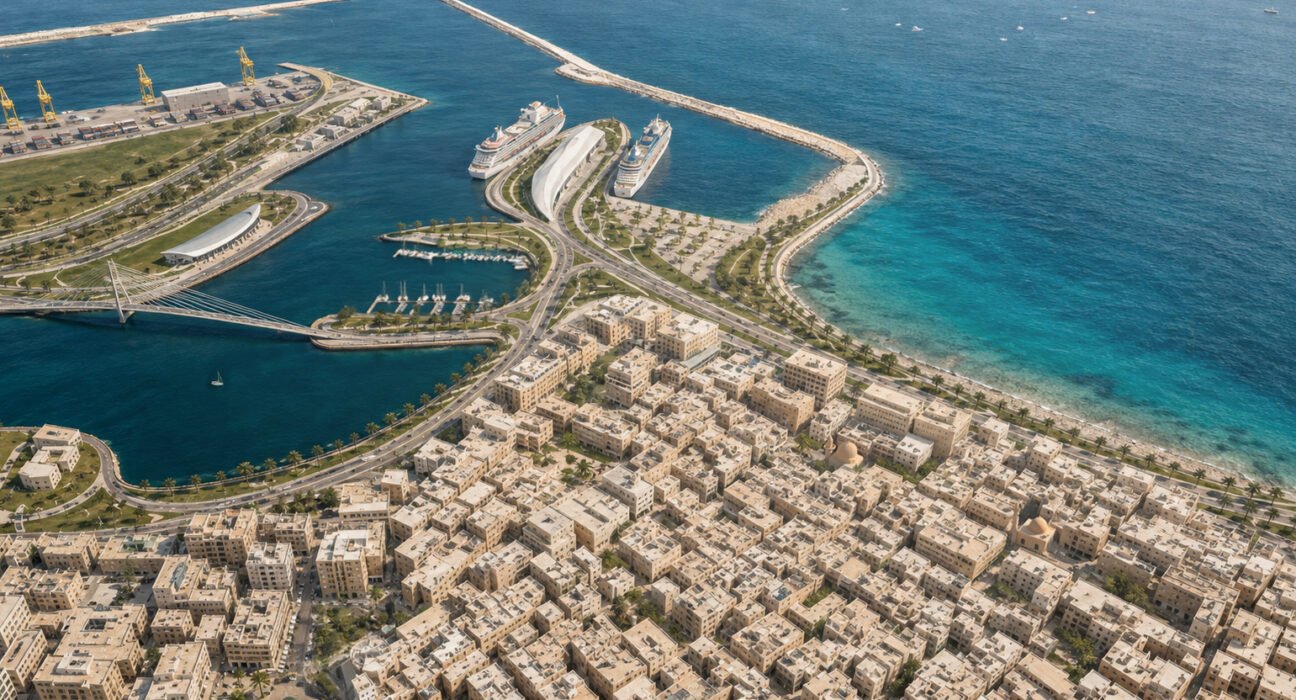
Architecture news rarely captures the full complexity of urban transformation, but Benghazi 2050 is one of those rare proposals that feels both visionary and grounded. Led by Zaha Hadid Architects alongside a multidisciplinary international team, the new concept for Libya’s historic port city outlines how digital planning, waterfront renewal, and heritage-sensitive design can shape a more resilient metropolitan future.
Created for A&O TEC, the proposal introduces a two-part framework for Benghazi’s long-term growth: a Vision and Spatial Strategy, and a Digital Planning Hub. Together, they aim to help manage rapid urbanization while preserving the city’s identity, reconnecting neighborhoods to the Mediterranean waterfront, and coordinating future investment through data-led planning. For readers following luxury architecture, luxury design, and large-scale citymaking, this is a compelling example of how ambitious planning can elevate everyday urban life.
Architecture News Spotlight: What Is Benghazi 2050?
Benghazi 2050 is a concept proposal for a “Next Generation City Plan” designed to guide development in Benghazi through 2050. The team behind the plan includes ZHA, A&O TEC, Prior + Partners, Homa, Buro Happold, Systematica, and Fichtner, combining expertise in architecture, engineering, infrastructure, strategy, and digital systems.
Benghazi occupies a unique position on Libya’s Mediterranean coast. It is not only a historic port but also a major cultural, commercial, and economic center in eastern Libya. As the city enters a new phase of expansion and renewal, the central challenge is clear: how can growth happen without erasing the urban memory, waterfront character, and social fabric that define Benghazi?
The proposal responds with a coordinated urban framework focused on:
- Restoring the relationship between the city and its shoreline
- Celebrating Benghazi’s heritage and historic districts
- Connecting old and new neighborhoods through transport and walkability
- Supporting sustainable water management and ecological diversity
- Using digital tools to guide evidence-based development decisions
The Vision and Spatial Strategy for a Connected Waterfront City
The first component of the project is the Vision and Spatial Strategy, which interprets Benghazi’s identity and translates it into an adaptable framework for future development. Rather than imposing a rigid masterplan, the strategy acts more like a matrix that can evolve over time as new investments, districts, and infrastructure projects come online.
This approach is especially significant in a city experiencing fast-paced change. Benghazi’s future growth will not depend on a single landmark project, but on how effectively many interventions work together across housing, transport, public realm, employment, and environmental resilience.
Reconnecting the historic core and the coast
One of the most striking goals is the reconnection of the historic center with the waterfront. In many Mediterranean cities, the shoreline is both a civic front door and a cultural asset. Benghazi’s plan recognizes that the waterfront can become a defining public realm once again, linking heritage, mobility, and leisure.
The strategy proposes stronger physical and visual ties between:
- The old town and port areas
- Residential districts and metropolitan zones
- Public transport corridors and pedestrian routes
- New knowledge and employment districts
For the luxury architecture audience, this matters because premium urban living increasingly depends on the quality of the wider city, not just individual buildings. Walkable connections, attractive waterfronts, and heritage-rich public spaces are now central to urban value.
Adaptability over rigid planning
Another strength of the plan is its emphasis on adaptability. Instead of treating urban design as a fixed end state, the framework is meant to coordinate phased delivery over decades. That makes it more resilient in the face of economic shifts, demographic change, and environmental pressures.
Natural systems are also integrated into the planning logic, with attention to ecological diversity and sustainable water management. This reflects a broader trend in contemporary urban design: infrastructure and landscape are no longer background elements, but essential structuring tools for future cities.
The Digital Planning Hub Could Change How Benghazi Grows
If the spatial strategy provides the vision, the Digital Planning Hub provides the intelligence. This is the second major pillar of the proposal, and arguably the most forward-looking. In today’s architecture news, digital twins, GIS mapping, and data-driven planning are becoming essential for managing metropolitan growth, and Benghazi 2050 embraces that shift fully.
The Digital Planning Hub brings together available datasets and new digital information into a shared spatial interface. The goal is to map the city in detail, understand the forces shaping it, and provide stakeholders with a common evidence base for decision-making.
What the platform includes
According to the proposal, the hub is designed to incorporate multiple layers of information, including:
- Geographic Information Systems and geospatial datasets
- Three-dimensional urban models
- Population and land-use data
- Transport and infrastructure networks
- Environmental and resilience analysis
- Current developments and future planning scenarios
In practical terms, this means planners, designers, engineers, and public stakeholders can assess proposals within a much wider urban context. Rather than planning in isolation, projects can be evaluated in relation to mobility, density, environmental performance, and surrounding communities.
The long-term ambition is even more significant: the platform can serve as the foundation for a dynamic digital twin of Benghazi. That would allow the city to monitor change over time, test scenarios, and align future delivery with measurable goals.
Why This Matters in Global Architecture News
This project stands out in architecture news because it blends three priorities that are often treated separately: heritage preservation, strategic urban expansion, and digital innovation. Many masterplans excel in visual ambition but struggle to explain implementation. Benghazi 2050 attempts to bridge that gap by pairing a spatial vision with an operational planning tool.
It also aligns with a wider international movement toward waterfront regeneration and brownfield renewal. Similar large-scale plans in cities such as Cluj-Napoca, Lisbon, and Budapest show how former industrial edges, riverfronts, and underused districts are being reimagined as mixed-use, connected, and climate-aware urban quarters.
What makes Benghazi distinctive, however, is its combination of historic significance and future-facing methodology. The project is not just about expansion; it is about restoring civic identity while building a framework for long-term livability.
What Luxury Design Audiences Can Take From Benghazi 2050
For readers interested in luxury home, luxury decor, and luxury design, urban masterplans may seem distant from interiors or residential aesthetics. But in reality, the best luxury environments begin with the city itself. A refined home experience is shaped by waterfront access, mobility, public space, environmental quality, and cultural richness.
Benghazi 2050 suggests a more holistic model of premium urban development, where quality of life is supported by:
- Beautiful and accessible waterfront landscapes
- Integrated transport and walkable neighborhoods
- Heritage-led placemaking
- Smart infrastructure and digital governance
- Resilient ecological systems embedded in the city plan
That broader definition of luxury, one rooted in connection, place, and long-term value, is increasingly shaping the future of global urbanism.
Conclusion
In the latest architecture news, Benghazi 2050 emerges as more than a concept image package. It is a strategic vision for how a historic Mediterranean city can grow with intelligence, preserve its identity, and reconnect with its waterfront through coordinated design and digital planning. If realized over time, the proposal could become a benchmark for resilient urban regeneration in North Africa and beyond.
The clearest takeaway is this: the future of great cities will belong to plans that unite culture, infrastructure, and data. Benghazi 2050 shows how that future might look.