
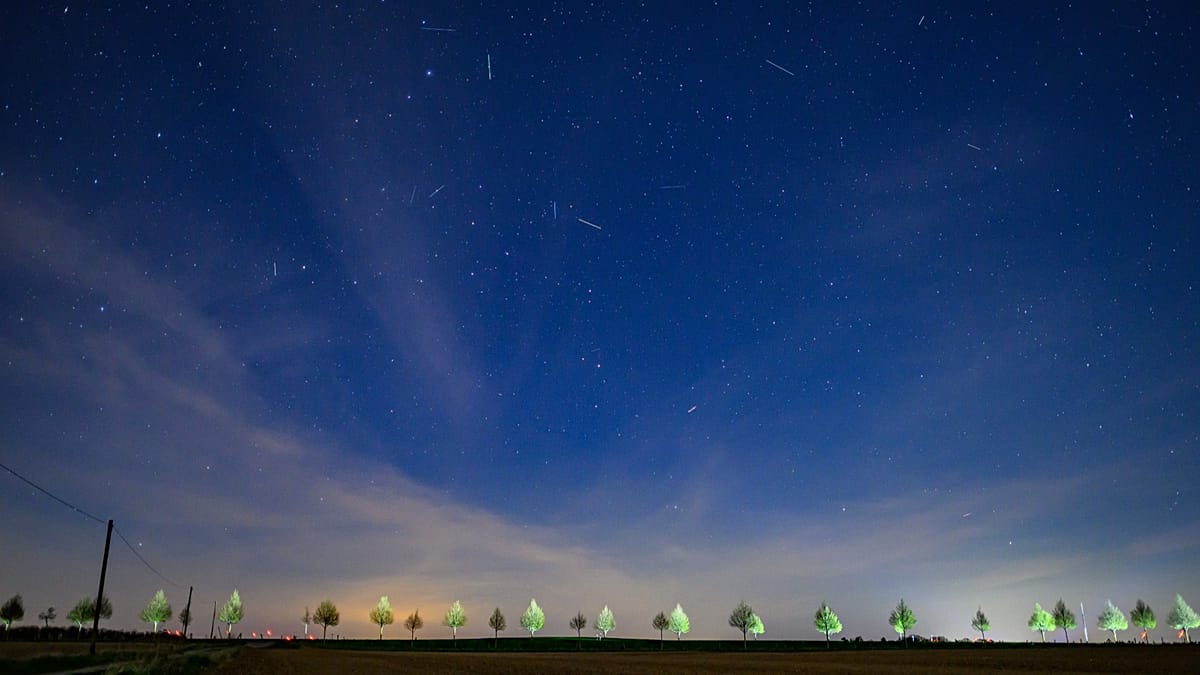
The night sky has always been the ultimate luxury backdrop: rare, immersive, and impossible to replicate. But satellite light pollution is emerging as a serious threat not only to astronomy, but also to the future of luxury design, high-end travel, and dark-sky architecture.
New research from the European Southern Observatory warns that plans to launch up to 1.7 million satellites could dramatically brighten the night sky, undermining observatories, natural darkness, and the visual serenity that many luxury brands and hospitality concepts increasingly treat as premium value. For luxury decor and design sectors built around exclusivity, atmosphere, and sensory experience, this is no longer a niche science story. It is a design story.
Why satellite light pollution matters beyond astronomy
The headline concern is scientific: bright satellite constellations can leave streaks across telescope images and wash out views of the cosmos. Researchers say the impact could become devastating if orbital traffic rises from today’s roughly 14,000 satellites to the far larger numbers proposed by private companies and national programs.
Yet satellite light pollution also has cultural and commercial consequences. Darkness is increasingly understood as a finite luxury resource, much like silence, clean air, and pristine landscapes. In elite hospitality and residential design, access to an unspoiled night sky is becoming part of the amenity package.
- Remote desert resorts market stargazing as a signature experience
- Ultra-luxury villas use outdoor lounges and glass architecture to frame celestial views
- Wellness retreats promote circadian-friendly environments with minimal artificial light
- High-end destinations use dark-sky status as a mark of environmental prestige
If the sky becomes permanently brighter, those experiences lose some of their rarity and emotional impact.
The luxury appeal of darkness in architecture and decor
Luxury design has evolved far beyond marble, metals, and collectible furniture. Today, the most sophisticated spaces are often defined by what they preserve rather than what they add. Natural darkness has become a design asset.
Dark skies as a premium design element
Designers working on estates, eco-resorts, and remote retreats increasingly consider the night environment as carefully as daylight orientation. Outdoor terraces, infinity pools, rooftop observatories, and low-glare landscape lighting all rely on a dark atmospheric setting to feel exceptional.
That is where satellite light pollution becomes relevant to luxury decor. A brighter sky changes ambiance. It softens contrast, reduces visible stars, and alters the sense of stillness that premium exterior environments are designed to create.
Biophilic and wellness-led interiors
There is also a wellness dimension. Research has long suggested that excessive light at night can disrupt biological rhythms in both humans and animals. For luxury brands focused on restorative living, sleep optimization, and biophilic design, preserving darkness is aligned with broader health and sustainability values.
In practical terms, this connects with:
- Circadian lighting strategies in luxury residences
- Outdoor lighting plans that minimize skyglow
- Material palettes designed to support calm, low-sensory environments
- Hospitality concepts centered on sleep, recovery, and nature immersion
What the new satellite research found
According to the European Southern Observatory study, proposed constellations of large and especially bright satellites could make the night sky significantly more luminous. One of the starkest warnings concerns Reflect Orbital’s proposed satellites, which would use mirrors to redirect sunlight to Earth at night.
Researchers said these satellites could appear extremely bright, and that a full deployment of 50,000 could make the entire night sky up to four times brighter. They also warned that images from major observatories, including the Vera C. Rubin Observatory in Chile, could be rendered unusable in many cases.
The observatory team has called for a cap of 100,000 satellites in orbit and for satellites to be dim enough to remain invisible to the naked eye. That position reflects growing concern that satellite light pollution is moving from manageable nuisance to systemic environmental problem.
Luxury travel, branded residences, and the disappearing night sky
For luxury travel operators and developers, the implications are tangible. Stargazing is not a fringe amenity anymore. It is part of the storytelling around exclusivity, remoteness, and ecological integrity. Resorts in deserts, mountains, islands, and protected landscapes often use the promise of untouched skies as a differentiator.
If those skies begin to resemble suburban conditions, brand positioning may need to shift. A destination can still offer privacy and high design, but the emotional power of a truly star-filled sky is difficult to substitute.
This creates new strategic questions for luxury brands:
- Will dark-sky preservation become a stronger part of ESG messaging?
- Could observatory partnerships become a status symbol in hospitality?
- Will architects increasingly design for shielded lighting and sky conservation?
- Might premium buyers begin to value certified dark-sky locations more highly?
As with clean-water access or protected viewsheds, darkness may soon be treated as a scarce environmental amenity.
Design ethics, sustainability, and orbital congestion
The issue does not stop at brightness. Researchers also pointed to environmental concerns tied to mass satellite launches, including energy use, emissions, and the growing risk of space debris collisions. That chain-reaction scenario, often called Kessler syndrome, raises broader questions about how much infrastructure Earth’s orbit can safely absorb.
For luxury design and brand leaders, this is a reminder that sustainability now extends beyond materials sourcing and carbon-conscious construction. It increasingly includes invisible systems that shape the lived experience of place, from soundscapes to biodiversity to satellite light pollution.
The most future-facing luxury concepts may be the ones that recognize environmental quality as the new expression of status. In that context, preserving darkness is not anti-technology. It is about balancing innovation with stewardship.
What happens next
Regulators, especially the US Federal Communications Commission, are under growing pressure to weigh the visual and environmental costs of mega-constellations before granting approvals. Astronomy groups want stricter limits, dimmer satellites, and more serious review of cumulative impacts.
For the luxury sector, now is the time to pay attention. Whether you are shaping a boutique resort, a private residence, a wellness retreat, or an outdoor decor brand, the quality of the night sky is becoming part of the design brief.
In the years ahead, satellite light pollution may prove to be one of the least expected forces reshaping luxury landscapes. The clearest takeaway is simple: true luxury is not just what we build, but what we protect. And that includes the darkness above us.