

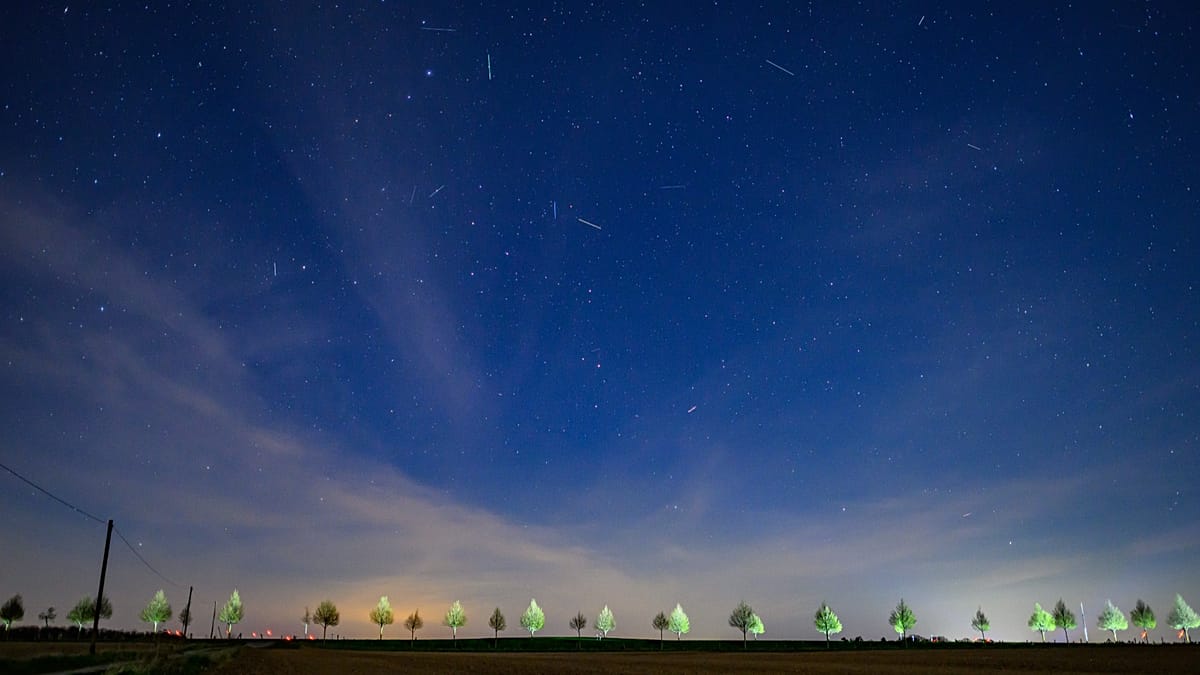
The night sky has long been the ultimate luxury backdrop: timeless, atmospheric, and impossible to replicate. But satellite light pollution is rapidly changing that experience, with researchers warning that planned mega-constellations could make darkness itself a rarity. For architects, interior designers, and developers working at the high end of residential and hospitality design, this is no longer just an astronomy story—it is a design story.
A new study from the European Southern Observatory warns that the rush to place up to 1.7 million satellites in orbit could dramatically brighten the sky, disrupt telescope observations, and alter how people experience outdoor spaces after dark. While scientists are focused on astronomical consequences, the implications extend into luxury architecture, luxury design, and luxury interiors, where natural ambience and sensory experience are central to value.
Satellite Light Pollution Is Reshaping the Luxury Experience of Darkness
In premium design, darkness is not emptiness; it is an asset. A secluded desert retreat, a cliffside villa, or a glass-walled mountain residence often sells not only on views during the day, but on star visibility at night. Satellite light pollution threatens that promise by increasing overall sky brightness and introducing visible moving objects and streaks overhead.
According to the research, some proposed satellite systems would be bright enough to significantly affect the appearance of the night sky worldwide. Scientists say the most reflective concepts could make the sky resemble conditions more commonly associated with suburban light pollution, even in remote areas prized for exclusivity and tranquility.
That matters because luxury buyers increasingly seek homes and resorts that offer:
- Connection to nature
- Wellness-oriented environments
- Low-light, low-noise escapes
- Authentic celestial views for terraces, pools, and outdoor lounges
If satellite light pollution intensifies, the premium attached to dark-sky locations may become harder to protect.
Why Astronomers Are Sounding the Alarm
The European Southern Observatory study warns that an enormous increase from today’s roughly 14,000 satellites to as many as 1.7 million could have devastating effects on ground-based astronomy. Large, bright satellites create streaks across images captured by telescopes, effectively ruining portions of scientific observations.
A Sky That Could Become Four Times Brighter
One of the most concerning proposals involves satellites designed to reflect sunlight toward Earth at night. Researchers say such systems could make the entire night sky up to four times brighter. Even when not directly aimed at an observer, scattered light would remain a major problem.
For observatories, that means compromised data. For the public, it means a transformed sky in which darkness is diluted and stars become harder to see.
The 100,000-Satellite Threshold
Researchers are calling for a cap of 100,000 satellites in orbit and argue that satellites should be dim enough to remain invisible to the naked eye. Regulators, particularly the US Federal Communications Commission, now face mounting pressure to weigh commercial ambition against scientific, environmental, and cultural costs.
What Satellite Light Pollution Means for Luxury Architecture
Luxury architecture increasingly celebrates immersion in the landscape. Expansive glazing, rooftop observatories, outdoor bathing pavilions, and stargazing decks all depend on a compelling night environment. Satellite light pollution introduces a new variable into how architects think about site value and long-term experiential quality.
Several design sectors could feel the impact:
- Remote residential estates: Properties marketed for privacy and pristine skies may see one of their most emotional selling points diminished.
- Ultra-luxury resorts: Nighttime programming—from astronomy experiences to moonlit dining—could lose authenticity.
- Wellness retreats: Circadian-conscious design depends on darkness as much as daylight.
- Observatory-inspired homes: Projects that integrate telescopes or celestial viewing platforms may need to reassess feasibility.
In this sense, satellite light pollution is not merely a technical issue. It affects how architecture frames wonder, calm, and cosmic scale.
Interior Design and the Value of Circadian Darkness
Luxury interiors are increasingly shaped by wellness science. Designers now pay close attention to materials, acoustics, air quality, and lighting temperature. But true nighttime darkness outside the building envelope also plays a role in rest and recovery.
Researchers cited in the broader debate over bright satellite constellations note that loss of dark sky can disrupt the biological clocks of humans and animals. That aligns with a growing design movement centered on circadian health, sleep quality, and sensory restoration.
For luxury interiors, this raises important questions:
- How should bedrooms be designed in a brighter night environment?
- Will blackout systems become even more essential in remote properties?
- Can outdoor-indoor transitions still preserve a sense of natural night?
- How should designers position terraces, skylights, and glazing to maintain visual comfort?
As satellite light pollution grows, interior design may need to work harder to recreate the psychological benefits that naturally dark skies once provided for free.
Beyond Aesthetics: Environmental and Cultural Costs
The concerns do not stop at visual ambience. Scientists also warn of environmental and orbital risks connected to the rapid expansion of satellite networks. Launching millions of satellites carries an energy and resource burden, while growing congestion in orbit raises fears of collisions and cascading debris, known as Kessler syndrome.
There is also a cultural dimension. The night sky is a shared human inheritance—one that has shaped art, ritual, navigation, architecture, and storytelling for centuries. In luxury design, where heritage and emotional resonance are often part of a project’s identity, losing a clear night sky means losing a powerful source of inspiration.
Darkness, in this context, should be understood as a form of environmental scarcity and cultural capital.
How the Design World Can Respond
While regulators and space companies debate next steps, architects and designers do not need to remain passive. The industry can start treating dark skies as a measurable design resource worth protecting.
Practical responses include:
- Prioritising dark-sky impact studies for remote developments
- Integrating low-glare exterior lighting strategies
- Marketing properties with transparent environmental metrics, including sky quality where relevant
- Collaborating with astronomers and ecological consultants on sensitive sites
- Advocating for policy frameworks that recognise satellite light pollution as a real design and environmental issue
For luxury brands, this is also a positioning opportunity. In a market that increasingly values authenticity, wellness, and stewardship, defending access to darkness can become part of a broader sustainability narrative.
Conclusion: Satellite Light Pollution Is a Design Issue, Not Just a Space Issue
Satellite light pollution may sound distant, but its effects could be deeply terrestrial. From the usability of world-class observatories to the atmosphere of a luxury retreat, a brighter night sky changes how places feel, function, and are valued. The clearest takeaway is this: protecting darkness is no longer only the mission of astronomers. It is becoming an important concern for luxury architecture, luxury design, and luxury interiors as well.
If the night sky is one of the last truly universal luxuries, satellite light pollution may be the next major challenge to preserving it.