
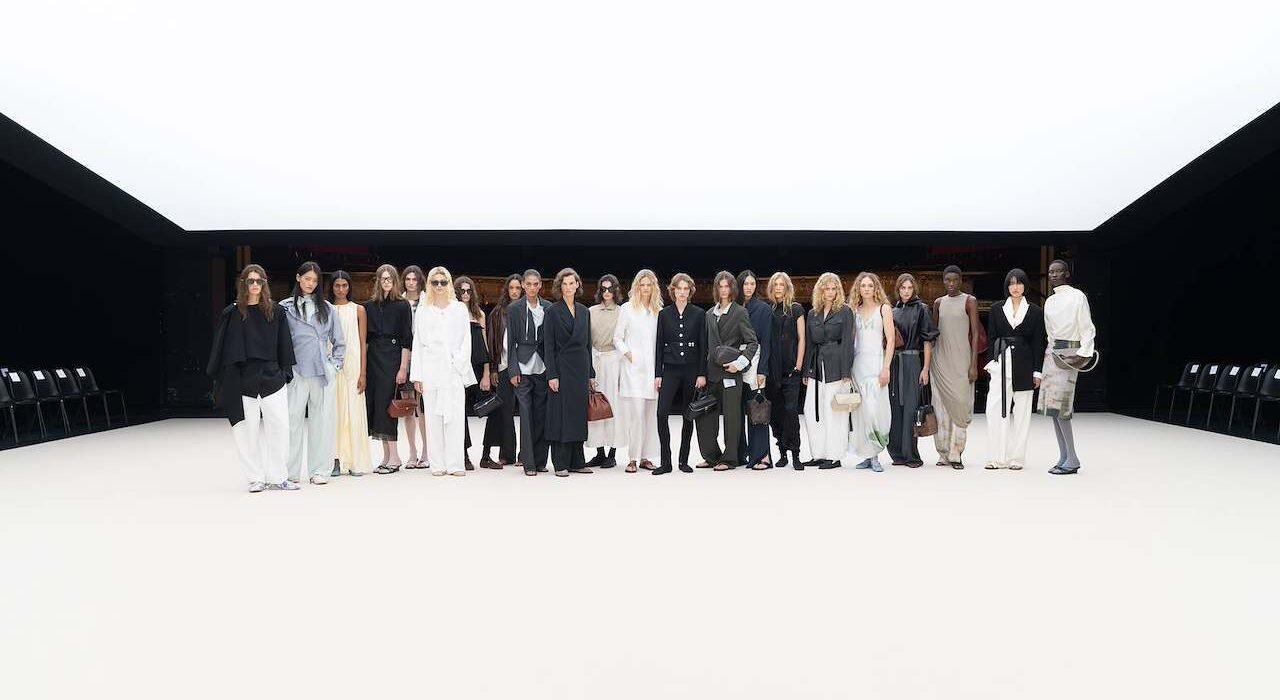
Luxury news Daily turns its attention to one of Paris Fashion Week’s more thoughtful presentations: TIME’s Spring/Summer 2027 show at the Théâtre du Châtelet. Staged on October 5 in one of Paris’s most historic cultural landmarks, the runway became more than a fashion event—it unfolded as a meditation on time, layering, material, and the evolving language of contemporary femininity.
By choosing the Châtelet, TIME placed its latest collection inside a venue already rich with memory. Rather than competing with that legacy, the brand worked with it, building what it described as an “Inner Stage” beneath a sloping illuminated structure. The result was a dialogue between architecture and clothing, where movement, sensation, and storytelling merged into a singular visual experience.
Luxury news Daily spotlight: TIME’s Spring/Summer 2027 vision in Paris
For this season, TIME expanded its ongoing narrative, The First Layer – Into One, by exploring how separate elements can coexist, contrast, and ultimately become whole. The runway concept reflected that philosophy with remarkable clarity. Inside the grand frame of the Théâtre du Châtelet, the brand introduced a second stage, subtly reframing the existing one and reinforcing the collection’s central idea: newness does not always come from adding more, but from seeing what is already there differently.
This concept translated into garments that emphasized structure, restraint, and tactile richness over spectacle. Rather than relying on excess, TIME focused on refinement. Silhouettes appeared composed yet fluid, designed to express inner confidence rather than surface theatrics. In that sense, the collection aligned with a wider shift in luxury fashion toward emotional depth, material honesty, and intelligent minimalism.
An iconic Paris venue becomes part of the collection
The Théâtre du Châtelet was not a neutral backdrop. Built in the 19th century, it carries decades of artistic and human history, making it an especially resonant setting for a brand so interested in memory, time, and transformation. TIME’s decision to layer a new stage within the existing theater echoed the collection’s own visual grammar.
The set design underscored several themes:
- Time as atmosphere: the historical venue brought a sense of continuity and permanence.
- Layering as method: adding an “Inner Stage” mirrored the way fabrics, colors, and emotions were built up in the collection.
- Movement as narrative: the runway emphasized the transitional moment when separate forms become one coherent expression.
For readers following Luxury news Daily, this kind of venue-driven storytelling is increasingly important in high-end fashion. Runway shows are no longer just product reveals; they are immersive brand statements designed to communicate values, heritage, and ambition.
The Moka Lee collaboration adds artistic depth
A major element of the Spring/Summer 2027 collection was TIME’s collaboration with artist Moka Lee. Known for works that examine the relationship between subject, viewer, and artist through portraiture, still life, and landscape, Lee often constructs layered images that hold multiple emotions at once. That visual language proved a natural fit for TIME.
Her practice of reconstruction and image layering closely parallels the collection’s treatment of femininity—not as a fixed identity, but as something shaped by memory, sensation, contradiction, and self-definition. In practical terms, that philosophy emerged in the collection through nuanced surfaces, subtle tonal shifts, and garments that suggested depth without overcomplication.
What made the collaboration effective was its conceptual coherence. It did not feel like an external art-world addition for prestige alone. Instead, it sharpened the brand’s message and gave the collection a richer emotional frame.
Fabric, color, and texture define the Spring/Summer 2027 collection
If the show was intellectually driven, it was also deeply material. TIME placed strong emphasis on the sensory qualities of fabric, using color and texture to express the passage of time and the role of chance in creation. One standout technique was cold dyeing, which allowed pigments to settle naturally into the cloth and produce softly irregular tonal variations.
Those effects gave the garments warmth and individuality, avoiding anything too flat or industrial. Across the collection, materials appeared chosen for their ability to reveal both polish and imperfection:
- Silk delivered light and luster
- Irregular folds captured traces of movement
- Contrasting textures highlighted the tension between softness and structure
- Layered surfaces suggested memory, touch, and transformation
This attention to fabric supports a broader luxury conversation: in a crowded fashion market, authenticity often comes from construction and feel rather than obvious branding. That is one reason the show stands out in Luxury news Daily coverage of the season.
Why TIME’s international strategy matters
Beyond aesthetics, the Paris presentation marked an important moment in TIME’s global expansion. The Korean label has long held a leading position in women’s ready-to-wear at home, originally growing alongside a generation of professional women seeking clothing that combined elegance with functionality. Its roots are deeply connected to social change, particularly the rise of women in the workplace during a period when structural inequality remained pronounced.
Today, TIME is translating that legacy for an international audience. The appointment of Jung In Choi as creative director of the international women’s collection signals serious intent. Under her leadership, the brand appears focused on balancing its heritage with a more global fashion vocabulary—one that speaks equally to tradition, modernity, and self-assurance.
Key takeaways from TIME’s positioning include:
- Strong brand heritage: a meaningful history tied to women’s empowerment and daily elegance.
- Creative clarity: a collection concept that feels disciplined and emotionally resonant.
- Global ambition: a strategic push into the international luxury fashion conversation through Paris.
For industry observers, this matters because it places TIME among the Asian brands using Paris not just for visibility, but for long-term cultural relevance.
The First Layer – Into One: a message of refinement
The phrase Into One captures the collection’s essence. TIME suggests that identity is not assembled through endless accumulation, but through editing, balancing, and clarifying what is already present. That idea was visible in the silhouettes, in the staging, and in the collaboration with Moka Lee.
In a luxury landscape often dominated by noise, the collection proposed something quieter and arguably more lasting: character over excess, purity over overload, and emotion over instant effect. It was a reminder that understated fashion can still carry major narrative force.
Conclusion
Luxury news Daily readers looking for the season’s most conceptually coherent shows should keep TIME Spring/Summer 2027 firmly on their radar. At the Théâtre du Châtelet, the brand delivered a Paris fashion show that combined architectural sensitivity, artistic collaboration, refined materials, and a clear vision of modern femininity. More than a runway presentation, it was a statement about how luxury can feel intelligent, intimate, and internationally relevant all at once.