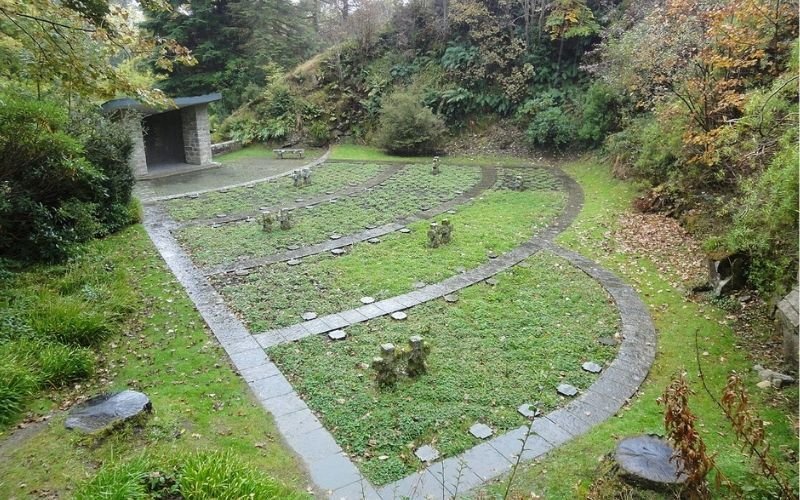
Some of the most memorable Ireland Travel experiences are not found in crowded landmarks, but in places that invite you to slow down and reflect. Tucked into the Wicklow Mountains, Glencree German War Cemetery is one of those rare destinations: serene, moving, and unexpectedly beautiful.
In the world of luxury travel, exclusivity often means privacy, atmosphere, and emotional depth rather than opulence alone. Glencree delivers exactly that. Set inside a former quarry with the Glencree River nearby and a dramatic cross carved into the landscape above, this hidden County Wicklow site offers a different side of Ireland Travel—one rooted in history, remembrance, and the restorative power of nature.
Why Glencree Deserves a Place on Your Ireland Travel Itinerary
Located in the small village of Glencree, County Wicklow, the German War Cemetery honors 134 German soldiers and civilians who died on Irish soil during the First and Second World Wars. The setting is strikingly peaceful, which makes its connection to global conflict all the more poignant.
For travelers seeking meaningful places beyond the standard sightseeing circuit, Glencree stands out for several reasons:
- Secluded beauty: The cemetery sits within a disused quarry surrounded by mountain scenery.
- Historic depth: It connects Ireland, Germany, and wider European history in one compact site.
- Quiet luxury appeal: It offers stillness, space, and reflection—qualities many discerning travelers increasingly value.
- Easy pairing: It fits naturally into a scenic Wicklow Mountains day trip with private touring, heritage stops, and gourmet dining nearby.
In an age when premium Ireland Travel is increasingly about authenticity, Glencree offers a powerful alternative to over-visited attractions.
The History Behind Glencree German War Cemetery
Who is buried here?
The cemetery contains 134 graves. Many of those interred were German servicemen whose bodies washed ashore on Irish coasts or who died after aircraft crashes during World War II. Six graves belong to German soldiers who died in British prisoner-of-war camps in Ireland during World War I.
Another section commemorates 46 German civilians who perished after the sinking of the SS Andorra Star off the coast of County Donegal in 1940. Their remains were later reinterred at Glencree after the cemetery opened.
One of the most notable burials is Major Hermann Gortz, a German agent who made contact with the IRA during the war years. His grave adds another layer of intrigue for visitors interested in wartime intelligence and Irish neutrality.
Why it was controversial
The creation of the cemetery was not straightforward. In the 1950s, the German War Graves Commission asked the Irish government to support a centralized burial place for German war dead in Ireland. Officials were initially hesitant, concerned that such a site might become politically sensitive or symbolic in uncomfortable ways.
After several years of resistance, the proposal was eventually approved. By 1958, attention turned to Glencree, where a former quarry was identified as the ideal location. The site’s natural dignity and quiet grandeur helped secure support, and the cemetery officially opened in 1961 after a modest public ceremony.
That backstory makes Glencree especially compelling for Ireland Travel readers interested in lesser-known heritage destinations with strong historical context.
A Place of Reflection in the Wicklow Mountains
What makes Glencree exceptional is not only its history, but its atmosphere. The cemetery is framed by stone, water, and woodland, with mountain air and a powerful sense of calm defining the experience. It feels removed from modern noise, making it ideal for travelers who value contemplative luxury and scenic immersion.
This is also a place tied to reconciliation. Glencree itself has a layered history: it was once home to a British Army barracks, later served other civic purposes, and in modern times became associated with peace and dialogue through the Glencree Centre for Peace and Reconciliation. That evolution gives the cemetery a broader meaning. It is not simply a burial ground, but part of a landscape shaped by memory, conflict, and healing.
Every November, ambassadors from Germany, France, Belgium, and Luxembourg join Irish attendees and representatives of the Royal British Legion for remembrance ceremonies here. The annual gathering underscores Glencree’s continuing role in honoring victims of war and fostering shared reflection.
How to Visit Glencree in Style
For luxury-focused Ireland Travel, Glencree works best as part of a curated Wicklow itinerary. Rather than treating it as a quick stop, build your day around the region’s natural elegance and heritage appeal.
Recommended ways to experience Glencree
- Book a private driver-guide for a seamless journey from Dublin through the Wicklow Mountains.
- Pair it with scenic stops such as Sally Gap, Glendalough, or the Military Road.
- Choose an off-peak visit for maximum tranquility and better light for photography.
- Add a refined lunch or afternoon tea at a country house hotel in Wicklow.
- Allow time to walk and absorb the landscape rather than rushing through.
The cemetery is not a grand tourist spectacle, and that is precisely its charm. For sophisticated Ireland Travel, it offers something increasingly rare: a genuine sense of discovery.
What Makes This Hidden Gem So Memorable?
Glencree leaves an impression because it combines multiple elements travelers often seek but rarely find together:
- Unspoiled natural scenery
- Deep emotional resonance
- European wartime history in an Irish setting
- Minimal crowds
- A strong sense of place
There is even a cultural footnote that adds to its intrigue: Charlie Chaplin reportedly visited the cemetery while it was under construction during one of his trips to Ireland in the 1960s era. It is a small detail, but one that reinforces Glencree’s quiet pull on curious visitors.
For anyone planning thoughtful Ireland Travel, this cemetery proves that the country’s most rewarding destinations are not always the most famous. Sometimes they are the places that ask for silence, attention, and time.
Conclusion: A Different Kind of Ireland Travel Experience
If your ideal Ireland Travel itinerary includes beauty, history, and meaningful moments away from the crowds, Glencree German War Cemetery deserves a place on your list. It is a hidden Wicklow retreat where landscape and memory meet, offering visitors a rare blend of solemn heritage and peaceful mountain scenery.
In luxury travel terms, Glencree is not about excess—it is about privilege of access, quiet, and perspective. Visit slowly, take in the surroundings, and you will leave with something more lasting than a photo stop: a deeper understanding of Ireland’s complex past and its gift for creating spaces of reflection.