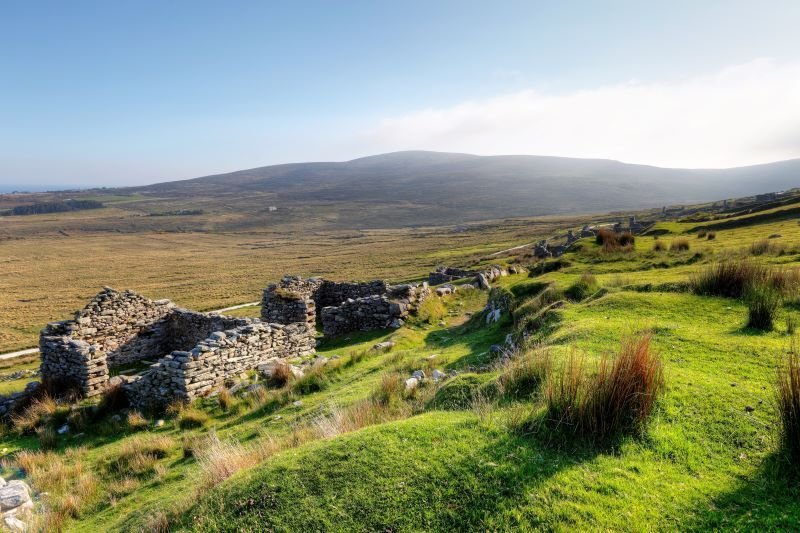
Ireland Travel often conjures up grand manor stays, Michelin-starred dining, and dramatic coastal drives—but some of the country’s most unforgettable destinations are the places people left behind. Across windswept islands, mountain slopes, and former medieval ports, Ireland’s historic ghost villages reveal a quieter, more haunting side of the island that pairs beautifully with a refined, slow-travel itinerary.
For luxury travelers seeking more than postcard scenery, these deserted settlements offer rare access to Irish history, culture, and landscape in their purest form. From Achill Island to Kerry and Donegal, each site tells a story of resilience, migration, weather, famine, and changing fortunes. Here’s how to experience them as part of a richly layered Ireland Travel itinerary.
Ireland Travel Through Time: Why Ghost Villages Belong on a Luxury Itinerary
Luxury Travel in Ireland is no longer defined solely by five-star hotels and private chauffeurs, though both are easy to find. Today’s high-end traveler is often looking for meaning, privacy, and memorable storytelling. Ireland’s ghost villages deliver all three.
These abandoned places are compelling because they connect visitors to the human side of the landscape. Rather than simply admiring a coastline or mountain pass, you begin to understand who once lived there, how they survived, and why they were forced to leave. That perspective adds depth to any Ireland Travel experience.
- Exclusivity: Many of these sites feel remote and uncrowded.
- Cultural richness: They illuminate Ireland’s medieval, monastic, and famine-era history.
- Scenic drama: Expect Atlantic vistas, ruined stone cottages, and wild natural beauty.
- Elegant pairings: They can be combined with boutique hotels, luxury lodges, and private guided tours.
Five Historic Ghost Villages to Add to Your Ireland Travel Wish List
1. Slievemore, Achill Island, County Mayo
Perhaps the most visually striking of Ireland’s deserted settlements, Slievemore stretches along the lower slopes of Slievemore Mountain on Achill Island. Nearly 100 stone cottages remain, arranged in a way that still hints at a once-functioning community.
The site is believed to have been used into the 20th century as seasonal “booley” homes, where families stayed during summer grazing periods. Yet archaeological evidence suggests habitation reaches much further back, likely to medieval times. Walking here feels immersive rather than museum-like: ancient tracks, field systems, and the mountain backdrop create an atmosphere of deep stillness.
For an elevated Ireland Travel experience, pair Achill with a luxury coastal retreat in Mayo and arrange a private local guide who can explain the area’s agricultural past and cultural significance.
2. Great Blasket Island, County Kerry
Off the coast of the Dingle Peninsula, Great Blasket Island is one of the most evocative abandoned communities in Ireland. Once home to a small Irish-speaking population, the island became known for its literary and linguistic importance as well as its traditional way of life based on fishing, farming, and weaving.
In 1953, the remaining islanders were evacuated to the mainland as isolation and severe weather made life increasingly unsustainable. Today, visitors can still see many of the structures left behind, though time and Atlantic weather have taken their toll.
This is an exceptional stop for Ireland Travel enthusiasts interested in language, island culture, and rugged seascapes. The finest way to visit is by combining a stay in a high-end Dingle accommodation with a seasonal boat excursion and a visit to the Blasket Centre for historical context.
3. Port, County Donegal
Tucked away near Glencolmcille, the ghost village of Port is among the most haunting sites in Donegal. Built from local stone, the crumbling cottages belong to what is thought to have once been a thriving maritime settlement.
Port’s abandonment is widely linked to the Great Famine, making it especially poignant. Unlike places where some residents remained, this appears to have been a village that was almost entirely lost. The result is a landscape that feels suspended in grief and memory.
For travelers planning Ireland Travel in the northwest, Port offers a striking counterpoint to Donegal’s celebrated luxury escapes, cliffside drives, and contemporary food scene. A private guided route through southwest Donegal can place the village in the wider story of famine and emigration.
4. Clonmines, County Wexford
Clonmines stands apart for its medieval pedigree. Once a prosperous settlement with a river port, castles, religious buildings, and strong Norman-era connections, it flourished after the arrival of William Marshal in the 13th century.
Its decline came when the river that supported its trade gradually dried up in the 1600s. What remains now are ruins and traces of a once-important town, much of it on private land. Even so, Clonmines is one of the most fascinating destinations for travelers interested in forgotten urban history rather than rural abandonment alone.
In a luxury Ireland Travel itinerary, Wexford works beautifully with country house stays, historic estates, and curated heritage touring.
5. Inis Cathaig (Scattery Island), County Clare
Scattery Island, set in the Shannon Estuary near Kilrush, combines monastic heritage with the remains of a more recent island community. Founded in the 6th century by St. Senan, the island contains the ruins of six churches and an impressive round tower rising roughly 120 feet.
The island also preserves traces of everyday life long after its religious foundation: cottages, a street, graves, and a lighthouse all speak to a population that gradually dwindled before the island became uninhabited in the late 20th century.
Seasonal ferry access and guided tours make Scattery one of the more accessible abandoned sites in Ireland Travel planning. It pairs especially well with luxury stays in Clare, golf excursions, or private tours along the Wild Atlantic Way.
How to Experience Ghost Villages in Style
If you want to blend heritage exploration with comfort, keep these strategies in mind:
- Base yourself well: Choose a five-star hotel, manor house, or design-led coastal retreat within driving distance.
- Book expert guides: Local historians add nuance you won’t get from signboards alone.
- Travel seasonally: Late spring to early autumn offers the best access, especially for islands.
- Dress for conditions: Even luxury-focused Ireland Travel means embracing weatherproof footwear and layers.
- Combine themes: Pair ghost villages with fine dining, whiskey tastings, spa stays, or scenic helicopter transfers where available.
The Deeper Appeal of Ireland’s Abandoned Places
What makes these sites so memorable is not only their beauty, but their emotional resonance. They remind visitors that the Irish landscape is shaped as much by absence as by presence. Empty cottages, ruined churches, and deserted island lanes speak powerfully of communities that adapted for centuries before circumstances forced change.
For thoughtful travelers, this is where Ireland Travel becomes transformative. You are not simply sightseeing—you are stepping into stories of endurance, loss, and identity that still echo across the land and sea.
In the end, Ireland’s ghost villages are among the country’s most moving destinations. For anyone planning an elevated, meaningful Ireland Travel escape, they offer a rare mix of history, solitude, and unforgettable scenery—proof that some of Ireland’s greatest treasures are the places left behind.