
Architecture news rarely feels as consequential as this. With the UIA World Congress of Architects 2026 now underway in Barcelona, the city has become a live testing ground for how architecture can respond to climate pressure, housing challenges, material scarcity, and shifting cultural expectations.
Running from June 28 to July 2, the 29th edition of the triennial congress is organized by the International Union of Architects and unfolds across several venues in Barcelona and Sant Adrià de Besòs. Under the theme “Becoming. Architectures for a Planet in Transition”, the event gathers architects, students, institutions, and researchers from more than 130 countries for a wide-ranging debate on the future of the built environment. For readers tracking high-end design, urban transformation, and forward-thinking residential trends, this is architecture news with clear implications far beyond the conference circuit.
Architecture News From Barcelona: Why UIA 2026 Matters
Barcelona last hosted the congress three decades ago, and its return comes at a pivotal moment. Named UNESCO World Capital of Architecture 2026, the city is using the event to frame architecture not just as a design discipline, but as a tool for ecological repair, civic resilience, and material innovation.
The congress is expected to draw around 10,000 participants and is structured as a distributed urban event rather than a single-site convention. That matters because the format mirrors the message: architecture today must engage with real places, real infrastructures, and real communities.
Among the issues shaping this year’s architecture news agenda are:
- Climate emergency and coastal adaptation
- Housing affordability and social trust in cities
- Circular construction and material reuse
- Public space at multiple scales
- Digital systems, computation, and AI in architecture
- The civic role of institutions, awards, and professional culture
For the luxury architecture and luxury home sectors, these themes are especially relevant. Premium design is increasingly judged not only by aesthetics and exclusivity, but also by environmental intelligence, longevity, and responsible sourcing.
The Theme “Architectures for a Planet in Transition” Explained
The congress program is organized around six thematic axes, each designed to expand how architecture is discussed and practiced. Together, they create a framework that feels highly current within global architecture news and design discourse.
The six thematic axes
- Becoming More-than-human — exploring the relationship between architecture, ecosystems, and non-human life
- Becoming Circular — focusing on reuse, waste reduction, and material cycles
- Becoming Embodied — addressing construction methods, labor, and physical experience
- Becoming Interdependent — examining governance, collective responsibility, and shared urban futures
- Becoming Hyper-Conscious — considering data, digital systems, and technological awareness
- Becoming Attuned — looking at cultural production, atmosphere, and spatial sensibility
This structure makes the congress more than a sequence of lectures. It positions architecture as a multidisciplinary field touching policy, economics, landscape, infrastructure, and daily life. That breadth helps explain why this moment in architecture news resonates with architects, developers, interior designers, and luxury homeowners alike.
The Central Exhibition at Three Chimneys Is a Major Highlight
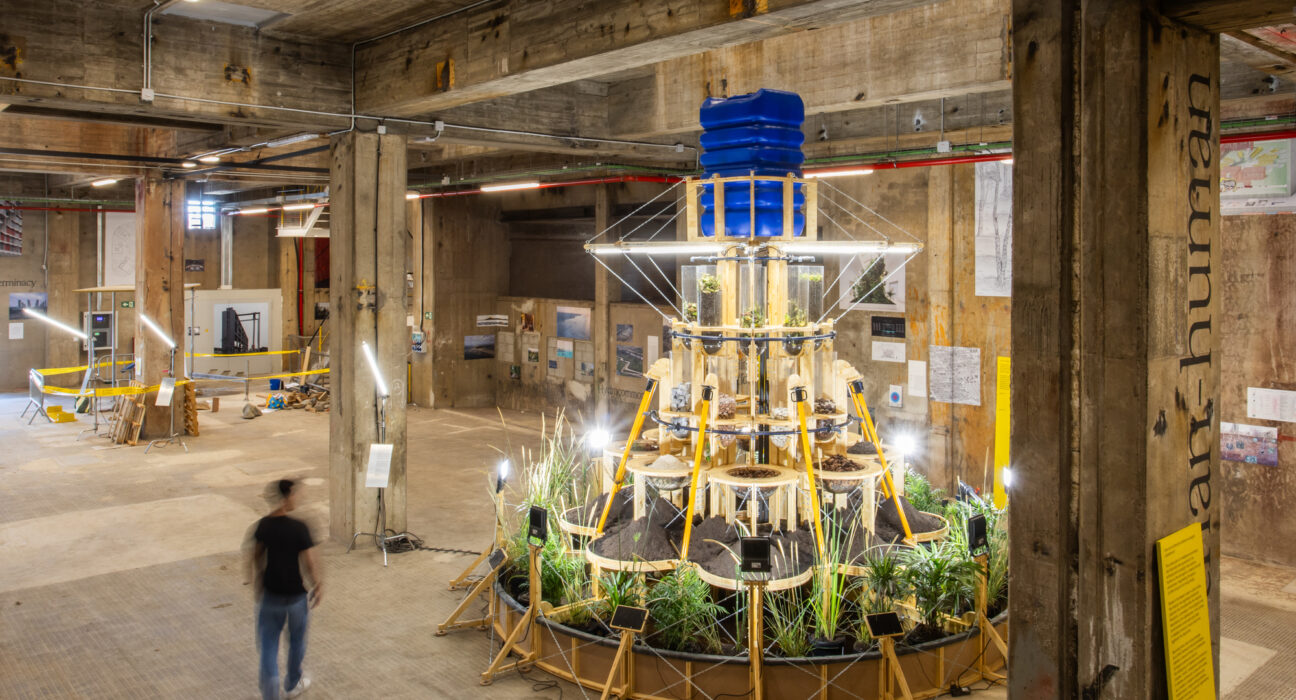
The emotional and intellectual core of the event is the Central Exhibition at the Three Chimneys complex, a former power plant in Sant Adrià de Besòs. The turbine hall has been transformed into a 4,000-square-meter laboratory for experimentation, filled with installations, models, drawings, prototypes, videos, and research-driven design proposals.
Rather than presenting architecture as polished imagery alone, the exhibition foregrounds process, systems thinking, and urgent problem-solving. It brings together 12 Research by Design commissions, more than 200 contributions from speakers, student work, and competition entries.
Key exhibition themes and standout contributions
Projects on view address some of the most pressing topics in current architecture news:
- Water scarcity and wastewater reuse in dense urban environments
- Circular building methods using mineral and organic waste
- Invisible atmospheric forces that shape spatial experience
- Housing, legislation, and public accountability
- Spatial investigation as a design and political tool
Featured contributors include Colectivo C733, BAUKUNST, BC Architects, H Arquitectes, BRUTHER, and Forensic Architecture. The exhibition also incorporates the results of the International Emerging Workshop, which brought together 180 students from around the world, plus selected works from UNESCO-UIA student and young architect competitions.
Importantly, the exhibition will open to the general public free of charge from July 3 to July 19, extending the congress beyond the professional audience.
Speakers, Venues, and the Ideas Shaping Global Design
The broader program unfolds across three major venues: the CCIB, Disseny Hub Barcelona, and the Three Chimneys complex. More than 250 international speakers are participating in over 40 sessions, debates, workshops, presentations, and public forums.
Several headline conversations stand out in this cycle of architecture news. Junya Ishigami is set to explore blurred boundaries between nature and architecture, while Kate Orff and Dirk Sijmons address water systems and coastal adaptation. Lacaton & Vassal, in dialogue with H Arquitectes, focus on building longevity—an increasingly important value in both sustainable and luxury residential design.
Later sessions bring in Marina Tabassum and Palinda Kannangara on climate-responsive construction, Jan Gehl on urban life and trust, and Mariana Mazzucato on the economics of the common good. The program also turns toward computation and speculation through Mario Carpo’s discussion of AI in architecture, while Forensic Architecture examines territory, evidence, and spatial politics.
The UIA Gold Medal ceremony at the Sagrada Família adds symbolic weight, while the final day closes with the reading of the Congress Manifesto and the handover to Beijing, host of the next congress in 2029.
What This Means for Luxury Architecture and Home Design
For those in luxury architecture, luxury decor, and luxury home design, the lessons emerging from Barcelona are practical as well as philosophical. Today’s premium spaces are being shaped by a new definition of value—one that merges craft, comfort, sustainability, and adaptability.
Key takeaways from this architecture news moment include:
- Material intelligence is becoming a luxury standard. Reclaimed, circular, and low-impact materials are moving from niche to aspirational.
- Long-life buildings are gaining prestige. Flexibility, retrofit potential, and enduring quality now matter as much as visual drama.
- Nature integration is deepening. Designers are thinking beyond landscaping toward water systems, microclimates, and biodiversity.
- Research-led design is influencing residential projects. High-end homes increasingly reflect performance-based thinking, from passive cooling to healthier interiors.
- Cultural meaning remains essential. The most compelling luxury spaces still deliver atmosphere, narrative, and emotional resonance.
In that sense, the congress is not only a major event in professional architecture news; it is also a preview of where refined living environments are headed next.
Conclusion: Barcelona Sets the Tone for the Next Era of Architecture
The UIA World Congress 2026 is more than a global gathering—it is a statement about architecture’s evolving responsibility. By centering ecology, housing, circularity, and public life, Barcelona is showing that design excellence and planetary awareness are no longer separate conversations.
For anyone following architecture news, this congress offers a clear takeaway: the future of luxury and mainstream design alike will be shaped by resilience, reuse, intelligence, and beauty in equal measure. As the profession looks toward 2029 and beyond, Barcelona has set a bold and timely benchmark.