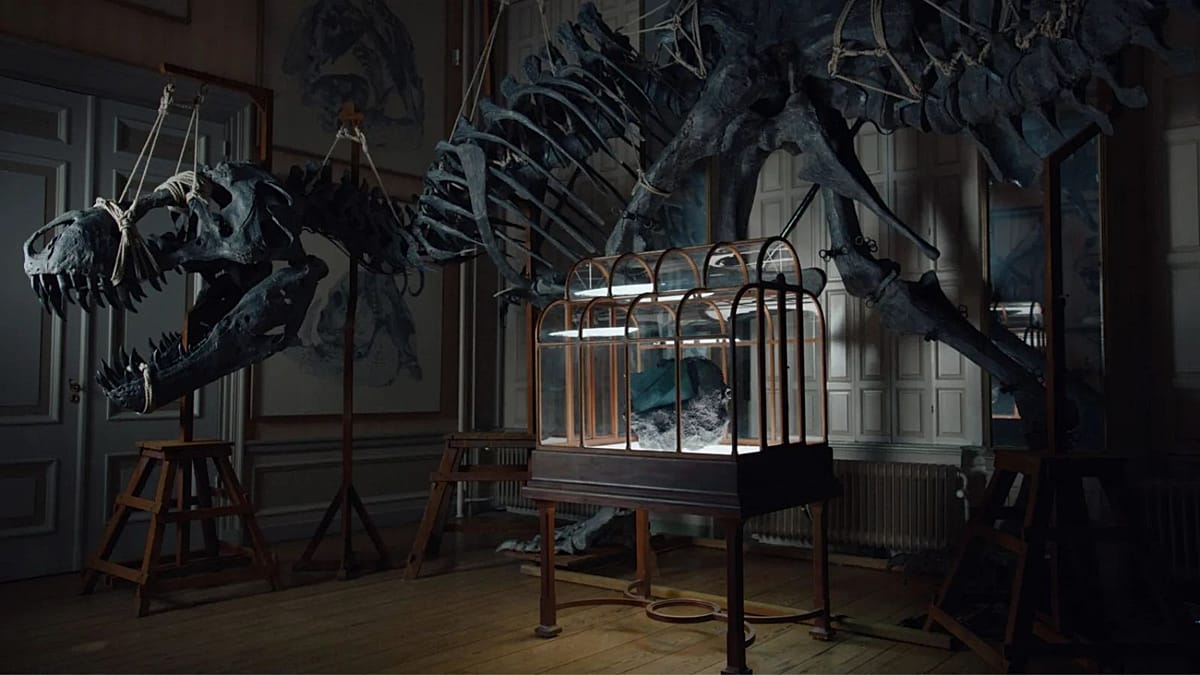
Luxury has always thrived on rarity, craftsmanship and a compelling story—but T-Rex leather introduces a new frontier altogether. Blending biotechnology, artificial intelligence and material innovation, this speculative-yet-real biomaterial concept is pushing the conversation far beyond fashion and into luxury architecture, luxury design and luxury interiors.
Originally unveiled through a one-off luxury handbag, T-Rex leather was developed as a lab-grown leather alternative using reconstructed dinosaur collagen. The result is not simply another sustainable material experiment; it is a provocative blueprint for how future luxury surfaces may be imagined, valued and specified.
What Is T-Rex Leather?
T-Rex leather is a biofabricated material created from collagen sequences linked to fossilised Tyrannosaurus rex remains, then reconstructed using AI-assisted computational biology. Scientists reportedly began with fragments of fossil collagen and used advanced modelling to fill in missing genetic information, enabling the collagen structure to be rebuilt and translated into a lab-grown leather material.
Rather than relying on animal hides, the process points toward a new class of engineered biomaterials that can be grown in controlled environments. That makes T-Rex leather especially relevant to premium sectors seeking sustainable alternatives without sacrificing exclusivity, tactile richness or narrative value.
Why this matters for luxury categories
- Luxury design gains a material with unprecedented storytelling power.
- Luxury interiors may benefit from new high-end upholstery and wall-surface options.
- Luxury architecture could eventually integrate biofabricated finishes with a lower dependence on conventional animal-based materials.
T-Rex Leather and the New Language of Luxury
For years, lab-grown leather has struggled with perception. It has often been framed as a substitute—measured against traditional leather rather than appreciated as a category of its own. T-Rex leather changes that framing by introducing rarity through innovation, not extraction.
In luxury markets, desirability is rarely about utility alone. Materials become iconic when they combine performance with provenance. Marble from a legendary quarry, hand-finished bronze, rare hardwood veneers and artisanal textiles all carry cultural weight. T-Rex leather inserts biotechnology into that tradition, creating a material whose value lies in both scientific ingenuity and emotional resonance.
That shift is important for designers and specifiers. Instead of asking whether a biomaterial can imitate conventional leather, the better question becomes: can it offer a richer aesthetic, ethical and conceptual proposition? In elite design circles, the answer may increasingly be yes.
How AI Helped Make T-Rex Leather Possible
Artificial intelligence played a central role in the development of T-Rex leather. Because fossil records are incomplete, scientists needed computational tools to infer and reconstruct missing sections of the collagen code as accurately as possible. In simple terms, AI made the leap from fragmentary prehistoric data to usable biological design more feasible.
This reveals a broader trend across luxury design innovation: AI is no longer just a visualisation tool or a marketing assistant. It is becoming part of material creation itself. In architecture and interiors, that could influence everything from:
- Custom biomaterial development
- Surface optimisation for durability and texture
- Low-waste fabrication workflows
- Faster prototyping for bespoke luxury applications
As digital tools increasingly merge with biological engineering, material authorship is being redefined. Tomorrow’s most coveted finishes may be designed as much in the lab as in the atelier.
Potential Applications in Luxury Interiors and Architecture
Although the first expression of T-Rex leather arrived as a handbag, its real long-term potential may lie in spatial design. Premium interiors are ideal testing grounds for next-generation materials because clients in this market value exclusivity, texture and innovation.
Where it could appear first
- Bespoke upholstery: statement seating, headboards and lounge installations
- Decorative panels: wrapped walls, cabinet fronts and luxury retail fixtures
- Hospitality design: private members’ clubs, boutique hotels and high-concept suites
- Yacht and jet interiors: ultra-premium environments where rarity drives material selection
For luxury architecture, biofabricated materials such as T-Rex leather could support a broader move toward high-performance natural-feel surfaces with controlled production standards. If scalability improves, designers may specify these materials not just for novelty, but for traceability, consistency and environmental positioning.
Sustainability, Scarcity and the Future of Biofabricated Materials
The real power of T-Rex leather lies in how it combines two ideas that luxury often struggles to reconcile: sustainability and scarcity. Traditional luxury has often depended on finite resources, intensive extraction or animal-derived materials. Biofabrication offers a different route—one where rarity can be created through intellectual property, craftsmanship, limited production and scientific sophistication.
That does not mean every experimental biomaterial will become commercially viable. Challenges remain, including:
- Scaling production without losing quality
- Meeting luxury performance expectations
- Pricing competitively at the ultra-premium end
- Securing trust among designers, buyers and clients
Still, the direction of travel is clear. High-end consumers increasingly want materials that signal innovation as much as status. In that context, T-Rex leather feels less like a gimmick and more like an early indicator of where aspirational design is heading.
Why Designers Should Pay Attention Now
Even if T-Rex leather remains niche in the near term, it marks an important shift in material culture. The luxury sector is entering an era in which the most desirable surfaces may be defined by their origin story, biotech credentials and speculative appeal just as much as their finish or feel.
For interior designers, architects and luxury brand strategists, the lesson is simple: material innovation is becoming a competitive advantage. Clients are looking for spaces and objects that feel singular, forward-thinking and culturally relevant. Bioengineered materials can satisfy that desire in ways conventional finishes may no longer be able to.
T-Rex leather may have begun as a bold concept piece, but its significance is much larger. It suggests that the future of luxury design will not merely preserve heritage materials—it will invent entirely new ones. And for luxury architecture, luxury interiors and collectible design, that could be the most exciting evolution of all.