

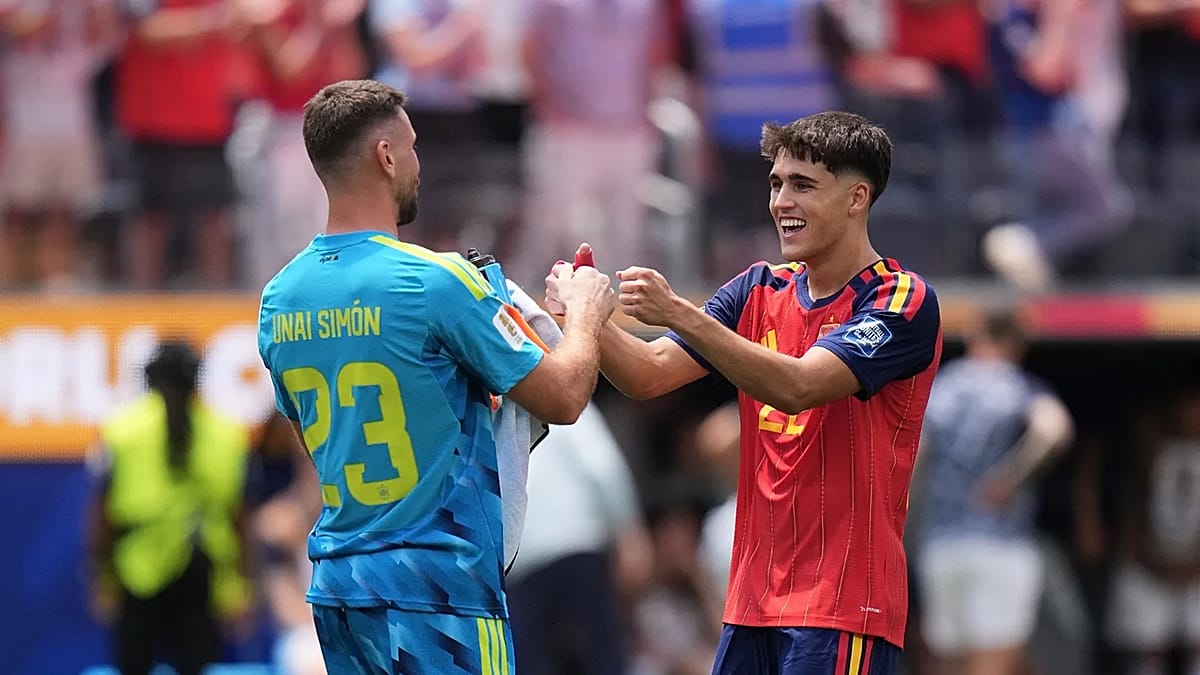
Great design is often judged by what it reveals, but elite performance is just as often defined by what it prevents. Unai Simón’s World Cup record, set during Spain’s 3-0 win over Austria, offers a striking lesson in structure, restraint, and precision—qualities that resonate far beyond football and into the worlds of luxury architecture, luxury design, and luxury interiors.
With 519 consecutive World Cup minutes without conceding a goal, Spain’s goalkeeper surpassed the long-standing mark of 518 minutes previously held by Italy’s Walter Zenga. The achievement is historic in sporting terms, yet it also reflects a broader principle familiar to top designers: excellence is built through disciplined systems, flawless execution, and confidence under pressure.
Unai Simón’s World Cup record and the art of controlled performance
Unai Simón’s World Cup record did not happen in a single dramatic moment. It was the result of sustained consistency across multiple matches, including clean sheets against Austria, Cape Verde, Uruguay, and Saudi Arabia in the 2026 tournament, combined with shutout minutes carried over from Spain’s 2022 campaign.
That kind of continuity mirrors the way exceptional spaces are created. In luxury architecture, the most admired homes and hospitality environments are rarely defined by one standout feature alone. Instead, they succeed because every element works together:
- Proportion and balance shape the overall experience
- Materials support both beauty and durability
- Circulation and flow reduce friction
- Lighting enhances clarity, mood, and function
- Fine detailing protects the integrity of the whole concept
In the same way, Unai Simón’s World Cup record represents more than shot-stopping. It reflects a system in which timing, positioning, communication, and composure all align. Like a carefully composed interior, the result appears effortless only because the underlying framework is so strong.
Why Spain’s defensive structure felt like luxury design in motion
Spain’s 3-0 victory over Austria was not merely efficient—it was elegant. Luis de la Fuente’s side controlled the contest with assurance, while Mikel Oyarzabal’s finishing and Marc Cucurella’s creative contributions gave the attack polish and rhythm. Pedro Porro’s headed goal added to the sense that every component of the team was operating with clarity.
That balance between creativity and protection is central to luxury design. The best high-end spaces never sacrifice comfort for visual impact, nor function for style. They create a seamless dialogue between expression and order.
What luxury interiors can learn from Spain’s performance
The parallels are surprisingly clear. Spain attacked with confidence because the team’s defensive foundation was reliable. In luxury interiors, designers often create bold focal points only when the practical backbone of the space has been fully resolved.
Consider the shared principles:
- Confidence comes from structure: A well-planned layout supports expressive design choices.
- Calm is a premium feature: Just as Simón remained composed under pressure, serene interiors rely on disciplined editing.
- Details matter most at the highest level: Finishes, transitions, and hidden functionality define true luxury.
- Consistency builds trust: Whether in sport or spatial design, repeated excellence is what creates a lasting reputation.
Unai Simón’s World Cup record can therefore be seen as a masterclass in invisible excellence—the kind of achievement that high-end design professionals understand well. When everything is working perfectly, the audience notices the beauty first, not the complexity behind it.
A record built over time, not by accident
One reason Unai Simón’s World Cup record carries such weight is that it bridges tournaments. His clean-sheet streak included minutes from Spain’s 2022 match against Morocco, which ended in a penalty shootout loss, as well as the closing phase of the group-stage defeat to Japan. By carrying that defensive resilience into 2026, Simón turned isolated moments into a narrative of endurance.
That long-view approach is deeply relevant in luxury architecture. Landmark residences, boutique hotels, and bespoke interior projects are not judged only at launch. Their value lies in how well they endure—visually, functionally, and emotionally.
Designers and architects often speak about timelessness, but timelessness is really the product of smart continuity. It comes from choices that remain coherent over years rather than merely impressive for a season. Unai Simón’s World Cup record embodies that same idea: longevity achieved through precision.
Spain vs Austria: a performance defined by refinement
While the record understandably drew headlines, Spain’s overall display against Austria deserves attention in its own right. Oyarzabal opened the scoring before halftime from a low ball delivered by Cucurella. Porro then extended the lead with a headed finish, and Oyarzabal sealed the result late on with another composed strike from a second Cucurella assist.
Austria’s goalkeeper Alexander Schlager prevented the scoreline from becoming even more emphatic, but Spain still looked fluid, organised, and consistently dangerous. It was a polished team performance, marked by the kind of effortless sophistication associated with luxury design projects that appear simple only because every layer has been refined.
That is perhaps the most compelling angle of all. Unai Simón’s World Cup record may belong to one player statistically, but it was supported by a collective framework—just as a standout interior relies on architects, designers, artisans, lighting specialists, and makers all working in harmony.
What comes next after Unai Simón’s World Cup record
Spain now moves on to a high-profile knockout clash with Portugal in Dallas, a fixture that brings added drama given Cristiano Ronaldo’s presence. Yet regardless of what happens next, Unai Simón’s World Cup record has already secured its place in tournament history.
For readers interested in luxury architecture, luxury design, and luxury interiors, the story offers an unexpected but valuable reminder: true greatness is often quiet. It is found in discipline, in structure, and in the ability to make immense pressure look controlled. Unai Simón’s World Cup record is not just a football milestone—it is a study in the elegance of systems that hold firm when everything is on the line.
And that, in both sport and design, is the essence of lasting luxury.