

Australia-Fiji Defence Pact Reshapes Pacific Strategy and Regional Influence
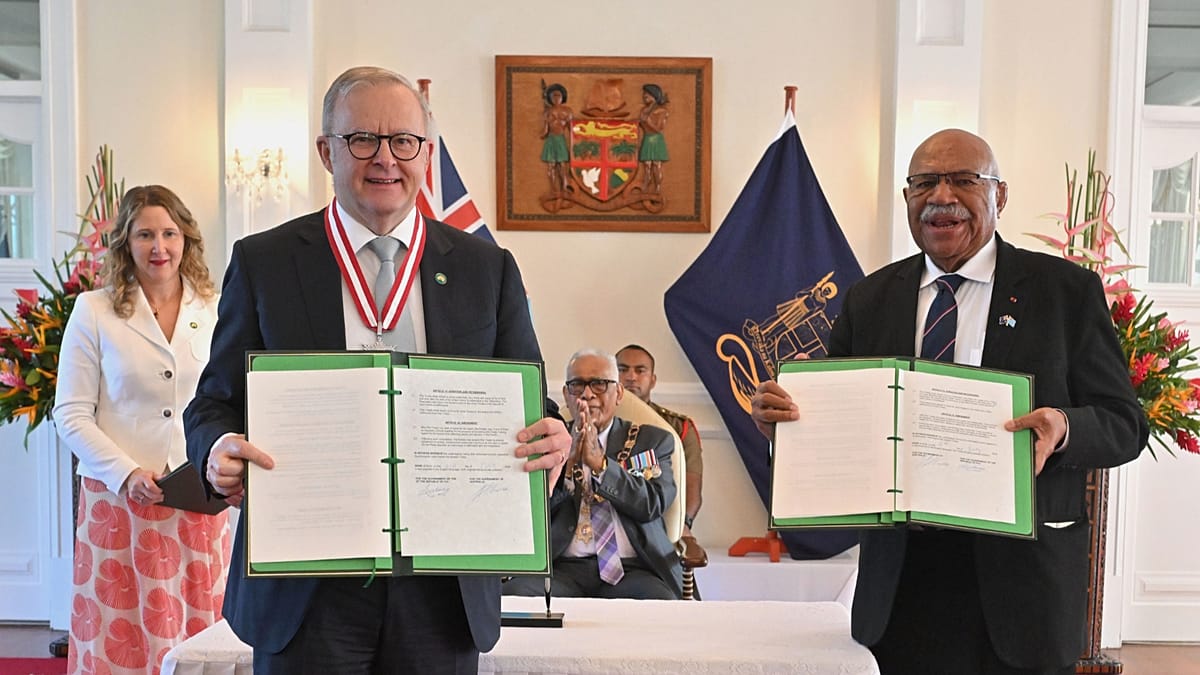
The new Australia-Fiji defence pact marks a significant shift in Pacific geopolitics, with implications that reach far beyond military policy. Announced in Suva alongside a major long-term investment package, the agreement signals a renewed contest over influence, stability, infrastructure and strategic alignment across the South Pacific.
Although defence treaties are not an obvious fit for luxury architecture, luxury design or luxury interiors, high-level geopolitical agreements often shape the investment climate that drives premium development, hospitality expansion and waterfront real estate across island nations. In regions where security and economic confidence go hand in hand, policy changes can ripple into the built environment.
What the Australia-Fiji Defence Pact Includes
The Australia-Fiji defence pact, formally introduced as the Ocean of Peace Alliance, creates Fiji’s first mutual defence treaty. Under the agreement, both nations commit to aiding one another in times of need, elevating their relationship to a new strategic level.
At the same time, both governments signed a separate economic framework known as the Vuvale Union. Australia says it will invest more than AUD 1 billion over the next decade in Fiji, reinforcing not only security ties but also long-term economic cooperation.
Key elements of the agreement
- A mutual defence obligation between Australia and Fiji
- Expanded bilateral cooperation on regional security
- A decade-long Australian investment commitment exceeding AUD 1 billion
- Stronger political alignment in the South Pacific
For Australia, this is another step in reinforcing its role as a preferred regional partner. For Fiji, it provides new security assurances while preserving diplomatic flexibility with larger powers, including China.
Why the Australia-Fiji Defence Pact Matters Now
The timing of the Australia-Fiji defence pact is especially notable. It was signed on the same day Chinese state media reported a submarine test-launch of a long-range ballistic missile in the South Pacific. Australian officials criticised the move as destabilising, arguing that it adds to concerns over China’s rapid military expansion and lack of transparency in the region.
This context makes the treaty more than a routine bilateral arrangement. It is part of a wider struggle over influence in the Pacific, where island nations have become central to strategic competition between Australia, China and other regional actors.
Australian Prime Minister Anthony Albanese has intensified efforts to rebuild Canberra’s relationships in the Pacific since 2022, when China signed a secretive security deal with the Solomon Islands. That agreement prompted widespread concern in Australia and among allies over the potential for a future Chinese naval foothold in the South Pacific.
The broader strategic backdrop
- China has expanded its diplomatic and security presence in Pacific island states.
- Australia is seeking to reaffirm itself as the region’s most trusted partner.
- Pacific governments are balancing economic opportunity with sovereignty and security concerns.
- Infrastructure and development financing remain key tools of influence.
In that sense, the Australia-Fiji defence pact is both symbolic and practical. It demonstrates that security partnerships are increasingly tied to investment, diplomacy and national development.
Regional Reactions and China’s Role
Fijian Prime Minister Sitiveni Rabuka indicated he does not expect severe backlash from Beijing, stressing that the new arrangements do not undermine Fiji’s relationship with China. That measured tone reflects the delicate balancing act many Pacific governments must perform. China remains a major source of trade, funding and infrastructure interest across the region, even as security concerns grow.
Australia, meanwhile, has been more direct. Foreign Minister Penny Wong said Canberra regards China’s missile test as destabilising and has raised concerns about the lack of transparency surrounding Beijing’s military intentions.
The Australia-Fiji defence pact therefore sits at the intersection of diplomacy and deterrence. Rather than openly excluding China, it strengthens an alternative framework of partnership built around security guarantees and economic engagement.
A Wider Pattern Across the Pacific
The Australia-Fiji defence pact is not an isolated development. It follows a series of recent agreements designed to deepen Australia’s strategic presence across the Pacific.
Among the most important:
- Australia’s defence treaty with Papua New Guinea is taking effect this week.
- Australia and Vanuatu recently signed a bilateral security and economic treaty.
- Canberra is pursuing further discussions with the Solomon Islands on security cooperation.
- Regional summits with Pacific leaders are reinforcing these diplomatic efforts.
Taken together, these moves reveal a coordinated strategy. Australia is using defence cooperation, development finance and political engagement to counterbalance China’s growing influence while reassuring Pacific states that their sovereignty and economic priorities will be respected.
What This Could Mean for Investment and the Built Environment
While the Australia-Fiji defence pact is fundamentally a security story, its economic dimension could have secondary effects for sectors linked to design, tourism and construction. Stability is often a prerequisite for premium resort development, coastal master planning, infrastructure upgrades and high-end residential investment.
For markets connected to luxury architecture and luxury interiors, stronger economic support can improve confidence in:
- Hospitality-led mixed-use developments
- Airport, port and civic infrastructure projects
- Luxury resort renovation and expansion
- Demand for refined local-meets-global design concepts
In Pacific nations, architecture and design are deeply connected to identity, climate resilience and international capital. As governments secure new funding streams and strategic backing, the conditions for carefully planned development often improve. That does not guarantee a luxury building boom, but it can create a more stable backdrop for long-term investment.
Conclusion: A Security Deal With Regional Consequences
The Australia-Fiji defence pact is a pivotal development in the South Pacific, combining mutual defence commitments with substantial economic investment. It underscores Australia’s determination to remain a central regional partner at a time of heightened concern over China’s military posture and diplomatic reach.
More broadly, the Australia-Fiji defence pact shows how modern influence in the Pacific is no longer defined by security alone. It is shaped by aid, infrastructure, diplomacy and confidence in the future. For investors, policymakers and observers of regional development alike, this agreement is a strong signal that the Pacific will remain one of the world’s most strategically important arenas.