
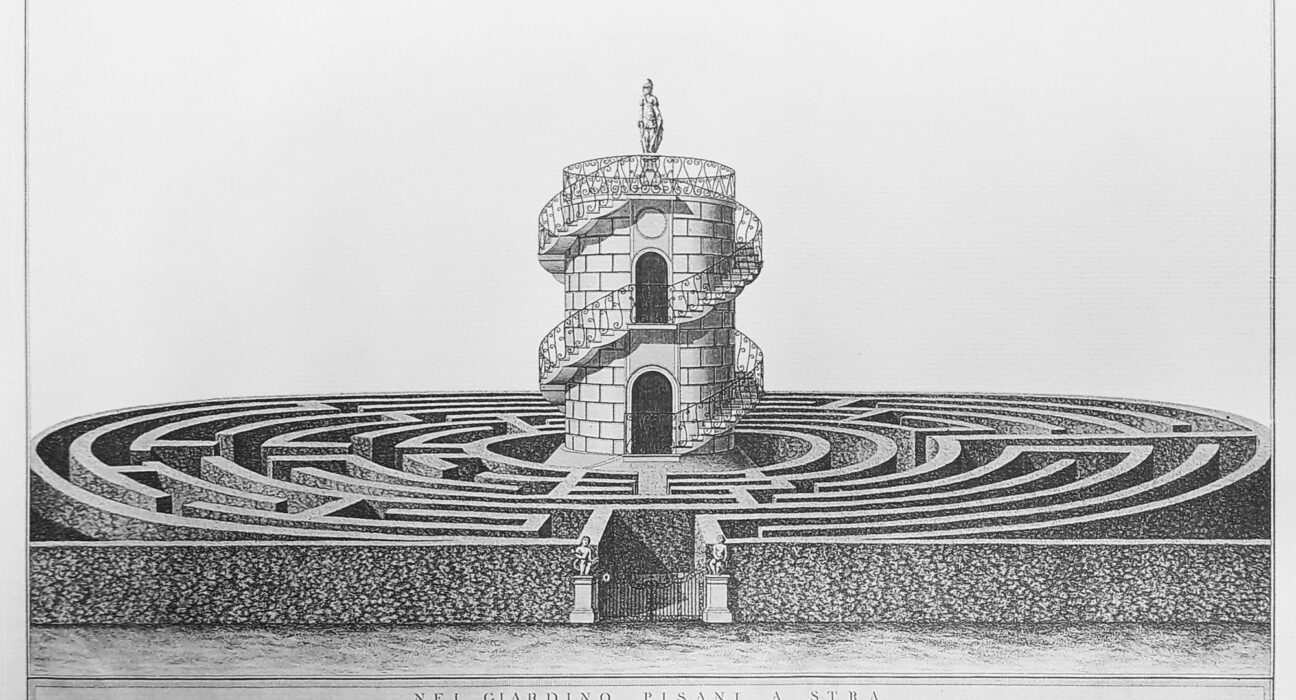
Architecture news often celebrates precision, clarity, and seamless circulation—but a newly highlighted book argues that some of the most powerful spaces do the opposite. O Livro dos Labirintos, by Francesco Perrotta-Bosch, offers a provocative reading of architecture through the idea of the labyrinth, revealing how uncertainty, movement, and gradual discovery can shape richer spatial experiences.
For readers invested in luxury architecture, luxury home design, and elevated interiors, this is more than a scholarly detour. It is a reminder that the most memorable environments are not always the most obvious ones. Sometimes, the highest form of design lies in what unfolds slowly: a sequence of rooms, framed views, hidden gardens, layered thresholds, and moments of surprise that transform circulation into experience.
Architecture News Spotlight: A Book That Sees Architecture as a Labyrinth
Published after five years of doctoral research conducted between FAU USP and Università IUAV di Venezia, Perrotta-Bosch’s book investigates the labyrinth across nearly four millennia. Rather than treating it as a mere ancient symbol, the study examines the labyrinth as a recurring architectural principle—one that appears in different eras, building types, and cultural frameworks.
The book begins with the mythic Labyrinth of Crete, traditionally attributed to Daedalus, and asks a striking question: why would architecture’s origin story be tied to a form that resists legibility and rejects straightforward movement? That question shifts the conversation away from architecture as pure rational construction and toward architecture as lived, bodily, emotional experience.
This framing gives the subject unusual relevance in today’s design culture. In an age obsessed with optimization, mapping, and frictionless movement, the labyrinth reintroduces complexity. It suggests that architecture can be meaningful not only when it directs us efficiently, but also when it invites exploration.
The Labyrinth as a Luxury Design Idea
What makes this especially compelling for luxury architecture is the way the labyrinth aligns with premium spatial values. In high-end homes, boutique hospitality, museums, and private landscapes, designers often create environments that reveal themselves gradually rather than all at once. The effect is sophisticated, intimate, and immersive.
Seen this way, the labyrinth is not simply a maze. It is a design logic built on sequence, anticipation, and sensory layering. It can appear in:
- Processional entrances that conceal the full home on arrival
- Courtyards and gardens discovered through framed passages
- Gallery-like interiors that unfold room by room
- Luxury retail and hospitality layouts that encourage wandering
- Large residences where light, texture, and proportion shift as one moves
For luxury home decor and interior architecture, this principle matters because exclusivity is often tied to experience. A space feels more refined when it offers depth, rhythm, and discovery instead of instant visual saturation.
From Ancient Myth to Modern Buildings
One of the book’s strongest contributions is its long historical arc. Perrotta-Bosch follows the labyrinth from Greco-Roman antiquity through medieval cathedrals and early modern gardens, then into contemporary programs such as museums, airports, and shopping centers. Across these examples, the labyrinth evolves from literal figure to organizational logic.
That distinction is important. A contemporary building does not need hedge walls or a mythical plan to be labyrinthine. It becomes labyrinthine when it structures experience as a route—when movement through the building is sequential, interpretive, and partially unpredictable.
In many contemporary spaces, this strategy is already familiar:
- Museums use circulation to build narrative and anticipation.
- Airports organize travelers through controlled flows and layered thresholds.
- Shopping centers often choreograph wandering, visibility, and return paths.
- Luxury residences create privacy and drama through transitional zones.
This is where the book intersects with current architecture news in a meaningful way. It offers language for something many designers practice intuitively: the idea that movement is not secondary to form, but central to how architecture is understood.
Why Uncertainty Still Matters in High-End Architecture
Modern architecture has often privileged transparency, openness, and immediate orientation. Perrotta-Bosch challenges that legacy by showing the value of environments that disclose themselves progressively. In the labyrinth, error and backtracking are not failures; they are part of the experience.
That perspective has surprising relevance for luxury design. In premium residential projects, complete visual exposure can flatten atmosphere. By contrast, carefully managed uncertainty can heighten elegance. A concealed stair, a narrowing corridor that opens into a double-height salon, or a landscaped path that reveals a pavilion only at the last moment—all of these gestures create emotional resonance.
In practical terms, architects and designers can translate this thinking into high-end projects through:
- Layered entry sequences
- Strategic use of partial views
- Contrasts between compression and expansion
- Interconnected indoor-outdoor circulation
- Material changes that mark progression through space
These techniques are especially powerful in luxury homes, where spatial storytelling often distinguishes exceptional design from merely expensive construction.
An Interdisciplinary View of Space
Another reason the book stands out in architecture news is its interdisciplinary reach. Perrotta-Bosch connects architecture with literature and visual art, drawing on figures such as Jorge Luis Borges and Julio Cortázar alongside artists like Richard Serra and architects including Álvaro Siza. This broadens the labyrinth from a formal device into a cultural and intellectual lens.
The publication’s graphic design, developed by Gustavo Piqueira of Casa Rex, reportedly echoes this same non-linear approach. That design choice is more than aesthetic packaging; it reinforces the core argument that disorientation can be a method of understanding. In other words, the book does not only discuss the labyrinth—it performs it.
For design-conscious readers, especially those interested in luxury decor and collector-level architecture books, this adds another layer of appeal. The object itself becomes part of the architectural argument.
What This Means for Luxury Homes and Future Design
The enduring insight of O Livro dos Labirintos is that architecture is not defined solely by efficiency or control. It is also defined by its ability to engage what cannot be fully predicted: curiosity, hesitation, memory, and discovery. That idea resonates strongly in the world of luxury home and luxury architecture, where experience increasingly outweighs pure display.
As digital tools make navigation ever more precise and buildings ever more optimized, spaces that preserve mystery may become even more valuable. The finest homes and interiors of the future may not be those that reveal everything immediately, but those that invite occupants to move, pause, wonder, and return.
In that sense, this piece of architecture news is also a timely design lesson. The labyrinth is not just an ancient symbol—it is a sophisticated blueprint for creating atmosphere, intimacy, and lasting spatial memory. For architects, interior designers, and luxury homeowners alike, the takeaway is clear: sometimes the most extraordinary spaces are the ones that let the journey lead.