Architecture news rarely feels as urgent as it does when design is tied directly to climate resilience, affordability, and community care. The inaugural Ammodo Architecture Awards place that urgency front and center, recognizing 23 projects and initiatives from around the world that prove architecture can be both beautiful and deeply transformative.
Based in Amsterdam, Ammodo Architecture has launched a new annual awards program focused on socially and ecologically conscious practice. The first edition honors a globally diverse group of recipients with grants ranging from €10,000 to €150,000, offering not just prestige but meaningful financial support to continue research, advocacy, construction, and community-based work. For readers tracking the most important developments in luxury architecture and design culture, this is a reminder that the future of excellence is increasingly measured by impact as much as aesthetics.
Architecture News: What the Ammodo Architecture Awards Recognize
The new awards program is designed to elevate architecture that responds to pressing social and environmental challenges. Rather than celebrating spectacle alone, the initiative highlights architects, collectives, and organizations creating practical, inclusive, and locally grounded solutions.
The 2024 awards are organized into three categories:
- Social Architecture — built works demonstrating socially and ecologically responsible design
- Social Engagement — projects advancing architecture through research, activism, public space, education, and community collaboration
- Local Scale — smaller, place-specific interventions with strong community impact
This framing matters. In current architecture news, many awards still favor formal innovation or high-profile commissions. Ammodo’s approach broadens the conversation, positioning design as a tool for collective wellbeing, social equity, and environmental stewardship.
A Global Jury and a Broader Vision for Architecture
The recipients were selected by a multidisciplinary advisory committee led by Joumana El Zein Khoury, Executive Director of the World Press Photo Foundation. The committee also included prominent voices from architecture and academia such as Andrés Jaque, Anupama Kundoo, Floris Alkemade, and Mariam Issoufou. Their involvement signals the award’s international credibility and its commitment to cross-disciplinary thinking.
Nominations came through both an open call and regional ambassadors, helping ensure geographic diversity and surfacing work that may not always appear in mainstream architecture news coverage. That global scope is one of the award’s strongest features: the honored projects span Asia, Europe, Africa, and Latin America, reflecting a wide range of local conditions and design responses.
Ammodo Architecture also plans to build a knowledge platform and expanding online archive. That long-term educational component could become just as influential as the awards themselves by making socially engaged design strategies more visible and accessible.
Highlights From the Social Architecture Winners
The Social Architecture category recognized two standout built projects that merge spatial quality with social purpose.
Long House with an Engawa, Japan
Designed by Yamazaki Kentaro Design Workshop in Yachiyo, Japan, this healthcare-focused project encourages intergenerational connection. Its design rethinks care architecture not as an isolated institutional model, but as a welcoming environment woven into daily life. The reference to the engawa — a traditional transitional space between indoors and outdoors — suggests a design language rooted in cultural continuity and human comfort.
La Balma, Spain
Created by Lacol in Barcelona, La Balma reimagines affordable collective housing. In a housing market defined by scarcity and rising costs, the project offers an important model for cooperative living, shared resources, and resident-centered design. It stands out in architecture news because it demonstrates that innovation in housing can be social, elegant, and replicable.
Social Engagement Projects Expanding the Role of Design
The largest category, Social Engagement, recognized 12 recipients whose work pushes architecture beyond the building envelope. These projects show how urban design, education, ecological restoration, and social infrastructure can intersect.
Several especially notable examples include:
- One Green Mile by StudioPOD in Mumbai, India, which transforms a congested urban area into a greener, community-oriented public realm
- Pivadenco Rural School by Duque Motta & AA and MAPAA in Chile, built with local materials and conceived as a flexible social and educational hub
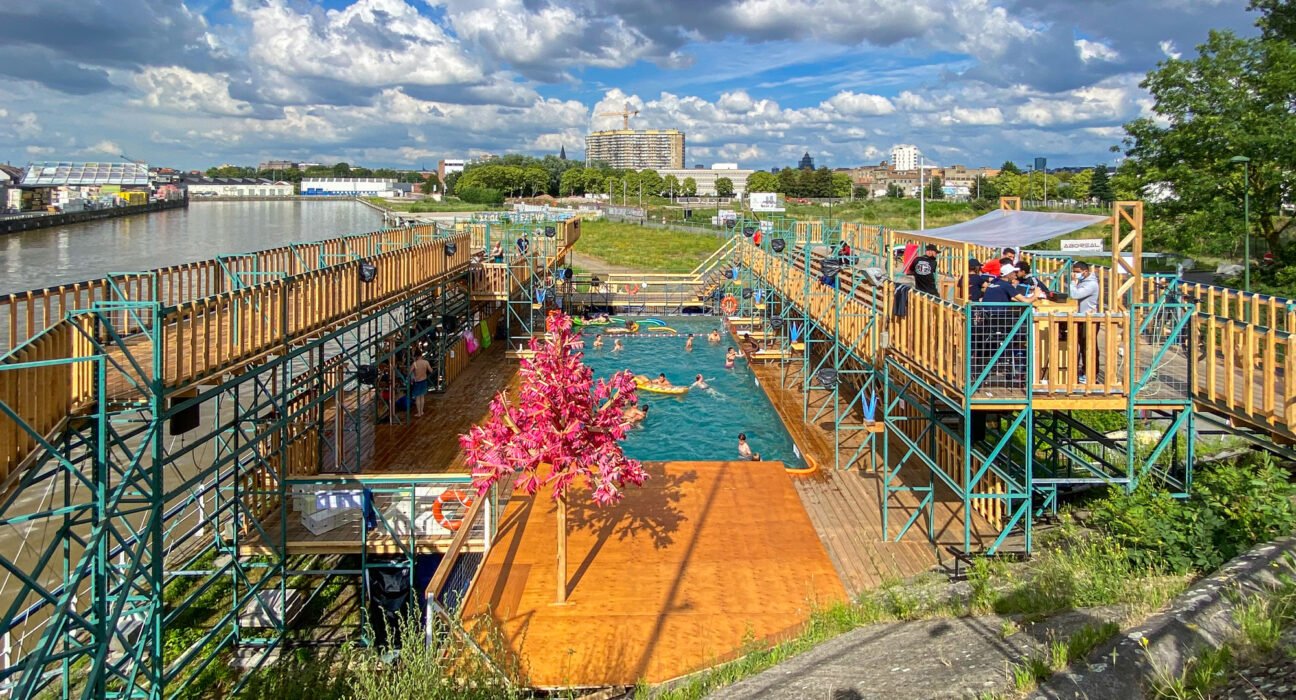
- FLOW by POOL IS COOL with Decoratelier Jozef Wouters in Brussels, Belgium, an imaginative public-space initiative
- Architecture in the Periphery by IAMÍ Institute in Brazil, emphasizing spatial justice and underrepresented urban realities
- Sustainable Alleys by RAMA estudio in Quito, Ecuador, addressing neighborhood-scale environmental and social conditions
Together, these works reveal a major shift in global design priorities. The best contemporary projects are not only formally resolved; they are participatory, climate-aware, and rooted in everyday use.
Why the Local Scale Category Matters
Some of the most compelling stories in architecture news emerge from small interventions with outsized impact. The Local Scale category celebrates exactly that, honoring nine community-driven efforts that respond directly to local needs.
Among the recipients:
- Warwick Junction Brook Street Child Care Facility in Durban, South Africa, by Asiye eTafuleni, supports working mothers within a market community
- 10th of July Family Group’s Community Hub in Lima, Peru, by Habitable, builds social life around food and public gathering
- Community Fog Catcher Prototype in Bogotá, Colombia, by Alsar-Atelier + Oscar Zamora, explores resource-conscious environmental design
- Community Added Value Center in Argentina, by Cooperativa CIMBRA, strengthens local participation and shared benefit
These projects may be modest in size compared with landmark commissions in luxury home or luxury design media, but their influence is profound. They show how architecture can support caregiving, livelihoods, public health, and climate adaptation in direct, tangible ways.
What This Means for Luxury Architecture and Design Culture
For audiences interested in luxury architecture, luxury decor, luxury home, and luxury home decor, the Ammodo Architecture Awards offer an important lens on where high-value design is heading. Luxury is no longer defined solely by rarity, cost, or visual drama. Increasingly, true design leadership includes durability, social relevance, craftsmanship, ecological intelligence, and long-term value for communities.
That does not diminish beauty; it deepens it. The most forward-looking design culture now embraces:
- Material responsibility and lower-impact construction
- Spaces that foster connection rather than isolation
- Adaptable, community-centered planning
- Design excellence rooted in local knowledge
In that sense, this story belongs firmly in architecture news because it captures a broader transformation across the profession.
Conclusion
The inaugural Ammodo Architecture Awards make one thing clear: the most meaningful architecture news today is about design that improves how people live while responding intelligently to ecological realities. By funding 23 recipients across Social Architecture, Social Engagement, and Local Scale, Ammodo Architecture is helping shift attention toward projects that combine innovation, care, and lasting public value. For anyone watching the future of architecture, these awards are not just a celebration of good work—they are a powerful signal of what design excellence now requires.